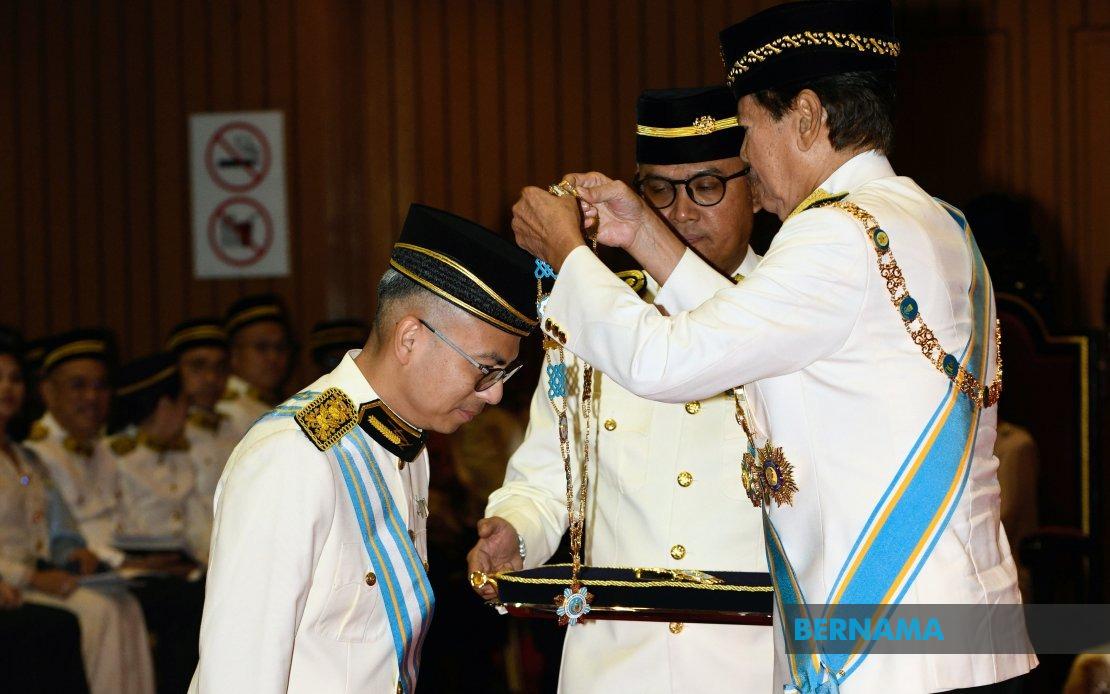
The Communications Minister Datuk Fahmi Fadzil has been elevated to Datuk Seri status, receiving one of Malaysia's most prestigious state honours during a ceremony in Penang that also marks the 85th birthday of the state's governor. The distinction came through the bestowal of the Darjah Panglima Pangkuan Negeri (DPPN) award, making him the sole recipient of this particular honour in the 2026 Investiture Ceremony for Penang State Orders, Decorations and Medals.
Fahmi, who serves as the MADANI Government's principal spokesperson, heads a significant cohort of 230 individuals being recognised across multiple tiers of state honours during the four-day ceremony that began in George Town. The investiture marks one of Penang's major annual celebrations of civic contribution and national service, drawing together representatives from government, business, civil society, and the cultural sectors. The scale of the recognition underscores the breadth of Penang's engagement with its communities and stakeholders across diverse fields.
Beyond Fahmi's singular elevation, the ceremony recognised 19 additional recipients with the Darjah Gemilang Pangkuan Negeri (DGPN), a rank that also confers the Datuk Seri title. This tier includes prominent figures such as Datuk Abdul Halim Mohammad, who chairs MARA Incorporated Sdn Bhd, and Datuk Loo Lee Lian, the chief executive officer of Invest Penang. The presence of business and investment leaders among the DGPN recipients reflects Penang's positioning as an economic hub and the state government's emphasis on recognising those driving commercial and industrial development in the region.
The broader honours structure demonstrates how Malaysia's state-level recognition systems operate across multiple tiers of distinction. Nine individuals received the Darjah Yang Mulia Pangkuan Negeri (DMPN), a rank below the previous two categories, while 72 recipients were conferred the Darjah Setia Pangkuan Negeri (DSPN), which carries the title Datuk. This tiered approach allows states to recognise varying levels of contribution whilst maintaining clear hierarchical distinctions that carry social and professional significance within Malaysian society.
Among the DMPN recipients was Datuk Azizee Ismail, a former chief of the Penang police force, reflecting the honours system's acknowledgement of long-serving public safety personnel. The DSPN category encompassed a diverse range of recipients, including the late Nordin Ahmad, a celebrated filmmaker, director, and scriptwriter with Cathay-Keris Film Productions, who received the honour posthumously. This recognition underscores Malaysia's cultural sector and the enduring influence of figures who shaped the nation's film industry during its formative decades.
Other DSPN recipients included Meor Ismail Meor Akim, the director-general of the National Disaster Management Agency (NADMA), and Datuk Mohd Irwan Mohd Mubarak, chairman of Bank Rakyat. These appointments highlight the state's intention to honour those managing critical national functions—disaster response infrastructure and inclusive financial services—that directly impact ordinary Malaysians' wellbeing and economic security. The diversity of sectors represented reflects a comprehensive vision of national service extending far beyond traditional political domains.
The ceremony itself was officially opened by Penang Governor Tun Ramli Ngah Talib and his wife, Toh Puan Raja Noora Ashikin Raja Abdullah, who arrived at the Dewan Sri Pinang venue to preside over proceedings that commenced on July 11. The governor's personal attendance and participation underscores the significance Penang places on these recognition events, transforming them from routine administrative occasions into moments of genuine state celebration and appreciation for civic contributors.
The four-day investiture schedule, spanning from July 11 through July 15, represents a substantial commitment of ceremonial and administrative resources. Beyond the 101 individuals receiving formal state honours across the various categories, the ceremony will also bestow medals and honorary decorations upon 1,120 additional recipients. This extended timeline and large total number of awardees suggest that Penang's honours system casts a notably broad net, recognising contributions from volunteers, community organisers, educators, and others whose work sustains civil society but may not reach ministerial or corporate leadership levels.
For Malaysian readers, particularly those in Penang and beyond, these honours ceremonies carry multiple layers of significance. Domestically, they represent formal state recognition of individuals whose work contributes to national development, social cohesion, and economic progress. For professionals and business leaders, they carry career implications, enhancing standing within professional networks and signalling recognition from established power structures. Internationally, Malaysia's state honours system demonstrates continuity with Commonwealth traditions whilst adapting to contemporary Malaysian governance and society.
Fahmi's elevation is particularly noteworthy given his portfolio as Communications Minister, a role increasingly central to how modern governments manage public narratives, media relations, and digital governance. His additional responsibility as government spokesperson means his public visibility and influence extend well beyond his ministerial portfolio. The timing of his honour, coinciding with celebrations for Governor Tun Ramli's milestone birthday, also suggests strong relationships between the federal government's MADANI administration and Penang's state leadership, potentially reflecting collaborative approaches to governance challenges affecting the northern region.
The honours ceremony also reflects Penang's status as Malaysia's most multi-ethnic state, where recognition spans diverse communities and sectors. The inclusion of figures from commerce, security, disaster management, finance, and culture—alongside religious and civic leaders—demonstrates how modern Malaysian honours systems attempt to transcend narrow political categories and recognise broader contributions to national life. This inclusive approach, replicated across Malaysia's states, reinforces the principle that citizenship and national service extend across multiple domains beyond elected politics.
Looking forward, these investiture ceremonies remain important barometers of state-level priorities and values. The prominence given to economic development figures like those from MARA and Invest Penang, alongside recognition of disaster management and financial inclusion champions, signals Penang's emphasis on inclusive prosperity and resilience. For Southeast Asian observers monitoring Malaysia's governance trends, such ceremonies offer subtle but meaningful insights into which sectors and individuals states consider instrumental to their vision of development and social progress.

