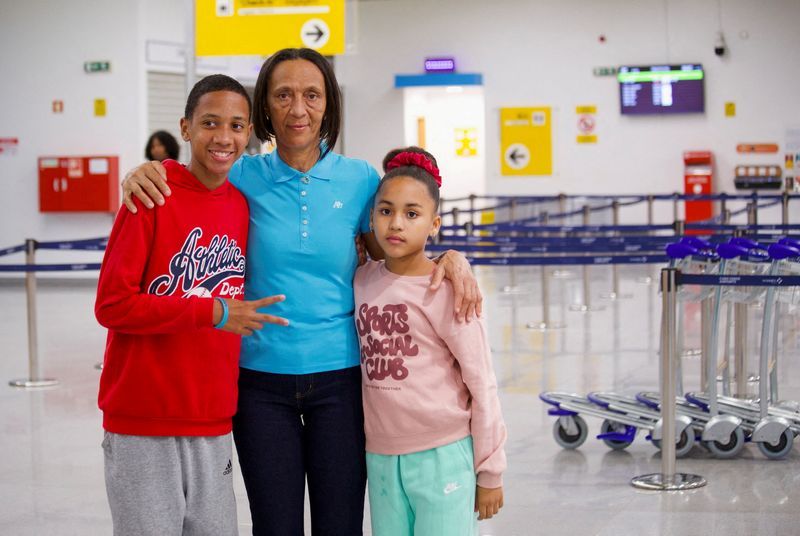
Ana Candida Evora, the mother of Cape Verde goalkeeper Vozinha, has finally received approval to travel to the United States and watch her son's World Cup performances after a visa application became a lightning rod for international attention. The 40-year-old keeper's emotional disclosure that his mother could not attend his standout display against Spain, combined with the subsequent viral attention, prompted intervention from the U.S. State Department's visa operations. Evora will now be able to witness Cape Verde's second group-stage match against Uruguay in Miami on Sunday, a fixture that will carry profound personal significance for both mother and son.
Vozinha delivered a masterclass in goalkeeping during Cape Verde's tournament opener in Atlanta, producing seven crucial saves to anchor an impressive 0-0 draw against European champions Spain. The performance was universally recognized as the standout individual contribution in the match, earning him official player-of-the-match honors and confirming Cape Verde's ability to compete at football's highest level. Yet the goalkeeper's elation at this career-defining moment was severely diminished by the knowledge that his mother, who would have been his greatest source of pride and encouragement, could not be present to witness it firsthand.
The absence became particularly poignant when Vozinha publicly revealed the circumstances behind it. Rather than a simple scheduling conflict or personal decision, his mother had been unable to secure the necessary travel documentation for entry into the United States. What initially appeared to be an individual family disappointment rapidly transformed into a humanitarian and diplomatic matter when media coverage of his tearful comments gained traction across international platforms. The emotional resonance of the story—a proud son unable to share his greatest professional achievement with his mother—struck a chord with audiences worldwide and caught the attention of relevant government authorities.
U.S. State Department officials responded with notable speed and decisiveness to the situation. The visa adjudication team operating from the American embassy in Praia, Cape Verde's capital, moved into close coordination with Evora to address her application with appropriate priority. Senior State Department representatives confirmed to journalists that the approval had been granted in full compliance with existing policies and procedures, suggesting that while the case received heightened attention, it was processed through standard channels rather than creating any procedural exceptions. The official statement emphasized that the decision maintained consistency with established standards while accelerating the timeline to permit her attendance at the upcoming fixture.
The backstory to Evora's visa complications reveals deeper structural challenges facing Cape Verdean citizens seeking entry to the United States. During the initial phases of the World Cup tournament, the Trump administration had implemented a sweeping immigration crackdown that required citizens from numerous developing nations to post substantial financial bonds—in some instances reaching $15,000 per person—as a prerequisite for lawful entry. This requirement created an insurmountable barrier for many prospective visitors from less economically developed regions, as the bond amount often exceeded several months' worth of local wages. While World Cup ticket holders were subsequently exempted from this bonding requirement, the initial policy had already discouraged or prevented numerous citizens from even attempting to pursue travel.
The financial burden imposed during the early phases of the immigration crackdown had effectively prevented Evora from exploring options to attend her son's first World Cup appearance. The combination of the substantial visa bond requirement and the associated costs of international travel had rendered the prospect economically unfeasible for a family from a small island nation in West Africa. Even as the bonding requirement was being reconsidered for sporting event attendees, the damage had already been done—the initial deterrent had already caused Evora to abandon her plans to travel to the United States to support her son during this pivotal moment in his athletic career.
The resolution of Evora's visa situation carries implications extending beyond a single family's joy. It demonstrates how international sporting events like the World Cup can create diplomatic moments and humanitarian considerations that occasionally override or accelerate standard bureaucratic processes. The visibility of Vozinha's situation, amplified by global media coverage and public sentiment, created sufficient pressure and public interest to justify expedited processing by U.S. officials. This pattern—where compelling personal narratives intersect with international sporting spectacles to generate policy responsiveness—reflects broader dynamics about how athletic competition can transcend pure sporting competition and become a vehicle for human connection and diplomatic goodwill.
For Cape Verde, a nation of approximately 560,000 people with a population scattered across ten volcanic islands off West Africa's coast, the World Cup represents an extraordinary achievement. The nation's qualification for this tournament represents decades of gradual development in African football infrastructure and coaching capabilities. Vozinha's standout performance against Spain has already elevated the goalkeeper's profile substantially, and his mother's presence at upcoming fixtures will add a deeply personal dimension to Cape Verde's remaining tournament matches. The narrative arc—from exclusion and heartbreak to inclusion and vindication—resonates far beyond football circles.
The timing of Evora's visa approval for the Uruguay match on Sunday creates a window for her to experience multiple elements of her son's World Cup journey. Beyond watching him compete against Uruguay, she will have the opportunity to absorb the atmosphere of international football competition at the sport's highest level and to witness firsthand the recognition and respect her son has earned through his athletic excellence. The match against Uruguay, scheduled to take place in Miami, offers a venue with significant South American immigrant populations and strong football tradition, creating an appropriate stage for this personal reunion and professional continuation.
The broader significance of this episode reflects the power of individual human stories within the context of massive international sporting events. While millions of fans will watch the World Cup for the sake of competition and national pride, narratives like Vozinha's remind audiences that behind every athlete stands a network of family members, mentors, and supporters whose sacrifices and presence fundamentally shape their achievements. That the U.S. State Department, regardless of the administration's broader immigration stance, responded positively to the specific circumstances of this case suggests that even within systems designed for restrictive immigration enforcement, space can exist for humanitarian consideration when circumstances gain sufficient visibility and public attention. For Ana Candida Evora, the visa approval transforms heartbreak into redemption.

%22%2F%3E%3C%2Fpattern%3E%3C%2Fdefs%3E%3Crect%20width%3D%22100%25%22%20height%3D%22100%25%22%20fill%3D%22url(%23ph3j096g)%22%2F%3E%3Crect%20width%3D%22100%25%22%20height%3D%22100%25%22%20fill%3D%22url(%23ph3j096p)%22%2F%3E%3Ctext%20x%3D%2250%25%22%20y%3D%2250%25%22%20text-anchor%3D%22middle%22%20dominant-baseline%3D%22central%22%20fill%3D%22rgba(255%2C255%2C255%2C0.95)%22%20font-family%3D%22Georgia%2C%20'Times%20New%20Roman'%2C%20serif%22%20font-weight%3D%22700%22%20font-size%3D%22320%22%20letter-spacing%3D%22-0.02em%22%3EGRS%3C%2Ftext%3E%3C%2Fsvg%3E)