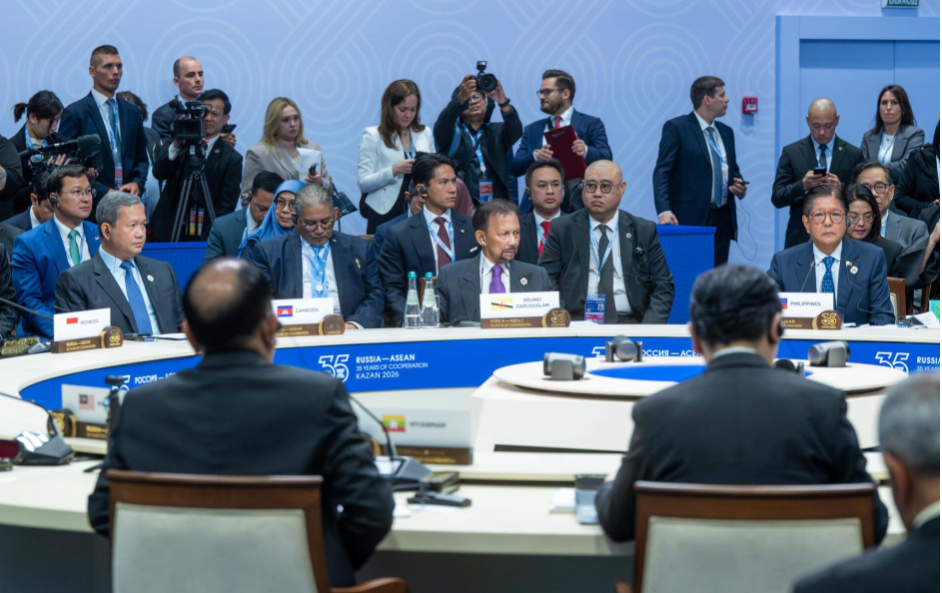
Sultan Hassanal Bolkiah travelled to Kazan, Russia on Thursday to participate in the Asean-Russia Commemorative Summit, where he commended President Vladimir Putin's hospitality and acknowledged the generosity of the local Tatarstan government and Kazan's residents. The Brunei monarch, accompanied by Foreign Minister Prince 'Abdul Mateen, also extended sympathies to Thailand's Prime Minister Anutin Charnvirakul following the death of Princess Bajrakitiyabha, setting a reflective tone for the gathering of Southeast Asian leaders in the Russian Far East.
The summit marked a significant moment for bilateral engagement, as both blocs took stock of three and a half decades of formal dialogue relations. During his address, the Sultan characterised the Asean-Russia partnership as notably resilient and increasingly consequential even as the international system undergoes profound transformation. He underscored that cooperation had matured across the three pillars of the Asean Community framework—the political-security pillar, the economic pillar, and the socio-cultural pillar—demonstrating comprehensive engagement rather than narrow sectoral cooperation.
According to the Sultan's remarks, the partnership has yielded concrete dividends for both sides and strengthened connections among ordinary citizens and communities. These people-to-people linkages are essential for sustaining political goodwill and ensuring that formal agreements translate into tangible improvements in living standards and shared security. The emphasis on mutual benefit reflects a pragmatic approach to regional diplomacy, where formal ties gain legitimacy and durability through demonstrable gains for populations on both sides.
Looking ahead to Asean's Vision 2045 roadmap, the Sultan identified Russia as a crucial collaborator in tackling challenges that transcend borders and resist purely national solutions. Political tensions and regional instability threaten economic development and investment flows throughout Southeast Asia, a region heavily dependent on open shipping lanes and stable relationships with major powers. Economic fragmentation—particularly the rise of protectionist barriers and rival trading blocs—poses direct risks to Asean economies that have long thrived on open markets and diversified supply chains. Climate change represents an existential threat to low-lying island nations and vulnerable agricultural regions throughout the region, requiring coordinated responses and technology transfer. Rapid technological change, from artificial intelligence to digital currencies, demands joined-up approaches to regulation and skill development.
The Sultan's emphasis on energy and food security as priority cooperation areas reflects immediate concerns across Southeast Asia. Many Asean members depend on imported energy and food, leaving them vulnerable to global market disruptions and geopolitical leverage. Russia, as a major exporter of both hydrocarbons and grain, represents a valuable diversification partner for several Southeast Asian nations seeking to reduce dependency on traditional suppliers. Climate action and disaster management cooperation take on heightened urgency in a region prone to typhoons, flooding and volcanic activity, where mitigation requires advanced monitoring systems and emergency response coordination. Addressing non-traditional security threats—from maritime piracy and human trafficking to terrorism and cyber attacks—requires intelligence sharing and capacity-building partnerships with capable external actors.
A particular emphasis on human development signals recognition that institutional relationships depend ultimately on cadres of trained professionals and informed publics who understand their counterparts. Educational exchanges, vocational training and professional networks create informal but durable channels for cooperation that persist even when diplomatic relations face strain. Young Southeast Asians who study in Russia or receive training from Russian experts become lifelong advocates for the relationship, while Russian specialists working in the region develop contextual understanding that informs their governments' regional strategies.
The formal outputs adopted at the summit's conclusion provide substance behind the rhetorical flourishes. The Kazan Declaration 2026 frames the partnership as one of unity within diversity—a diplomatic formulation that acknowledges different political systems and strategic cultures while emphasizing common interests. The Comprehensive Plan of Action spanning 2026 to 2030 translates aspirations into specific programmes, budgets and timelines. Separate joint statements on energy and cultural cooperation demonstrate the breadth of engagement. These documents will serve as benchmarks against which future implementation can be measured, providing Asean members and Russia with metrics for evaluating whether the partnership is deepening or merely drifting.
The inclusion of the Shanghai Cooperation Organisation and Eurasian Economic Commission representatives in the second plenary session underscores a broader context often overlooked in analysis of Asean-Russia relations. Both blocs are embedded in larger regional integration frameworks—Asean within the Indo-Pacific, Russia within Eurasian structures—and their bilateral partnership cannot be isolated from these overlapping memberships. The discussion of integration processes in Eurasia suggests that Russian policymakers are seeking to build bridges between Eurasian integration projects and Southeast Asian regional architecture, potentially creating new platforms for cross-regional dialogue.
The Asean-Russia Business Forum, held as a side event on June 17, indicates that governments are attempting to translate political goodwill into commercial activity. Private sector engagement can provide resilience to government-to-government relationships, as business networks create constituencies on both sides with vested interests in stability. For Malaysian readers, strengthening Asean-Russia ties carries particular significance given Malaysia's own economic interests in energy security, its investments in technology and defence modernisation, and its increasing engagement with Russia and other non-Western partners as part of a broader diversification strategy.
The timing of this summit occurs against a backdrop of significant geopolitical realignment in Asia-Pacific. Asean has long sought to maintain strategic autonomy and balanced relationships with major powers, resisting pressure to choose sides in great power competition. An emphasis on Russia cooperation can be interpreted as part of this balancing act, though the political sensitivities around Russia's international position remain acute. Several Asean members maintain close security relationships with the United States and its allies, creating potential friction with deeper Russia engagement, though the focus on non-traditional security and economic cooperation allows for managed compartmentalisation.
The Sultan's framing of the relationship as one that contributes to peace and stability carries implicit messaging about Asean's approach to regional security challenges. Rather than aligning with Western containment strategies toward Russia, Asean is positioning itself as a neutral platform for engagement and dialogue. This stance reflects long-standing Asean doctrine that inclusivity and dialogue serve regional interests better than exclusion and confrontation. For Southeast Asia, maintaining functional relationships across the great power divide has historically proven more beneficial than entanglement in external rivalries.
Moving forward, the success of these commitments will depend on implementation capacity on both sides. Asean secretariat coordination, national governments' domestic political support, and Russia's ability to sustain engagement despite international constraints will all prove crucial. For Malaysian observers, the strengthening of Asean-Russia cooperation presents both opportunities for economic partnership and challenges regarding navigating complicated geopolitical alignments. The partnership's effectiveness in addressing global challenges identified by the Sultan—climate change, food security, non-traditional threats—will ultimately determine whether it becomes a flagship example of meaningful regional cooperation or remains largely symbolic in character.
%22%2F%3E%3C%2Fpattern%3E%3C%2Fdefs%3E%3Crect%20width%3D%22100%25%22%20height%3D%22100%25%22%20fill%3D%22url(%23ph5kerlg)%22%2F%3E%3Crect%20width%3D%22100%25%22%20height%3D%22100%25%22%20fill%3D%22url(%23ph5kerlp)%22%2F%3E%3Ctext%20x%3D%2250%25%22%20y%3D%2250%25%22%20text-anchor%3D%22middle%22%20dominant-baseline%3D%22central%22%20fill%3D%22rgba(255%2C255%2C255%2C0.95)%22%20font-family%3D%22Georgia%2C%20'Times%20New%20Roman'%2C%20serif%22%20font-weight%3D%22700%22%20font-size%3D%22320%22%20letter-spacing%3D%22-0.02em%22%3EKTMB%3C%2Ftext%3E%3C%2Fsvg%3E)
%22%2F%3E%3C%2Fpattern%3E%3C%2Fdefs%3E%3Crect%20width%3D%22100%25%22%20height%3D%22100%25%22%20fill%3D%22url(%23ph2q7c8g)%22%2F%3E%3Crect%20width%3D%22100%25%22%20height%3D%22100%25%22%20fill%3D%22url(%23ph2q7c8p)%22%2F%3E%3Ctext%20x%3D%2250%25%22%20y%3D%2250%25%22%20text-anchor%3D%22middle%22%20dominant-baseline%3D%22central%22%20fill%3D%22rgba(255%2C255%2C255%2C0.95)%22%20font-family%3D%22Georgia%2C%20'Times%20New%20Roman'%2C%20serif%22%20font-weight%3D%22700%22%20font-size%3D%22272%22%20letter-spacing%3D%22-0.02em%22%3EAnwar%3C%2Ftext%3E%3C%2Fsvg%3E)