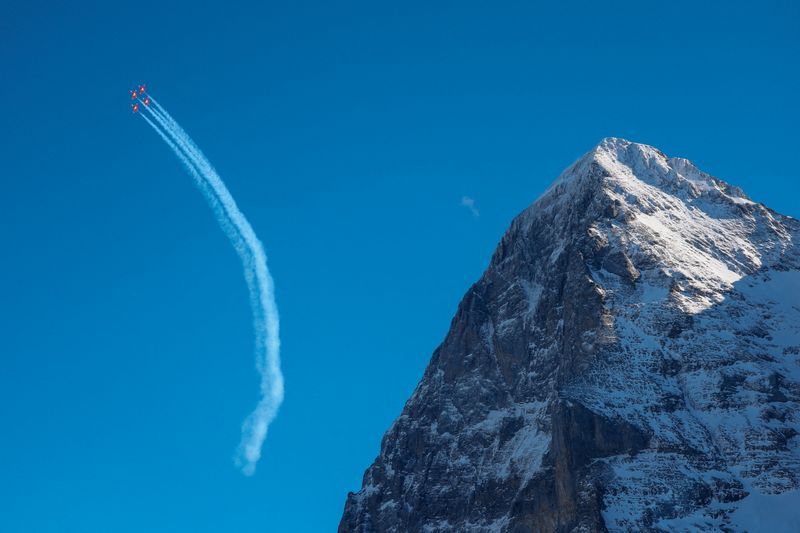
Fay Manners, a British mountaineer, has etched her name into Alpine climbing history by becoming the first British woman to pioneer a new route on the Eiger North Face. This summer, she and her Swiss climbing partner Roger Schaeli spent 13 days on the imposing wall carving out what they named "Solar Eclipse," a 2,952-foot route comprising 33 pitches. The achievement stands out not merely as a physical accomplishment, but as a symbolic breakthrough in a discipline where women's contributions have long remained marginalised, despite their proven capability and determination.
The Eiger North Face, dominating the Swiss Alps, represents one of mountaineering's most formidable challenges. Its roughly 5,900-foot wall of rock and ice has claimed numerous lives throughout history, from the early twentieth century when multiple fatal expeditions attempted its ascent, to the landmark 1938 first successful climb by a German-Austrian team. The face's reputation rests upon its volatility—sudden weather shifts, cascading rockfall, and extreme altitude create conditions that test even the most experienced climbers. For Manners, the wall held particular allure because of its technical complexity and the psychological demands it imposed.
Manners' journey to this moment began four years earlier when she climbed the established Heckmair Route on the same face. Rather than satisfying her mountaineering ambitions, that experience sparked a deeper curiosity. She began researching the wall obsessively, studying its geology, weather patterns, and existing routes. This intensive preparation eventually crystallised into a determination to return not as a follower of a predetermined path, but as a pioneer seeking unclimbed terrain. The distinction between repeating an established route and establishing one is profound. When climbers tackle known routes, they benefit from guidebooks, beta information, and the certainty that others have reached the summit before them. Route-finding climbers operate in uncertainty, unaware of rock quality, required protection, or whether they will successfully reach their objective.
The challenge of establishing new terrain fundamentally differs from traditional mountaineering because climbers must make real-time decisions about safety and feasibility without reference materials. "You don't know how hard it's going to be, you don't know the sort of protection that you'll need to put in, you really don't know if you're going to be able to make it to the top," Manners explained to Reuters. This uncertainty is compounded by the creative demands—route-setters must identify aesthetic lines, determine optimal sequences of pitches, and ensure the overall climb forms a coherent and worthwhile challenge for future ascensionists. The achievement thus represents not just athletic prowess but artistic vision and technical innovation.
For Manners, the significance of her accomplishment extends well beyond personal achievement into the realm of representation and gender equity within mountaineering. She points to a troubling pattern in climbing guidebooks: nearly every historical route-opener listed is male. This pattern, she argues, unconsciously communicates to women that serious climbing—the kind that involves establishing new terrain—remains a male domain. "If you're looking in the guidebook and every single name of the person that's opened a route is male," she observed, "somehow that's telling you that men are opening routes and women aren't." By placing her name alongside Schaeli's on the Solar Eclipse route, Manners has visibly altered that narrative, providing a concrete example that women possess the technical skill, creativity, and resilience necessary for groundbreaking Alpine climbing.
The history of women on the Eiger North Face demonstrates both their capability and the barriers they have overcome. In 1964, Daisy Voog became the first woman to successfully summit the North Face, years after being rejected from a mountaineering club solely because of her gender. Five years later, Japanese climber Michiko Imai participated as the sole woman on the six-person team that established the Japanese Summer Direttissima route. These precedents proved that women belonged on the wall, yet their relative scarcity in route-establishing teams underscores how systemic underrepresentation can persist even after individuals demonstrate clear capability.
Manners recognises that gender disparities in mountaineering partly stem from psychological barriers that women internalise from childhood. She reflects on how subtle messaging—comments about carrying capacity, assumptions about physical limitations, doubts about career viability—accumulates to shape self-perception and ambition. "Those doubts that we have and those stereotypes that we have, they're just so subtle that we don't even realise them," she noted. These ingrained assumptions influenced her own life trajectory. Growing up in England, she loved sport and imagined a career in athletics, but mentors discouraged her, suggesting that women's sports careers lacked financial sustainability. This discouragement steered her toward data science, a more conventional and economically secure path.
Manners' transition from data consultant to professional climber illustrates how structural opportunities can reshape individual trajectories. After relocating to Chamonix, France, while continuing remote data work, she caught the attention of The North Face, the outdoor equipment brand, which offered sponsorship with flexibility to maintain both pursuits. Within a year, her success as a sponsored athlete enabled her to leave data science entirely. "I really only realised that it was possible when it was happening," she reflected, "because I still had in my mind that there was no way that a female could have a career in sports." Her experience encapsulates how women's underrepresentation in elite sports reflects not capability deficits but systemic barriers—limited sponsorship opportunities, career uncertainty, and cultural messaging that shapes what women perceive as achievable.
The broader implications of Manners' accomplishment resonate throughout mountaineering and beyond. When women participate visibly in route-establishing—the most creative and technically demanding aspect of climbing—it fundamentally shifts perceptions about what is possible. Young female climbers researching the Eiger North Face in guidebooks will now see a woman's name among the route-openers. This visibility matters tremendously because, as Manners emphasises, representation and the actual execution of groundbreaking work reinforce each other. Seeing women succeed in difficult endeavours reduces the psychological barrier for others to attempt similar challenges.
Looking forward, Manners plans to return to the Solar Eclipse route, where she envisions an even more powerful outcome: all-female teams attempting repeats of her route. This aspiration reflects her understanding that pioneering routes constitutes only the first step in transforming mountaineering culture. When women not only open routes but also form teams to repeat them, to refine techniques, and to push further into unexplored terrain, they gradually normalise female participation in the sport's most elite and creative domains. Such normalisation requires multiple women succeeding sequentially, building upon each other's achievements and creating visible pipelines for younger climbers.
For Malaysian and Southeast Asian readers, Manners' breakthrough offers broader lessons about gender dynamics in elite sports and adventure tourism, sectors where the region increasingly competes globally. Southeast Asian mountaineers, particularly women, stand to benefit from expanding visibility of female route-setters and expedition leaders. The region's dramatic topography—from Borneo's Kinabalu to the volcanic peaks of Indonesia and the limestone karsts of Thailand—provides exceptional climbing opportunities. Yet women's participation in adventure sports development remains constrained by similar cultural assumptions and economic barriers that Manners encountered. Her achievement suggests that targeted sponsorship, flexible professional pathways, and deliberate efforts to elevate women's contributions can catalyse transformation.
The Solar Eclipse route represents far more than a technical climbing achievement, though it certainly qualifies as such. It embodies a deliberate choice to occupy space in a historically male-dominated field and to create pathways for others. Manners' articulation of her motivations reveals consciousness about how individual achievements gain meaning through their contribution to collective progress. By opening new ground on the Eiger, she has simultaneously opened conceptual space for women to envision themselves as innovators and leaders in mountaineering. In doing so, she has demonstrated that the barriers to women's participation in elite climbing stem not from physical or technical limitations but from cultural narratives that women themselves must actively resist and redefine.

