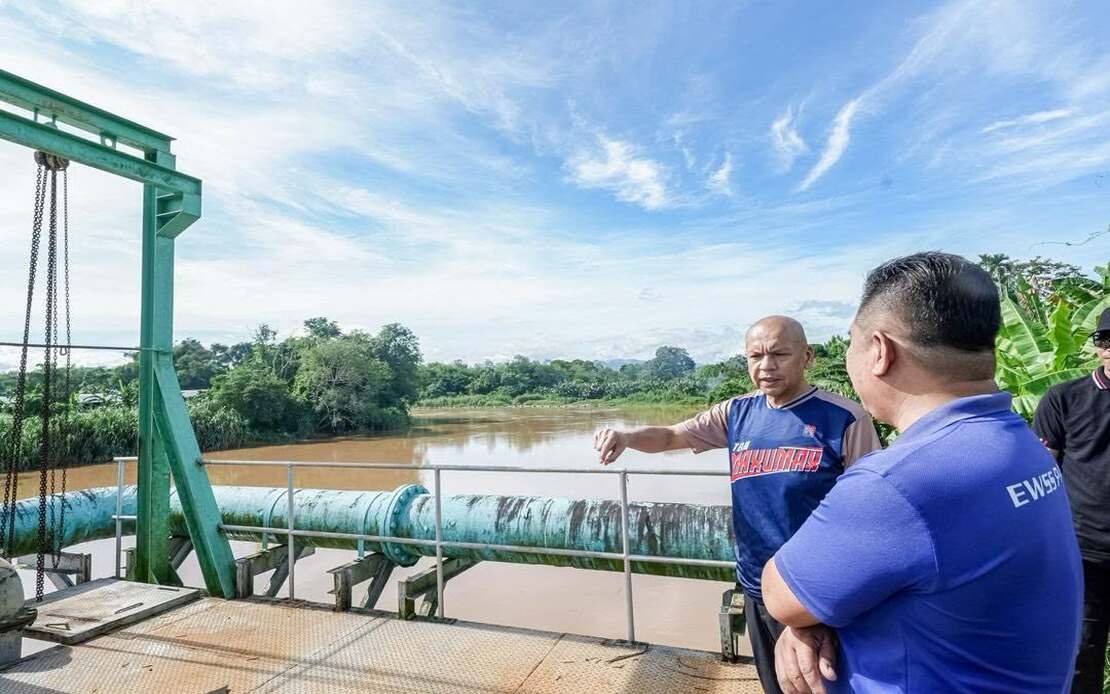
Domestic Trade and Cost of Living Minister Datuk Armizan Mohd Ali conducted an on-the-ground inspection of Papar's water infrastructure this week, reviewing the progress of multiple initiatives designed to resolve chronic supply shortages affecting the district. The visit came two days after a dedicated meeting on June 15 where officials briefed the Papar Member of Parliament on implementation timelines and current challenges within the water system. The timing reflects growing urgency around infrastructure bottlenecks that have periodically disrupted service delivery to residents across the constituency.
Two major projects are currently advancing within Papar's water network. The Kogopon Water Treatment Plant is undergoing expansion to double its daily production capacity from 40 million litres to 80 million litres, a critical intervention given the district's expanding population and economic activity. Simultaneously, infrastructure work continues on the Kampung Kabang intake system, which feeds raw water into the broader supply chain. Together, these projects represent a substantial investment in augmenting both the volume and reliability of treated water available to households and businesses throughout the region.
The capacity constraints plaguing Papar reflect a common challenge across Malaysia's smaller towns and rural districts, where infrastructure development has frequently lagged behind demographic shifts and economic expansion. As areas transition from primarily agricultural economies to mixed commercial and residential communities, water demand surges unpredictably. Papar's experience demonstrates how historical underinvestment in treatment capacity can create cascading problems that prove expensive and time-consuming to resolve. The doubling of Kogopon's output capacity suggests planners now anticipate medium-term demand growth that earlier infrastructure simply could not support.
During his inspection, Armizan also examined operational challenges at two critical treatment facilities: the EWSS Plant and the JETAMA Limbahau Plant. Both installations had experienced temporary shutdowns during the preceding week due to elevated turbidity levels in raw water entering the system. Turbidity, measured in nephelometric turbidity units (NTU), indicates the concentration of suspended particles—typically sediment, algae, or organic matter—that compromise water quality and strain filtration systems. When NTU values spike, treatment plants must either reduce output or cease operations entirely until source water quality improves sufficiently for standard processing protocols to function effectively.
Raw water turbidity fluctuations in Papar likely stem from several factors common to Sabah's water systems. Heavy rainfall, typical in Malaysian tropical climates, can rapidly increase suspended solids in rivers and streams. Agricultural runoff from surrounding farmland compounds the problem by introducing soil particles and organic debris. Additionally, any infrastructure weakness or bank erosion along intake channels degrades raw water quality. For treatment plants relying on conventional clarification and filtration methods, these periodic spikes create operational uncertainty that directly translates into supply interruptions for consumers downstream.
The temporary closures at EWSS and JETAMA Limbahau highlight a systemic vulnerability affecting Malaysian water utilities: insufficient buffering between raw water availability and treatment capacity. Unlike facilities equipped with advanced technologies such as membrane filtration or real-time turbidity monitoring systems, conventional plants struggle during quality degradation events. Consumers experience sudden supply loss, and utilities face pressure to restore service while simultaneously addressing water quality constraints beyond their immediate control. This operational predicament has become increasingly common as climate variability makes precipitation patterns less predictable across the region.
Armizan's field visit underscores a shift towards direct ministerial engagement with infrastructure challenges, moving beyond conference-room discussions to observe problems in real time. Such visits provide value by generating immediate pressure on technical teams to prioritize identified issues and enabling policymakers to understand constraints that may not appear obvious in official reports. In Papar's case, confronting the turbidity problem firsthand creates accountability pathways and signals to stakeholders that the government recognizes water supply as a priority concern deserving sustained attention and resources.
The minister's emphasis on linking field observations to more effective solution implementation suggests recognition that water infrastructure challenges in Malaysian districts often stem not primarily from technical ignorance but from coordination failures, resource allocation delays, and insufficient inter-agency communication. By establishing direct monitoring protocols and site-based problem-solving frameworks, Armizan's approach potentially addresses these governance gaps that frequently prolong infrastructure deficits.
For Malaysian consumers and policymakers observing developments in Papar, the situation illustrates broader questions about how effectively the country is managing water security amid climate uncertainty and continued urbanization pressures. Papar's experience—combining capacity shortfalls, seasonal quality degradation, and ongoing infrastructure upgrades—reflects patterns visible across multiple Malaysian states. The Kogopon and Kampung Kabang projects represent necessary but partial solutions; longer-term resilience will likely require integrated approaches encompassing source water protection, advanced treatment technologies, and adaptive management frameworks that can flex when raw water conditions deteriorate unexpectedly.
The pathway forward for Papar depends on successfully completing the announced upgrades while simultaneously addressing the operational fragility that turbidity events expose. Authorities must balance the timelines for capacity expansion with immediate interventions to stabilize treatment plant performance during the transition period. For residents enduring intermittent supply disruptions, the inspection visit and announced projects signal movement towards stability, though full resolution will require sustained investment and inter-agency coordination extending well beyond the immediate project completion dates.