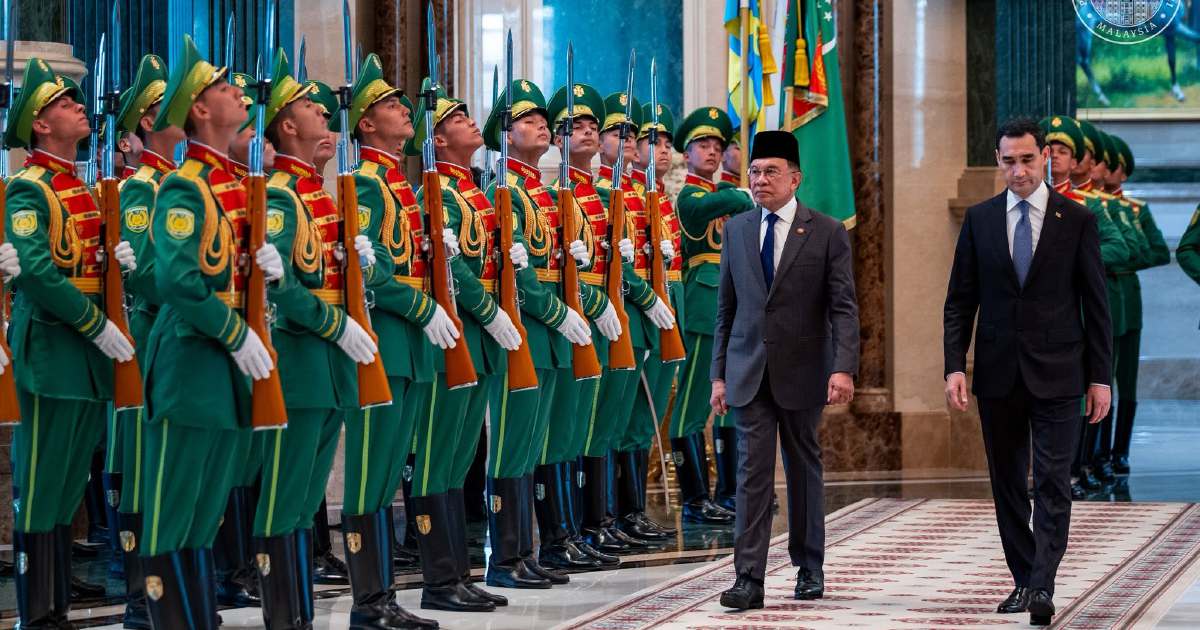
Prime Minister Datuk Seri Anwar Ibrahim arrived in Ashgabat for an official state visit, becoming one of the first Malaysian leaders in recent years to conduct high-level bilateral engagement with Turkmenistan. The ceremonial reception at the Presidential Palace represented more than a symbolic gesture—it reflected the nation's strategic pivot towards deepening relationships across Central Asia, a region historically peripheral to Malaysia's foreign policy focus but increasingly important within the broader context of Asian connectivity and resource diversity.
The official welcome ceremony itself carried significant diplomatic weight, suggesting that Turkmenistan's leadership views Malaysia as a substantive partner rather than a peripheral visitor. Such formal protocols, typically reserved for nations with whom a country maintains strategic partnerships or shared economic interests, indicate that both governments are prepared to elevate bilateral relations beyond the nominal acknowledgement that has traditionally characterised ties between Kuala Lumpur and Central Asian capitals.
For Malaysia, this visit represents an intentional shift in geopolitical positioning. Central Asia remains underexplored territory in Malaysia's regional strategy, despite the region's considerable reserves of natural gas, oil, and critical minerals. The Belt and Road Initiative has channelled substantial Chinese investment through Turkmenistan and its neighbouring states, creating corridors of economic influence that extend from China towards the Caspian Sea and beyond. By establishing personal diplomatic channels at the highest level, Anwar's administration signals an intention to ensure Malaysian interests are positioned within these evolving trade and investment networks.
Turkmenistan itself occupies a unique position in global energy markets and geopolitical calculations. As one of the world's largest natural gas exporters and a nation sitting at the intersection of multiple regional powers—Russia, China, Iran, and the broader European sphere—Turkmenistan's stability and openness to partnerships carry implications for global energy security. Malaysia's interest in engaging this nation reflects not merely energy concerns but also a recognition that Southeast Asian nations must cultivate direct relationships with significant global players rather than relying exclusively on established Western-led multilateral frameworks.
The timing of this visit also warrants consideration within Malaysia's broader diplomatic calendar. The Anwar administration has consistently emphasised the necessity of independent foreign policy formulation and the cultivation of diverse international partnerships. This Central Asian engagement aligns with that stated philosophy, demonstrating a willingness to move beyond traditional Malaysian diplomatic circles concentrated in Southeast Asia, the Middle East, and the Western world. Such diversification of diplomatic relationships serves both immediate pragmatic purposes and longer-term strategic insurance, ensuring Malaysia maintains multiple pathways for cooperation regardless of regional shifts or bilateral tensions elsewhere.
From an economic perspective, Malaysia's business community has increasingly sought opportunities within Central Asia, though often encountering barriers related to limited awareness, underdeveloped trade infrastructure, and competition from more established regional players. An official prime ministerial visit helps overcome these obstacles by elevating the political framework within which commercial engagement can flourish. Malaysian companies operating in telecommunications, construction, manufacturing, and finance have expressed interest in Central Asian markets, and high-level government backing facilitates the kind of regulatory cooperation and institutional coordination necessary for sustained business development.
The state reception also carries symbolic meaning for Malaysia's Muslim population and Islamic diplomacy positioning. Turkmenistan, though secular in governance, has a significant Muslim-majority population and maintains connections to broader Islamic and Asian networks. Malaysia's emphasis on Islamic moderation and interfaith dialogue aligns reasonably well with Turkmenistan's secular approach to governance, creating a foundation for cooperation on matters ranging from education and tourism to cultural exchange programmes that emphasise coexistence and shared civilisational values.
Furthermore, this visit demonstrates awareness within Malaysian leadership circles that the regional balance of power in Asia continues shifting in ways that require proactive diplomatic management. China's extensive investments in Central Asia through the Belt and Road Initiative have reshaped the entire region's economic and political orientation. For Malaysia, engagement with Central Asian nations offers counterbalance and diversification of partnerships, ensuring that Southeast Asian nations retain agency in shaping regional outcomes rather than becoming passive observers of great power competition in Eurasia.
The Presidential Palace reception, while ceremonial in appearance, thus functioned as a signalling mechanism to multiple audiences. To Turkmenistan's government, it conveyed Malaysia's recognition of Turkmenistan's importance and readiness for substantive cooperation. To Malaysia's domestic constituencies, particularly the business community and foreign policy observers, it indicated executive commitment to expanding Malaysia's diplomatic footprint beyond traditional spheres. To regional actors, the visit communicated that Malaysia intends to participate actively in shaping Central Asian engagement patterns rather than ceding the field entirely to established great powers.
Moving forward, this inaugural state visit likely represents the foundation for institutionalised cooperation between Malaysia and Turkmenistan across multiple domains. Regular high-level exchanges, enhanced trade protocols, and potential collaborative arrangements in energy, education, and technology sectors would represent the logical extensions of this ceremonial beginning. For Malaysia, a nation seeking to position itself as a bridge between regions and a capable middle power navigating complex geopolitical terrain, Central Asian engagement represents both opportunity and necessity in an increasingly multipolar world.