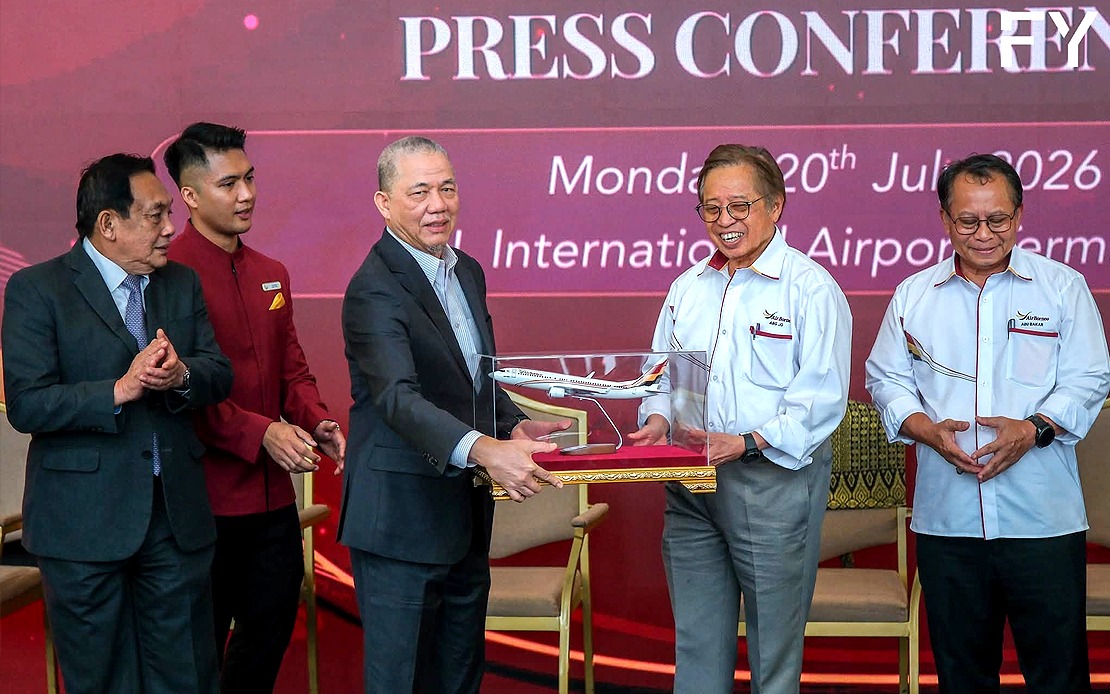
Deputy Prime Minister Datuk Seri Fadillah Yusof has thrown his weight behind Sarawak's ambitious venture into commercial aviation, positioning the newly launched AirBorneo Airways as a solution to the long-standing problem of expensive air tickets that have burdened residents across the state. The airline's inaugural flight from Kuching to Kuala Lumpur International Airport (KLIA) Terminal 1 took off on July 20, carrying Sarawak Premier Tan Sri Abang Johari Tun Openg alongside state ministers and senior officials, marking a symbolic moment for the state's development agenda.
Fadillah articulated a clear vision for the carrier, emphasising that AirBorneo would deliver more affordable fares while maintaining service quality and transparency. This dual commitment addresses a persistent tension in regional aviation: the challenge of keeping prices competitive without compromising operational standards and safety. For Malaysian travellers, particularly those in Sarawak's interior divisions, the prospect of lower-cost air travel carries real significance, as historically high ticket prices have deterred leisure travel and complicated business connectivity for small and medium enterprises seeking to expand beyond state boundaries.
The initiative transcends simple commercial operations. Sarawak's leadership, particularly Premier Abang Johari, has positioned AirBorneo as a strategic economic investment rather than merely a transport service. This framing reflects a broader regional trend in Southeast Asia, where state-owned carriers serve dual purposes: generating revenue while advancing national or sub-national development objectives. For Sarawak, maintaining air connectivity to rural and remote areas represents a critical social mandate, ensuring that communities in less populated regions retain access to essential services, healthcare, and economic opportunities despite geographical challenges.
The timing of AirBorneo's launch, just two days before Sarawak Day on July 22, carries symbolic weight that Fadillah deliberately highlighted. This proximity to the state's founding commemoration reinforces the narrative that the airline embodies Sarawak's autonomy and capacity for self-determination. In Malaysia's federal structure, where economic policy-making is shared between federal and state governments, the establishment of a state-owned airline represents a notable assertion of Sarawak's control over critical infrastructure and its ability to pursue independent commercial ventures aligned with local priorities.
Beyond the immediate transportation function, AirBorneo's architects envision the carrier as a catalyst for broader economic transformation. Improved air connectivity promises to unlock opportunities across multiple sectors: tourism development that capitalizes on Sarawak's rich cultural heritage and natural attractions, trade facilitation for local businesses seeking regional markets, investment attraction for companies requiring reliable logistics networks, and regional development initiatives that depend on efficient inter-city movement of people and goods. The ability to reduce transport costs fundamentally alters the calculus for businesses considering relocating operations or establishing supply chains within the state.
For the Malaysian aviation landscape, AirBorneo's entry introduces additional competitive pressure in the Kuching-Kuala Lumpur corridor, a commercially significant route currently serviced by established carriers. The potential for fare competition in this high-traffic segment could benefit millions of regular business and leisure travellers. However, the airline's success will depend on its ability to achieve operational efficiency and maintain scheduled services reliably. State-owned carriers across Southeast Asia have achieved varying degrees of success, with efficiency and market sustainability remaining persistent challenges.
The emphasis on rural connectivity deserves particular attention. Sarawak's geography—characterized by extensive interior territories with limited road infrastructure—makes air transport essential rather than optional for numerous communities. A state-backed airline has inherent incentive to maintain routes to less profitable regional airports where private carriers might not operate economically. This social consideration extends beyond commercial logic, reflecting government responsibility to ensure equitable access to connectivity across all populations within state boundaries, regardless of profitability metrics.
Fadillah's statement that AirBorneo represents Sarawak's ability to "build its own future" reflects deeper political currents within Malaysian federalism. The establishment of state-owned enterprises allows regional governments to pursue development strategies tailored to local circumstances rather than depending entirely on federal initiatives. This autonomy is particularly significant for Sarawak, which enjoys constitutional arrangements granting it greater control over certain policy domains compared to peninsula states. The airline effectively becomes a tangible expression of this constitutional position.
The service quality commitment remains crucial to AirBorneo's long-term viability. Low fares prove valuable only if accompanied by reliable scheduling, adequate safety standards, and professional customer service. Passengers throughout Southeast Asia have increasingly high expectations regarding airline operations, shaped by exposure to international carriers and previous experiences. Any perception that cost reduction has compromised operational quality could rapidly undermine market acceptance and generate negative word-of-mouth particularly damaging for a new entrant seeking to establish market credibility.
The broader Southeast Asian context provides instructive lessons. Regional aviation markets have witnessed proliferation of both full-service and low-cost carriers, generating competitive environments that ultimately benefit consumers through lower fares and expanded route networks. However, success requires sustained capital investment, professional management, and adaptation to evolving market conditions. Sarawak's venture must balance its social mandate regarding rural connectivity with commercial imperatives necessary for financial sustainability. This balance determines whether AirBorneo evolves into a genuine economic asset or becomes a perpetual drain on state resources.
Looking forward, AirBorneo's trajectory will influence perceptions regarding state-led commercial ventures in Malaysia. A successful operation demonstrates that regional governments can effectively manage complex enterprises while serving public interest objectives. Conversely, operational difficulties could reinforce skepticism about state ownership of commercial entities. For Malaysian policymakers and investors monitoring this development, the airline's performance provides valuable insights into feasibility of similar initiatives in other states or sectors where regional autonomy and public service objectives intersect with commercial viability requirements.

