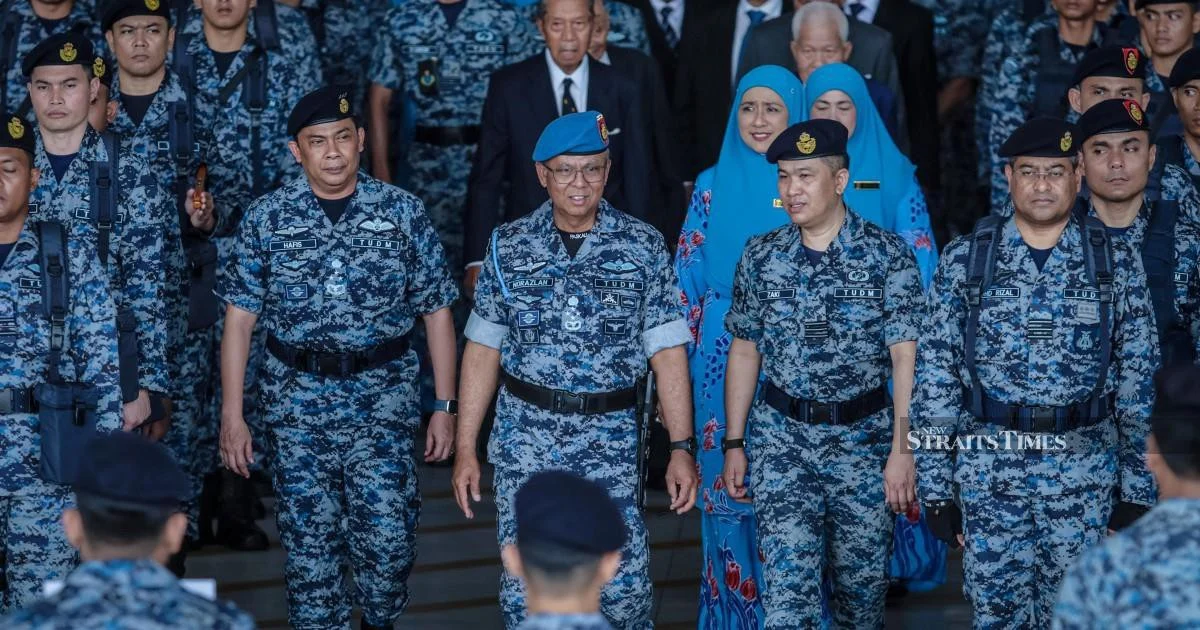
Malaysia's vulnerability at sea hinges increasingly on the strength of its airborne defence infrastructure, according to the nation's top military aviator, General Tan Sri Muhamad Norazlan Aris. Speaking at Subang, the RMAF chief emphasised that control of the skies directly determines whether commercial and strategic shipping routes remain secure against contemporary threats. As the country confronts a kaleidoscope of emerging regional tensions and great-power competition, this assessment underscores a fundamental shift in how Malaysia must conceptualise maritime protection—no longer as a purely naval concern, but as an integrated challenge requiring air superiority and constant surveillance.
The remarks arrive at a moment when Southeast Asia faces mounting complexity in its security architecture. Chinese military assertiveness in the South China Sea, evolving power dynamics following geopolitical shifts, and the proliferation of advanced defence systems have all reshaped the operational environment. For Malaysia, which depends heavily on seaborne trade through the Strait of Malacca and other passages, the implications are profound. The waters around the peninsula rank among the world's busiest, channelling roughly a quarter of global maritime traffic. Any disruption—whether from piracy, terrorism, regional conflict, or great-power rivalry—poses existential economic and strategic consequences for the country.
The RMAF chief's emphasis on aerial capabilities reflects a recognition that traditional surface-based naval platforms, while essential, can no longer be the sole custodian of maritime security. Modern threats operate across multiple dimensions simultaneously. Aircraft provide range, persistence, and rapid response that surface vessels alone cannot match. Long-endurance patrol aircraft can monitor vast ocean expanses; fighter jets offer rapid intercept capabilities; and integrated air defence systems can deny adversaries the freedom of action they might otherwise enjoy. For a medium-sized maritime power like Malaysia, investing in air power represents a force-multiplier that stretches limited defence budgets further than land-based assets might achieve.
Regional geopolitical turbulence has intensified scrutiny of Malaysia's defence posture. The ongoing competition between major powers for influence in Southeast Asia creates an unstable calculus where smaller nations must carefully balance security investments with diplomatic relationships. Malaysia has traditionally sought to maintain equidistance from larger powers while building practical partnerships with neighbours. Yet this equilibrium grows more precarious as regional tensions rise. The assertion that air power is "increasingly critical" signals Kuala Lumpur's determination to maintain strategic autonomy by developing indigenous capabilities rather than relying entirely on alliances or foreign guarantees.
The economic dimensions of maritime security deserve closer attention. Malaysia's manufacturing base, petrochemical industries, and trade-dependent economy all hinge on unimpeded shipping. A single incident affecting major shipping lanes could cascade through global supply chains, with disproportionate impacts on developing economies that lack alternative markets or sources. The Strait of Malacca, through which roughly one-third of seaborne trade passes, remains particularly vulnerable. Piracy, though diminished from its peak, persists as a manageable threat. More concerning to strategists are scenarios involving inter-state conflict, where maritime chokepoints become leverage points for regional powers. Robust air capabilities serve as a deterrent to such calculus, signalling that any attempt to disrupt Malaysian waters would encounter credible resistance.
The RMAF chief's comments implicitly acknowledge that Malaysia cannot match the military resources of larger regional powers. Instead, strategic investments in selective capabilities—particularly air defence and maritime patrol aircraft—offer disproportionate benefit. Acquiring modern jets, upgrading radar systems, and training personnel in advanced air operations represent force-multiplication strategies that smaller air forces adopt globally. For Malaysia, this translates to fewer aircraft and personnel spreading wider geographic responsibilities, demanding greater technological sophistication and operational efficiency than larger neighbours might require.
Backdropping these assessments is the evolving character of regional security itself. Traditional military exercises and confidence-building measures continue, yet they operate alongside more contestatory dynamics. Incidents involving military aircraft in international airspace, collisions between civilian and military vessels, and grey-zone operations short of declared conflict characterise the contemporary security environment. In such contexts, air-based surveillance and interception capabilities become crucial to generating situational awareness and maintaining control of airspace. The ability to quickly identify and respond to intrusions—whether military, civilian, or non-state actors—requires precisely the air force capabilities the RMAF chief advocates.
Implementing such a vision faces practical constraints. Defence budgets across Southeast Asia remain modest relative to those of major powers. Personnel recruitment and retention in technical fields competes with civilian sectors offering higher salaries. Aircraft procurement from international partners involves lengthy lead times and substantial capital expenditures. Malaysia must therefore make strategic choices about which capabilities to prioritise, which platforms to acquire, and how to develop human capital in highly specialised fields. The RMAF's advocacy for expanded air power reflects these competing pressures—a bid to secure resources and political support for an institution whose strategic relevance remains contested domestically.
Longer-term strategic considerations also inform this positioning. As Malaysia gradually transitions toward middle-income status and develops indigenous defence manufacturing capabilities, the question of air power becomes entangled with industrial policy and technology development. Building a capable air force can support broader technological advancement and economic diversification. Several Southeast Asian nations have pursued defence manufacturing as a tool for economic development and technological acquisition. Malaysia might similarly view air force modernisation not merely as a security imperative, but as a vehicle for building domestic expertise and industrial capacity.
The RMAF chief's emphasis on maritime air power ultimately reflects global trends where air-centric strategies increasingly dominate military planning. From American carrier aviation to Chinese maritime surveillance, airborne assets drive contemporary strategic thinking. For Malaysia, embracing this shift offers an opportunity to enhance maritime security through capabilities that smaller nations can more feasibly develop than, say, large naval fleets. Whether Malaysia can translate this strategic vision into sustained funding and coherent modernisation programmes remains an open question, one that will likely dominate defence policy discussions in coming years.
%22%2F%3E%3C%2Fpattern%3E%3C%2Fdefs%3E%3Crect%20width%3D%22100%25%22%20height%3D%22100%25%22%20fill%3D%22url(%23ph5q1cpg)%22%2F%3E%3Crect%20width%3D%22100%25%22%20height%3D%22100%25%22%20fill%3D%22url(%23ph5q1cpp)%22%2F%3E%3Ctext%20x%3D%2250%25%22%20y%3D%2250%25%22%20text-anchor%3D%22middle%22%20dominant-baseline%3D%22central%22%20fill%3D%22rgba(255%2C255%2C255%2C0.95)%22%20font-family%3D%22Georgia%2C%20'Times%20New%20Roman'%2C%20serif%22%20font-weight%3D%22700%22%20font-size%3D%22320%22%20letter-spacing%3D%22-0.02em%22%3EPAS%3C%2Ftext%3E%3C%2Fsvg%3E)

%22%2F%3E%3C%2Fpattern%3E%3C%2Fdefs%3E%3Crect%20width%3D%22100%25%22%20height%3D%22100%25%22%20fill%3D%22url(%23ph4y4bjg)%22%2F%3E%3Crect%20width%3D%22100%25%22%20height%3D%22100%25%22%20fill%3D%22url(%23ph4y4bjp)%22%2F%3E%3Ctext%20x%3D%2250%25%22%20y%3D%2250%25%22%20text-anchor%3D%22middle%22%20dominant-baseline%3D%22central%22%20fill%3D%22rgba(255%2C255%2C255%2C0.95)%22%20font-family%3D%22Georgia%2C%20'Times%20New%20Roman'%2C%20serif%22%20font-weight%3D%22700%22%20font-size%3D%22272%22%20letter-spacing%3D%22-0.02em%22%3EJohor%3C%2Ftext%3E%3C%2Fsvg%3E)