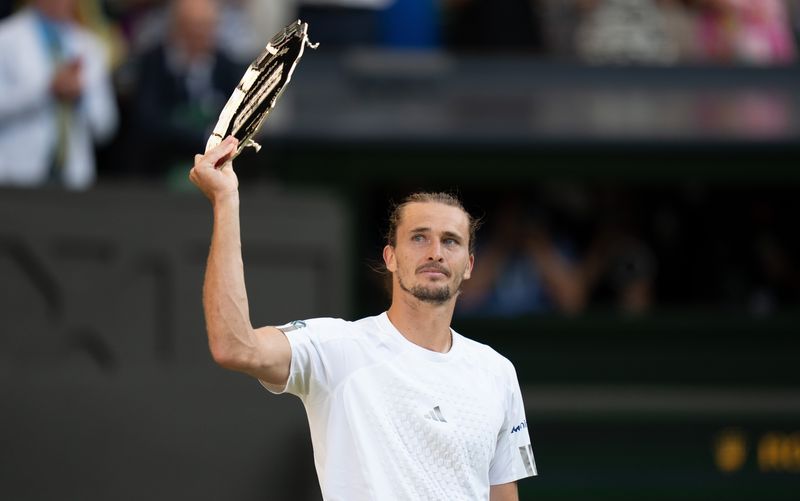
Alexander Zverev's runner-up finish at Wimbledon will catapult the German star to the second position in the ATP world rankings when the updated list is released on Monday, positioning him as the closest challenger to the sport's current elite. Yet the gulf between him and the reigning champions remains evident: Jannik Sinner and Carlos Alcaraz control men's tennis with their combined dominance, leaving Zverev searching for a pathway to break through. The 29-year-old, however, believes he has discovered the solution through a fundamental shift in his tactical approach, one centred on aggressive shot-making that he tested against Sinner himself at the All England Club.
Zverev's final on Sunday represented a watershed moment in his rivalry with the Italian world number one. The German contested 14 consecutive sets against Sinner before finally breaking that streak in this match, demonstrating that pure persistence, combined with technical refinement, can yield tangible improvements. Despite ultimately succumbing 6-7(7) 7-6(2) 6-3 6-4, Zverev orchestrated passages of compelling tennis that momentarily threatened to overwhelm his opponent. Had a crucial tumble not occurred at 3-3 in the third set, precisely when he held his sole break-point opportunity, the trajectory of the contest might have shifted dramatically. A victory would have made Zverev the first German male to claim the singles trophy since Michael Stich's triumph three decades earlier in 1991, underscoring both the magnitude of the occasion and how narrowly success slipped from his grasp.
The confidence radiating from Zverev stems largely from his breakthrough French Open victory last month, his first Grand Slam title after 41 previous attempts. Sceptics have noted the convenient absence of Alcaraz through wrist injury and Sinner's unexpected second-round exit in Paris, factors that diminish the accomplishment in some quarters. Nevertheless, for Zverev himself, the psychological transformation that accompanied defeating Flavio Cobolli en route to Roland Garros proved invaluable. That championship success embedded within him a conviction that a more assertive game could deliver results against the sport's hierarchy. At Wimbledon, evidence of this philosophical realignment emerged viscerally through his grasscourt performance, where he advanced further than ever before at the event, powered substantially by an attacking forehand that abandoned the hesitancy of earlier incarnations.
The statistical backbone of Zverev's evolution became apparent during the final itself. His first-serve percentage sustained itself around the 80 per cent mark throughout the contest against Sinner, a critical foundation upon which more aggressive court positioning rests. More significantly, his forehand—previously criticised as insufficiently bold—transformed into an offensive weapon that repeatedly created problems for the Italian. When opportunities presented themselves, Zverev no longer retreated into the conservative patterns that had defined earlier phases of his career; instead, he committed fully to striking through the ball, accepting the inevitable misses as the necessary cost of elevated risk-taking. This represents not merely a tactical adjustment but a fundamental reorientation of his competitive philosophy, one he intends to maintain regardless of immediate outcomes.
In conversations with the media following the final, Zverev articulated his commitment to this methodology with deliberate emphasis. He acknowledged that the year's opening months included matches where the new attacking approach exposed vulnerabilities, moments when he lacked the technical refinement to execute such demanding tactics consistently. Rather than reverting to safer patterns, however, he persisted with the methodology, trusting that repetition and refinement would gradually elevate his proficiency. The logic resembles a golfer deliberately working through a swing change: short-term performance may suffer, but the long-term architectural improvements justify temporary regression. Zverev framed his recent achievements—the French Open triumph and Wimbledon final appearance—as validation that the philosophy functions when implemented across sufficient volume of matches.
Yet Zverev operates within a landscape where Sinner and Alcaraz have accumulated twelve Grand Slam titles between them, establishing a dominance that threatens to crystallise into an era. The Spanish seven-time major champion, despite his current wrist complications, represents a generational talent whose trajectory promises sustained excellence for years to come. Sinner, meanwhile, has ascended to world number one with the kind of sustained excellence that suggests his position will prove difficult to dislodge. For Zverev, the challenge transcends mere skill acquisition; it requires psychological recalibration that positions him as a legitimate major-tournament threat rather than a perpetual finalist destined to collect runner-up finishes. He perceives incremental progress in his head-to-head record and the closeness of matches as encouraging signals, even absent victories, suggesting that the gap narrows through sustained competitive application.
The narrative surrounding "the third man" has preoccupied tennis observers for several seasons, with Zverev consistently occupying that position despite remaining substantially removed from the top two in terms of actual Grand Slam success and consistency across the calendar. Zverev understands that elevating himself from peripheral contender to genuine threat demands not merely proximity to Sinner and Alcaraz in rankings points, but competitive victories in tournaments carrying the greatest prestige. His Wimbledon performance provided evidence that such breakthroughs lie within reach, furnished the approach continues to evolve and his serving mechanics remain robust.
The physical toll of Sunday's final merits consideration within Zverev's evaluation of the match's trajectory. He reported that a fall at the critical juncture—specifically a hyperextension remarkably similar to a knee injury sustained two years prior—compromised his serving mechanics. The reduction in serve velocity that followed impacted his court control, particularly evident during the third set when his overall performance dipped noticeably. Such vulnerabilities underscore the precarious nature of his challenge: not only must he execute complex tactical adjustments, but he must do so while protecting his body from the cumulative stress of elite competition. The recovery across the fourth set, when he recommitted fully to his aggressive approach, suggested that tactical adjustments rather than physical incapacity determined the shift in performance, a distinction with significant implications for his trajectory moving forward.
For Malaysian tennis observers and Southeast Asian followers of the sport, Zverev's evolution carries particular resonance. The regional tennis community has long appreciated players who demonstrate sustained improvement through technical refinement and intellectual engagement with the sport's tactical dimensions. Zverev's explicit commitment to implementing and perfecting an attacking methodology, rather than defaulting to established patterns, reflects the kind of player development that resonates across Asian audiences. Moreover, as someone challenging the continental European and Spanish/Italian dominance of contemporary tennis, Zverev represents a diversification of elite competition that broader global audiences find compelling.
The Wimbledon final also illuminates the broader competitiveness of men's tennis beyond the summit. While Sinner and Alcaraz undoubtedly command the sport's highest echelon, the presence of a genuine challenger—one capable of pressing the world number one to a fourth-set tiebreak in a major final—suggests the sport's competitive depth remains healthy. For viewers across Southeast Asia tuning into major tournaments, this dynamic provides engagement beyond inevitable coronations, introducing narrative tension into contests that might otherwise appear pre-determined by the pedigree of the participants.
Moving forward, Zverev's trajectory will likely determine whether his Wimbledon showing represented genuine progress or a momentary plateau before regression. The attacking forehand and elevated first-serve percentages must translate into victories over the sport's elite across varied surfaces and circumstances. His explicit goal of competing and winning major tournaments rather than merely participating suggests he understands the distinction between respectable runs and championship calibre performances. Should he successfully maintain the aggressive methodology while minimising unforced errors and injury risks, Zverev possesses the capacity to deliver Grand Slam titles beyond the potentially asterisked French Open victory. Conversely, if the year concludes without additional major success, questions will resurface regarding whether the tactical adjustments provide sufficient advantage to bridge the gap that Sinner and Alcaraz, through their relentless excellence, continue to establish.

