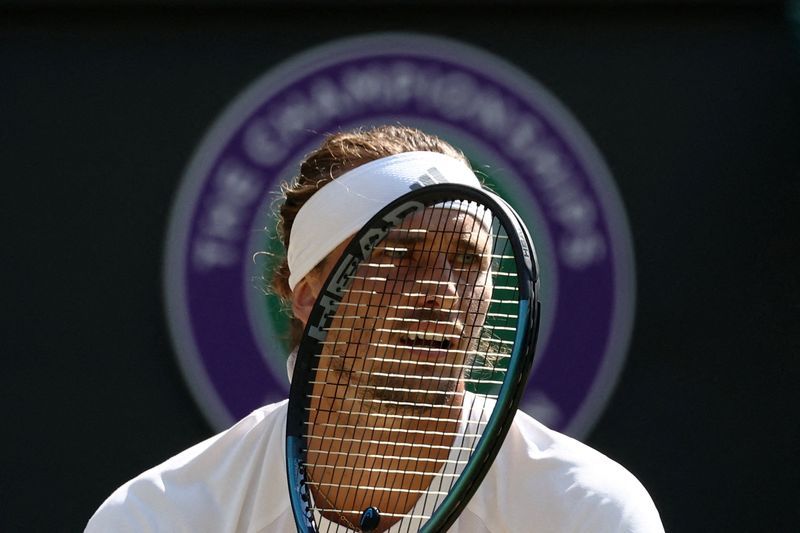
German second seed Alexander Zverev has finally broken through his psychological barrier against Taylor Fritz, delivering a commanding 6-4 6-4 6-2 victory on Court One to secure his maiden Wimbledon semi-final appearance. The result represents a major breakthrough for the 26-year-old, who enters the last four with momentum building following his French Open triumph and hopes of capturing back-to-back Grand Slam crowns. This decisive performance at the All England Club marks a turning point in a rivalry that has haunted Zverev for more than two years, during which Fritz had won seven consecutive encounters including a memorable victory at last year's tournament.
The path to Zverev's semi-final berth underscores the mental fortitude required at tennis's highest level. Entering the match, Zverev carried the weight of repeated failures against an opponent who had seemingly found his measure across multiple surfaces and occasions. Yet on this sweltering London afternoon, the German played with the precision and composure required to dismantle Fritz's game plan. Breaking serve early proved instrumental, allowing Zverev to establish a 5-4 lead in the opening set before weathering a determined late fightback from his American rival to claim the first frame without dropping more games.
Fritz's misfortunes appeared compounded when he required medical attention for a right knee concern following the third game of the second set, a moment that coincided with Zverev's acceleration in intensity. Rather than relying solely on his opponent's difficulties, Zverev seized the initiative with aggressive shot-making, securing the crucial break that effectively put the match beyond doubt. The home crowd's eruption when news arrived that British hopeful Arthur Fery had moved two sets ahead seemed to energise Zverev further, prompting the German to close out the set with commanding ease as Fritz's resistance visibly crumbled.
The third set showcased Zverev at his most dominant, an exhibition of backhand brilliance and court positioning that left little for Fritz to work with. A scintillating backhand winner sealed a double break at 4-1, putting the outcome beyond mathematical doubt. From that point, Zverev administered the final rites with minimum fuss, wrapping up the set and securing passage to his 12th major semi-final appearance. The complete nature of the victory cannot be understated—it represents the kind of comprehensive dismissal that indicates a player firing on all cylinders, having resolved technical and tactical issues that had previously troubled his performances.
Zverev's breakthrough holds particular significance within German tennis history. By reaching his first Wimbledon semi-final, he joined an elite cohort of German men who have achieved the same feat in the professional era dating from 1968. The company includes four former champions and major finalists: Boris Becker, Michael Stich, Rainer Schuettler, and Tommy Haas. This historical context reflects both the difficulty of reaching the final four at Wimbledon and the scarcity of German male success on grass courts in recent decades, making Zverev's achievement a noteworthy milestone for a nation with a storied tennis heritage.
Zverev's post-match commentary revealed the mental preparation required to overcome such a daunting psychological barrier. He acknowledged the difficulty of the opening service game, where he faced three break points and recognised that previous failures loomed large in his consciousness. His assessment that an "almost perfect match" was necessary proved prescient—only through sustained excellence across all three sets could he neutralise an opponent who had earned the upper hand through a sequence of competitive encounters. This self-awareness suggests a player who understands the importance of matching superior execution against a rival whose recent record had become genuinely intimidating.
The semi-final confrontation with Fery presents an intriguing subplot for British tennis. Fery has captured the imagination of home supporters while also reaching his maiden Wimbledon semi-final, creating a unique situation where the All England Club's narrative has become centred on first-time participants at this stage. The homegrown challenge will appeal to a crowd that naturally gravitates toward local representation, though Zverev arrives as the favourited and more accomplished player across his broader career. The German's jocular acknowledgment that the crowd would understandably favour Fery reflected his confidence and composure—hallmarks of a player who has moved past the pressure that previously affected him.
Zverev's continued journey toward a potential second consecutive Grand Slam title represents one of the tournament's dominant storylines. Having won the French Open, where he demonstrated the sustained excellence required to claim major honours on clay, the German now seeks to prove his grass-court credentials at the highest level. The ability to transition between surfaces and maintain form across the calendar year separates merely talented players from true champions. His demolition of Fritz suggests technical adjustments and mental refinement that could prove decisive against Fery or whichever opponent emerges from the other semi-final.
For regional players and coaches observing from Southeast Asia, Zverev's resurgence contains valuable lessons about mental resilience and tactical adaptation. The German's previous struggles against Fritz demonstrated how patterns of defeat can accumulate, creating psychological weight that extends beyond mere statistics. Yet his willingness to confront that challenge head-on at a critical moment—the quarter-finals of a Grand Slam—illustrates the championship mentality required to transcend such barriers. His approach of focusing on execution rather than historical records proved vindicated through the clinical destruction of an opponent who had previously held the upper hand.
As Zverev prepares for his semi-final against Fery, the narrative of two first-time semi-finalists meeting on grass remains compelling. Yet the German enters that contest having definitively exorcised one demon. By ending his Fritz curse through an accomplished performance, Zverev has demonstrated the form and mental clarity that could carry him toward Wimbledon's final. The journey from frustrated rival to commanding victor speaks to a player approaching peak competitive form, precisely the trajectory that bodes well for any player aspiring toward major titles in the remainder of the season.

