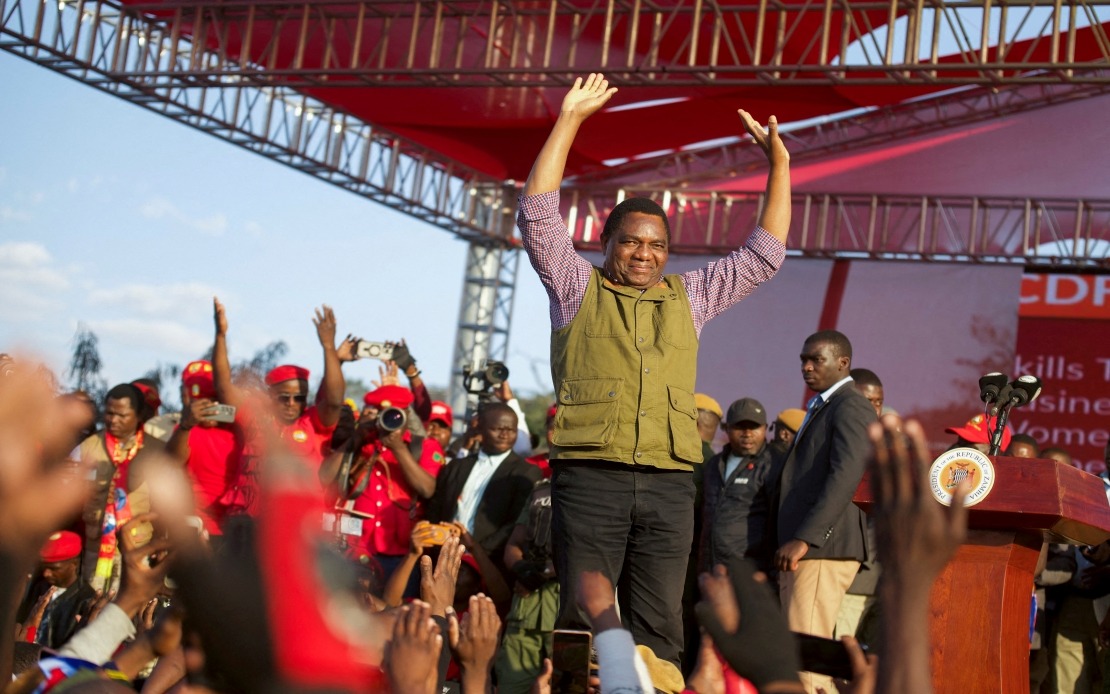
Zambian President Hakainde Hichilema has emerged with a decisive advantage in his campaign to secure a second term in office, according to preliminary election results announced Sunday at the Electoral Commission of Zambia's headquarters in Lusaka. With tallies from 135 of the country's 226 constituencies now counted, the 64-year-old incumbent and ruling United Party for National Development (UPND) standard-bearer has accumulated 1,544,140 votes, a margin that positions him firmly ahead of the 12 other candidates competing for the presidency.
The electoral mathematics favour Hichilema's advancement toward victory. His closest competitor, Brian Mundubile of the National Reconciliation Party for Unity and Prosperity (NRPUP), trails significantly with 1,030,662 votes counted thus far. This gap of more than half a million votes at this stage of counting represents a commanding lead that would prove difficult for opposition candidates to overcome, even accounting for results still outstanding from nearly 100 remaining constituencies. Electoral Commission of Zambia Chairperson Mwangala Zaloumis released the consolidated figures around 2130GMT from the National Election Results Centre.
Under Zambia's constitutional framework, a presidential candidate must capture more than 50 per cent of all valid votes cast to be declared president-elect outright. Should no candidate achieve this threshold, the constitution mandates a runoff ballot between the top two finishers. The current trajectory suggests Hichilema's vote share may already exceed this requirement, though final certification awaits completion of the tallying process from all constituencies.
Hichilema's professional background as an economist and rancher has shaped his policy priorities during his first term, which commenced in 2021 following his dramatic victory over then-incumbent Edgar Lungu by a margin exceeding one million votes. That prior triumph demonstrated substantial public appetite for the UPND's platform and Hichilema's leadership vision. His campaign for re-election builds upon the record compiled during this initial period, emphasising restructuring of Zambia's historically burdensome debt obligations that constrained economic policy-making and government service provision.
The incumbent has highlighted achievements in revitalising Zambia's crucial mining sector, a cornerstone of the national economy that had declined under previous administrations. Beyond mineral extraction, Hichilema's government expanded social sector investments, particularly through universal free education at public primary and secondary schools. These initiatives addressed longstanding inequality in educational access and reflected a development philosophy centred on broadening opportunity, particularly for youth in less advantaged communities.
Mundubile, the 55-year-old lawyer challenging from the NRPUP, has nevertheless demonstrated organisational capacity and regional support, particularly within constituencies situated along Zambia's urbanised corridor—the geographical band stretching roughly through the capital and extending into the Copperbelt region to the north. The Copperbelt, historically a centre of political competition and trade union influence, has represented contested electoral terrain. The opposition alliance led by Mundubile has secured parliamentary representation in multiple constituencies within these urban zones, suggesting that while Hichilema commands a national lead, the political landscape contains pockets of organised opposition strength.
For Southeast Asian observers, Zambia's electoral dynamics reflect broader continental patterns. The southern African nation, like many developing economies across Asia and Africa, faces the perennial challenge of balancing debt management with investment in social infrastructure and human capital development. Zambia's debt restructuring efforts, which Hichilema emphasises as a central achievement, parallel comparable struggles across Southeast Asia where several nations have negotiated with creditors and pursued fiscal consolidation while maintaining growth-oriented spending.
The mining sector's centrality to Zambian prosperity also resonates with regional experience. Malaysia, Indonesia, and other Southeast Asian economies similarly depend on commodity exports and possess mining industries that require strategic management to ensure sustainable revenue generation and equitable distribution of resource wealth. Hichilema's mining sector revival therefore addresses challenges recognisable to Malaysian and regional policymakers navigating commodity-dependent development models.
The competitive presence of opposition forces, whilst Hichilema maintains a substantial lead, underscores that electoral democracy in southern Africa remains contested and dynamic. Mundubile's capacity to mobilise support in urban constituencies suggests that Zambian voters retain meaningful choice and that political competition functions. This stands in contrast to concerns about democratic backsliding in some regions, demonstrating that electoral competition and institutional processes continue functioning in Zambia.
The completion of vote counting in the remaining constituencies will determine whether Hichilema's current advantage translates into an outright first-round victory or whether Zambia's constitutional runoff mechanism activates. Either scenario would represent a significant democratic endorsement, as Hichilema secured his initial election only three years prior. A second-term victory would provide the sitting president extended tenure to deepen economic reforms, consolidate debt restructuring gains, and pursue longer-term developmental objectives in education and sectoral diversification.
Zambia's experience offers lessons for regional democracies navigating post-pandemic recovery and economic adjustment. Hichilema's emphasis on debt sustainability alongside social investment suggests a governing philosophy attempting to balance fiscal responsibility with equity concerns. As developing economies across Asia and Africa confront similar pressures to stabilise finances whilst addressing inequality and underinvestment in human development, Zambia's electoral outcomes will signal whether publics reward such balanced approaches or demand alternative policy directions.
The final determination of Zambia's presidency awaits full tallying, yet the current returns position Hichilema decisively within grasp of his second term. The opposition's parliamentary gains and Mundubile's competitive positioning in urban areas indicate that whilst the presidency appears likely to remain with the UPND, broader political contestation will characterise Zambian governance during Hichilema's next administration. This mixture of decisive presidential advantage and substantive parliamentary opposition reflects a maturing democratic system in which electoral outcomes shape but do not entirely determine the political landscape.

