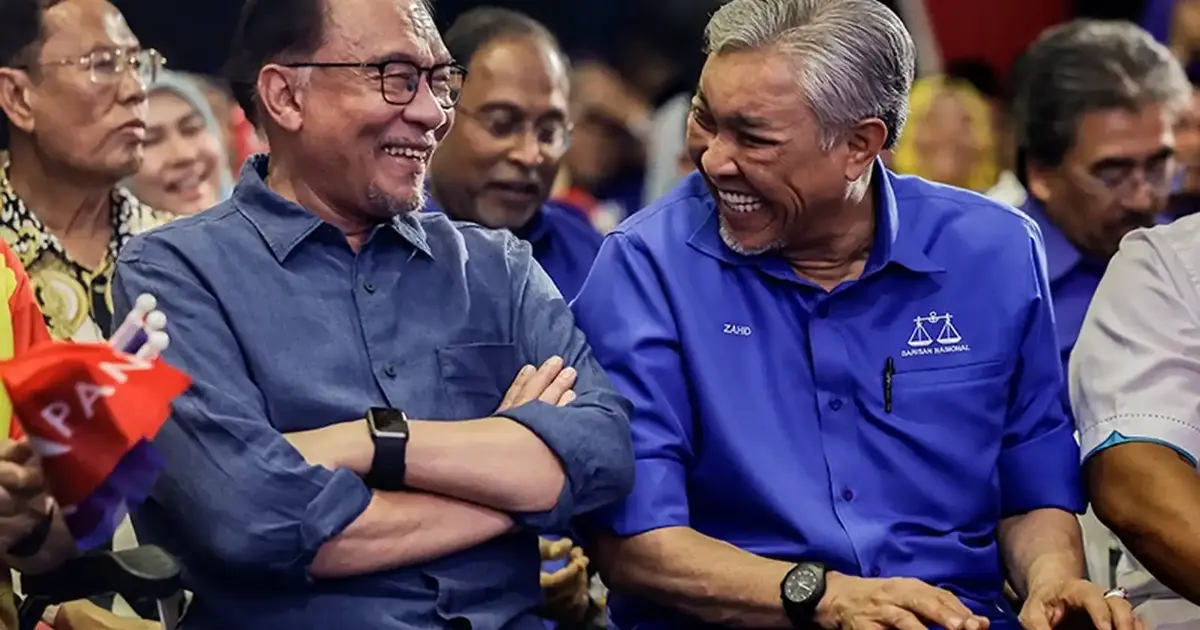
Deputy Prime Minister Zahid Hamidi has chosen an unconventional avenue to engage with Prime Minister Anwar Ibrahim, responding to the premier's recent poetic composition with creative verse of his own. The exchange, carried out in literary form, represents a notable moment of symbolic communication between two of Malaysia's most prominent political figures, reflecting the sometimes theatrical nature of top-level political discourse in the country.
As chairman of Barisan Nasional, Zahid seized the opportunity afforded by his poetic reply to underscore the coalition's fundamental commitment to preserving the unity government arrangement. This reaffirmation carries particular weight given the complex political calculations that have underpinned Malaysia's governing coalition since 2022, when the historic pact between BN, Pakatan Harapan, and other component parties was forged in the aftermath of the general election.
The exchange between these two political heavyweights suggests an effort to maintain civil and creative modes of dialogue, even as Malaysia's political landscape remains characterised by underlying tensions and competing interests. Poetry as a medium for political communication is relatively rare in Malaysia's contemporary politics, making this interchange noteworthy for observers seeking to understand the evolving relationship between the prime minister and his deputy.
BN's position within the unity government has been a subject of considerable scrutiny and speculation among political analysts and observers. The coalition, which historically dominated Malaysian politics for decades before losing federal power in 2018, has had to recalibrate its role and influence as part of a broader governing arrangement. Zahid's explicit statement regarding BN's commitment demonstrates an attempt to project stability and unity at a time when coalition politics remains inherently fragile.
The unity government itself represents a significant departure from Malaysia's previous political patterns. Formed to navigate a deeply fractured parliament following the 2022 elections, the coalition has managed to survive multiple potential crises and has delivered several legislative achievements. However, questions about its durability persist, particularly given the distinct ideological positions of its component parties and the absence of formal power-sharing agreements in some respects.
Zahid's emphasis on BN remaining committed until the completion of the government's term addresses concerns that have periodically surfaced regarding the stability of the arrangement. Malaysian political history is replete with examples of coalition governments fragmenting before their natural conclusion, making such reassurances significant even if they are largely expected utterances from senior coalition figures.
The broader context of this poetic exchange includes the ongoing personal and political relationship between Anwar and Zahid, two leaders with distinct constituencies and governing philosophies. Anwar, representing Pakatan Harapan's reformist agenda, and Zahid, anchoring the more traditionally-oriented BN perspective, have nevertheless maintained a functional working relationship within the unity framework. Their ability to communicate, even through creative mediums, reflects this pragmatic accommodation.
For Malaysian political watchers, the significance of Zahid's response extends beyond the verses themselves. It signals that despite the various pressures and complexities facing the government, the top leadership remains engaged in dialogue rather than confrontation. This matters considerably for the stability of the coalition and for public confidence in the government's capacity to function effectively.
BN's role within the unity government has evolved as the arrangement has matured. The coalition brings substantial institutional expertise, significant representation in parliament, and considerable ground networks that contribute meaningfully to governance. Zahid's position as both deputy prime minister and BN chairman places him at a critical juncture where he must balance the interests of his coalition with the broader imperatives of maintaining the unity arrangement.
The poetic exchange also reflects Malaysia's ongoing political culture, where symbolic gestures and rhetorical flourishes continue to play an important role alongside substantive policy discussions. In a political environment where trust remains fragile and calculations are constantly made regarding coalition durability, such positive engagements between senior leaders can carry disproportionate weight in shaping public perception and investor confidence.
Looking ahead, the sustainability of the unity government will likely depend on continued commitment from all component parties, including BN's ongoing participation and engagement. Zahid's explicit reaffirmation addresses potential anxiety within his own coalition about BN's long-term role and ensures that stakeholders understand the party's intention to maintain the arrangement through to the government's completion of its full term.
The exchange between Anwar and Zahid ultimately underscores a pragmatic political reality in contemporary Malaysia: despite competing interests and historical rivalries, governing coalitions demand a degree of civility and mutual engagement from their senior leadership. Whether conducted through poetry or policy papers, such communication remains essential to preventing the unity government from fragmenting under pressure.

