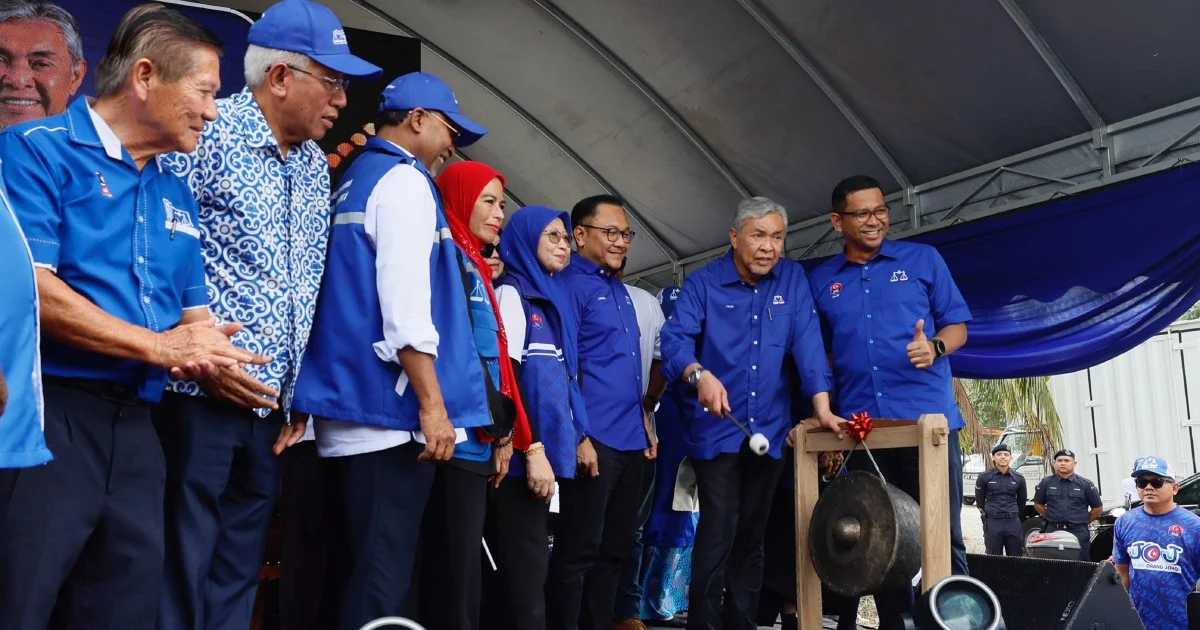
Deputy Prime Minister Datuk Seri Dr Ahmad Zahid Hamidi has challenged PAS to move beyond rhetorical commitments and deliver tangible electoral backing for Barisan Nasional candidates contesting the Johor state election, casting doubt on the sincerity of the Islamist party's pledged cooperation. Speaking in Batu Pahat, the UMNO leader effectively issued a test of PAS's willingness to translate political statements into ground-level mobilisation, a critical measure of coalition cohesion as Malaysia's most developed state heads toward the polls.
The challenge reflects mounting scrutiny within the ruling coalition over whether partnership agreements between BN and PAS will hold firm when votes are counted. Zahid's comments suggest internal conversations about resource allocation, campaign intensity, and the mechanics of electoral cooperation have moved beyond procedural agreement into matters of verification and accountability. His public call effectively signals that BN expects to see tangible evidence of PAS support rather than accepting pledges at face value, raising the bar for what constitutes meaningful partnership.
This dynamic highlights a persistent tension within Malaysia's political landscape since the 2022 general election realignment. PAS has positioned itself as a linchpin in the federal coalition architecture, but scepticism persists among traditional BN components about whether PAS members and grassroots supporters will genuinely campaign for non-Islamist candidates or merely stand aside. Zahid's intervention suggests BN strategists believe PAS activation at the ground level remains uncertain, particularly in constituencies where BN candidates face strong opposition from other quarters.
The Johor election holds particular significance as a testing ground for coalition mechanics. The state has traditionally been BN stronghold, but recent electoral volatility across Malaysia has raised questions about voter loyalty and the capacity of component parties to deliver support bases. A strong performance by BN in Johor would bolster arguments that the coalition remains electorally viable, while underperformance would feed narratives about coalition fragility and PAS's unreliability as a partner.
Zahid's statement also carries implications for the broader coalition calculus. PAS involvement in BN represents a significant shift from pre-2022 politics, and the partnership remains conditional on mutual benefit and credible performance. Zahid's public challenge amounts to setting measurable expectations before votes are cast, establishing grounds for post-election attribution of success or failure. Should BN perform well, both UMNO and PAS will claim credit; should performance disappoint, Zahid has already positioned himself to argue that PAS failed to deliver the support it promised.
The timing of Zahid's remarks underscores coalition preparations entering a more intensive phase. Public statements by coalition leaders at this stage typically reflect finalisation of campaign strategies, resource mobilisation, and division of labour among component parties. That Zahid felt compelled to address PAS's role publicly suggests either that internal communications about performance expectations had not sufficiently clarified matters, or that BN leadership wanted to send a signal to PAS supporters themselves about expectations.
From the perspective of PAS, such challenges present delicate navigation challenges. The party's involvement with BN represents a deliberate strategic choice distinct from its previous positioning, and PAS leaders must manage expectations among their core supporters while demonstrating commitment to coalition partners. Zahid's comments essentially force PAS into a position where the party must either intensify visible campaign activities or risk appearing uncommitted to the coalition partnership.
The electoral outcome in Johor will likely influence coalition dynamics ahead of future contests. If BN performs strongly, the partnership model will be declared successful and potentially replicated in other state elections. If performance disappoints, recriminations between coalition partners will create friction that could undermine the federal coalition's stability. Zahid's preemptive challenge arguably reflects anxiety within UMNO about whether the PAS partnership will prove electorally productive.
For Malaysian voters, these coalition manoeuvres underscore how electoral outcomes depend not merely on campaign messaging but on the capacity of political partnerships to function effectively at ground level. The competition within BN over credit and responsibility for electoral results mirrors broader questions about coalition durability in an era of volatile electoral behaviour and shifting political alignments.
Zahid's intervention also signals that BN strategists view Johor as winnable territory where coalition mobilisation could prove decisive. By publicly challenging PAS to demonstrate support through action, UMNO's deputy president effectively raised the stakes for coalition performance, establishing clear accountability metrics before campaigning reaches its intensity peak. For PAS, the onus now rests on demonstrating through visible electoral activity that the party's coalition commitment extends beyond statements to substantive ground operations.
The Johor election therefore emerges not merely as a state-level contest but as a proving ground for Malaysia's current coalition architecture, with Zahid's challenge to PAS serving as a revealing window into the coalition's internal dynamics and the conditions that must be met for successful electoral cooperation.

