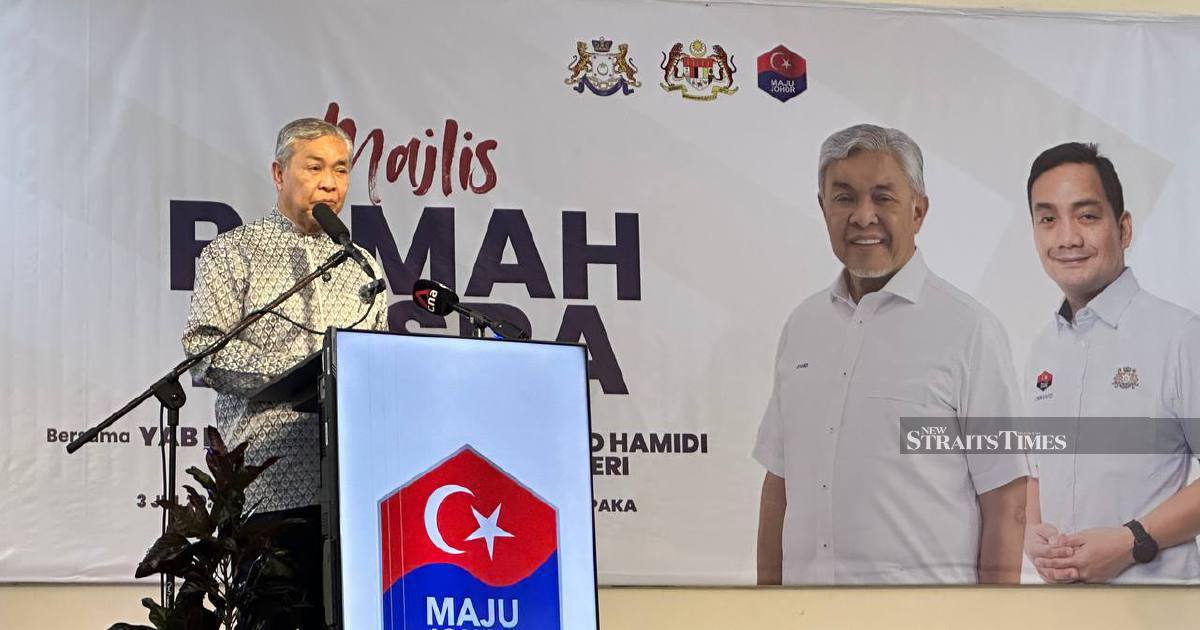
Barisan Nasional chairman Datuk Seri Dr Ahmad Zahid Hamidi has made an explicit appeal to his coalition partners within the unity government framework, urging them to move beyond old grievances and cease attacks on Umno and the broader Barisan Nasional during the current Johor election campaign. The plea underscores growing tensions within Malaysia's power-sharing arrangement as the country approaches state-level elections that will test the stability of the national coalition framework.
Zahid's intervention reveals the delicate balancing act required to maintain the unity government, which has brought together ideologically diverse parties since 2022 with the primary objective of preventing political instability. The coalition encompasses Umno, Malaysian Chinese Association, Malaysian Indian Congress, Perikatan Nasional, and several smaller parties, each with distinct constituencies and historical grievances. As Johor, traditionally a Barisan stronghold, enters its electoral cycle, these internal tensions have begun surfacing more visibly in public statements and campaign messaging.
The emphasis on avoiding "old issues" is significant because Malaysian politics remains deeply shaped by historical events, including the 1997 Asian financial crisis, the 2008 transition that first cost Barisan its parliamentary majority, successive election losses, and various corruption allegations involving party leaders. These episodes have created lasting fault lines within the coalition, particularly between Umno and its smaller partners who sometimes felt sidelined or blamed for collective failures. Zahid's request suggests these resentments remain potent enough to undermine campaign unity if not carefully managed.
For Malaysian voters, especially in Johor, this dynamic carries practical implications. A unified coalition campaign typically generates stronger organisational capacity and messaging coherence, potentially translating to higher effectiveness in mobilisation and electoral performance. Conversely, public displays of intra-coalition tension risk confusing supporters about the coalition's actual priorities and can energise opposition movements by highlighting perceived hypocrisy or weakness. The Johor election thus becomes a litmus test for whether the unity government model can sustain itself through competitive electoral cycles.
The timing of Zahid's appeal is particularly noteworthy because Johor has represented Barisan Nasional's most reliable electoral base, delivering consistent victories across successive general and state elections until 2018. The state's political character as a BN stronghold means that any electoral slippage would carry disproportionate symbolic weight, signalling either erosion of the coalition's traditional support base or evidence that internal contradictions have become electorally consequential. Zahid's intervention thus addresses both party management and broader coalition survival concerns.
Peikatan Nasional's inclusion in the unity government has introduced particular complexity, given its emergence as an alternative political force that displaced Umno from power in several states in 2020 before the 2021 constitutional crisis realigned national politics. Partners within Perikatan may harbour grievances about Umno's dominance within the national coalition and could be tempted to air these differences during state campaigns, either to establish their own distinct identity or to pursue advantage in local political dynamics. Zahid's appeal specifically addresses this risk.
The Malaysian political context also reflects broader patterns in Southeast Asian coalition politics, where multi-party systems frequently require post-election power-sharing arrangements that strain party relationships. The unity government represents an attempt to establish stability through agreed principles of cooperation, yet electoral cycles invariably create pressure for individual parties to differentiate themselves and claim credit for achievements. State elections provide particularly acute tests because local governance records become subject to evaluation in ways that national coalition agreements cannot easily contain.
Zahid's leadership role in making this appeal carries additional significance because he has himself faced historical controversies, including legal proceedings that only recently concluded. His position as BN chairman and implicit arbiter of coalition discipline requires that he maintain sufficient credibility with partners while avoiding the appearance of using his role to suppress legitimate political debate. The appeal thus reflects careful calibration between ensuring coalition cohesion and acknowledging that partners retain agency in how they conduct their own campaigns.
For opposition parties observing this internal coalition dynamic, Zahid's intervention provides valuable intelligence about where coalition pressure points lie. Opposition campaigns can potentially be shaped to exploit these identified vulnerabilities, particularly if they can amplify rhetoric that resonates with grievances Zahid himself has acknowledged exist within the unity government. This competitive dynamic means that Zahid's attempt to manage coalition messaging may itself become weaponised in opposition campaign strategy.
The Johor election campaign trajectory will reveal whether Zahid's appeal achieves its intended effect or whether partners maintain their independence in ways that undermine stated coalition unity objectives. Success would indicate that the unity government has developed sufficient institutional mechanisms for managing internal disputes, while public continuation of attacks would suggest that coalition partners either perceive limited electoral cost to non-compliance or feel constrained by local political dynamics that supersede national coalition preferences.
Longer-term implications extend beyond immediate Johor election outcomes. If the unity government cannot effectively maintain message discipline during state campaigns, this raises questions about its capacity to function during the next federal election cycle, where pressures on individual parties to establish distinct platforms will intensify substantially. Zahid's intervention thus represents an early governance test with implications reaching far beyond Johor's immediate political fortunes.

