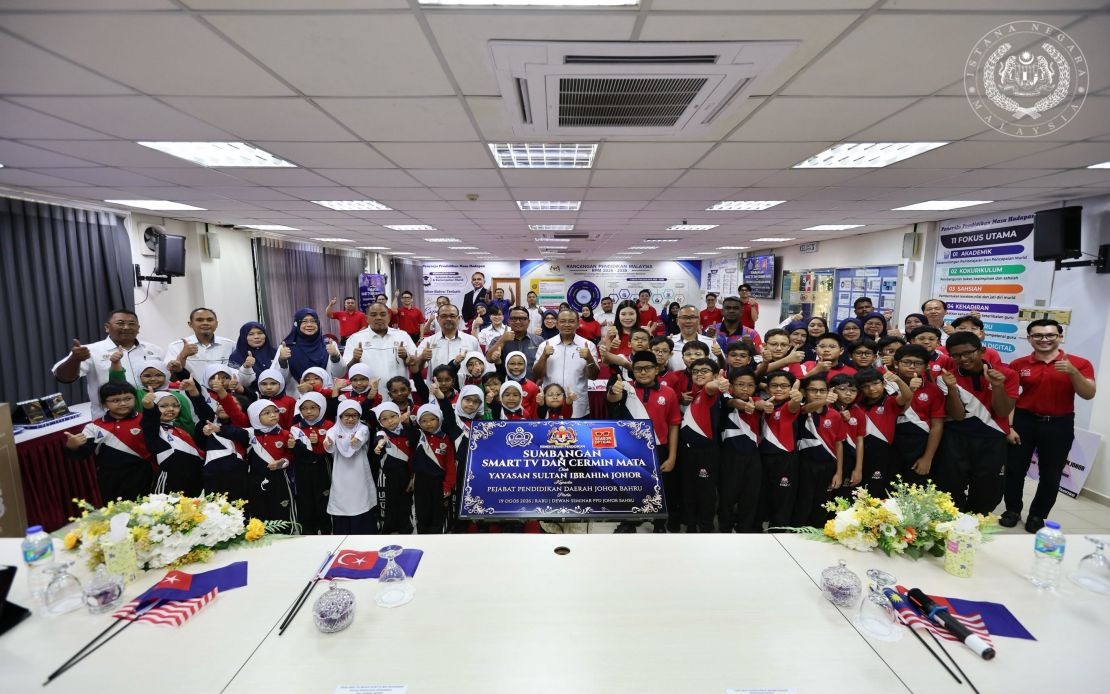
The Yayasan Sultan Ibrahim Johor (YSIJ) has deepened its commitment to educational advancement in the state through a substantial donation of technology and medical aids targeting schools and students under the Johor Bahru District Education Office. The initiative reflects ongoing efforts by the foundation to address both digital infrastructure gaps and the health needs of economically disadvantaged learners, two factors that directly influence academic performance and school attendance.
The donation package comprises 10 large-format smart televisions—each measuring 75 inches—distributed to selected schools to enhance classroom learning through digital content delivery. Alongside these displays, 2,000 pairs of prescription spectacles have been allocated to B40 category students across 20 educational institutions. This two-pronged approach simultaneously tackles technological capacity in schools while removing a significant barrier to learning for low-income families who often cannot afford vision correction.
Central to this initiative's effectiveness is the deployment of Columba Vision Screener technology, an automated eye-scanning device that significantly accelerates the identification of vision problems among students. The device, which was donated by His Majesty Sultan Ibrahim, King of Malaysia, can complete individual vision assessments in approximately 10 seconds. This rapid-screening capability is particularly valuable in school settings where traditional eye examinations would require extensive time and specialist personnel.
The spectacles themselves have been sourced through a strategic collaboration with Season Optical, a commercial partner brought into the programme specifically to ensure quality and durability. Both the frames and lenses meet standards suitable for extended student use, addressing concerns about the longevity of donated items in educational environments. This partnership model demonstrates how private sector involvement can enhance the reach and sustainability of charitable initiatives without compromising on product quality.
Vision impairment among school-age children remains an underrecognized impediment to learning outcomes across Southeast Asia, particularly among families with limited financial resources. Students who cannot see classroom materials clearly often fall behind academically, face social challenges, and experience higher dropout rates. By proactively screening and correcting vision issues, initiatives like this one address a foundational requirement for educational equity that extends beyond traditional curriculum support.
The formal handover took place at a ceremony hosted by the Johor Bahru District Education Office, with YSIJ senior manager Shah Reza Md Kanafe presenting the donations to Johor Education Department Student Development Sector principal assistant director Mohd Khatta Muhamad and Johor Bahru PPD chief officer Adnan Samsudin. The presence of Sally Loh, managing director of Season Optical, underscored the collaborative nature of the programme and the commercial sector's role in supporting educational welfare.
Johor has historically positioned itself as an educational hub within Malaysia, and such donations reinforce that commitment while addressing specific gaps in resource distribution. The introduction of smart televisions to classrooms aligns with Malaysia's broader Digital Transformation initiative, enabling schools to incorporate multimedia resources, online educational content, and interactive learning tools into daily instruction. For schools in less affluent districts, such equipment often represents a substantial capital investment that would otherwise remain unfeasible within tight education budgets.
The combination of vision screening technology and spectacle distribution also reflects a public health dimension to educational policy. Undetected or uncorrected refractive errors—including myopia, hyperopia, and astigmatism—affect learning concentration, class participation, and long-term academic trajectory. Early intervention through school-based screening programmes has demonstrated measurable improvements in academic performance and school engagement in international studies, making this approach evidence-informed rather than merely charitable.
For Malaysian policymakers and educational administrators, such initiatives provide a model for leveraging foundation resources, commercial partnerships, and specialized technology to address compound educational challenges. The programme's scalability is noteworthy; if successful in Johor Bahru, similar models could be adapted across other districts facing comparable infrastructure and student welfare constraints. The Columba Vision Screener technology, in particular, offers efficiency gains that could support large-scale vision screening programmes without the need for extensive specialist clinical resources.
The emphasis on B40 student cohorts ensures that the benefits reach families most vulnerable to educational inequality. Students from lower-income households face compounded disadvantages—including potential nutritional deficiencies, limited home-based learning resources, and reduced access to preventive health care. Addressing the vision barrier specifically removes one preventable obstacle while simultaneously improving the learning environment through technology upgrades that benefit entire school populations.
As Malaysia continues to navigate post-pandemic educational recovery and the integration of digital tools into mainstream pedagogy, contributions from established foundations become increasingly critical. The YSIJ's sustained focus on Johor underscores the importance of regionally embedded charitable entities that maintain consistent engagement with local education systems and understand community-specific needs. Such continuity allows for more targeted, effective interventions than ad hoc donations alone.
Looking forward, the success of this donation programme may inform broader discussions about sustainable funding models for school infrastructure and student health initiatives. Combining public sector educational administration with private sector manufacturing expertise and foundation capital creates a framework that could address multiple development priorities simultaneously. For Southeast Asian economies grappling with education budget constraints, this tripartite model offers practical lessons in resource mobilization and collaborative problem-solving.

