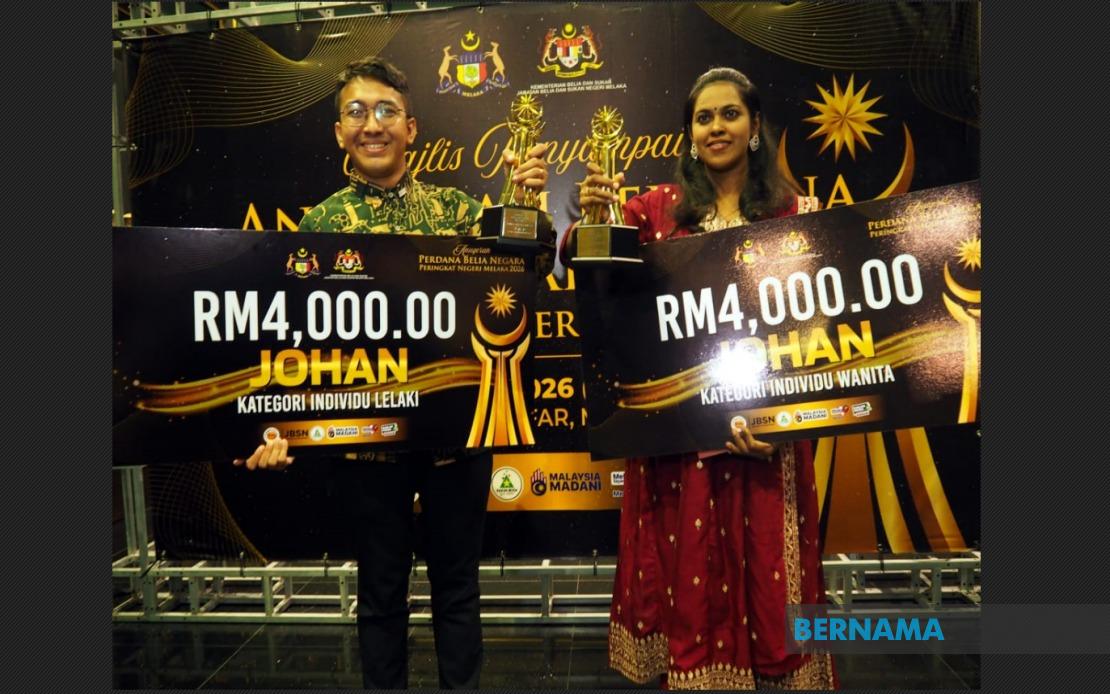
The 2026 Melaka State-level National Youth Awards ceremony, held in Ayer Keroh, celebrated the achievements of two exceptional young leaders whose commitment to developing the next generation has set them apart in their respective fields. Harris Daniel Hermee, a 28-year-old syariah lawyer and graduate of Universiti Sultan Zainal Abidin, clinched the top honour in the male individual category, while primary school educator SS Mayuri, aged 30, emerged as the winner in the female category. Melaka Chief Minister Datuk Seri Ab Rauf Yusoh presided over the ceremony, which underscored the state's commitment to identifying and honouring young professionals who are making tangible differences within their communities.
Hermee's path to recognition reflects a deliberate strategy of continuous improvement and expanding his sphere of influence beyond initial success. Having placed third in the previous year's competition, he used that outcome as motivation rather than disappointment, channelling his energy into participation in larger-scale national and international youth development initiatives. His approach demonstrates the kind of resilience and growth mindset that state and national youth development authorities actively seek to cultivate among Malaysia's emerging leaders. The lawyer attributed his achievement not solely to individual effort but to the broader movement of dedicated young Malaysians whose engagement spans from grassroots community work through to participation in high-level platforms at both domestic and international levels.
Hermee's professional trajectory reveals a deliberate commitment to applying his expertise in Islamic law directly toward youth empowerment. His involvement with Gerakan Belia 4B Hang Tuah Jaya marked a formative period where he helped design and execute programmes centred on youth leadership, sporting development, and voluntary community service. These initiatives were developed in collaboration with established government bodies and community organisations, giving them institutional backing while maintaining flexibility for grassroots implementation. This collaborative model has become increasingly important in Malaysia's youth development landscape, where siloed efforts yield fewer results than coordinated approaches involving multiple stakeholders.
Beyond his work with youth organisations, Hermee serves as Youth State Assembly Member for Pengkalan Batu, a position that provides him with direct access to policy discussions and resource allocation decisions affecting young people in his constituency. This dual role—serving simultaneously as an advocate within formal governance structures and as an active participant in community-based initiatives—positions him to bridge the gap between policy intention and on-ground execution. Such positions have become crucial in Malaysian local governance, where youth representation in assemblies can either amplify or dilute the actual voice of younger citizens depending on the incumbent's commitment and effectiveness.
Mayuri's recognition in the female category highlights the critical role that educators play in youth development beyond the confines of classroom instruction. Her work with the Melaka and Malaysia Tamil Youth Club Council demonstrates how educators can extend their influence into community spaces, particularly among vulnerable student populations preparing for major examinations. The primary school teacher has focused her efforts on providing targeted mentoring and motivational support to students approaching the SPM examination, understanding that academic success for many young Malaysians depends partly on encouragement and belief in their capabilities during crucial developmental periods.
Mayuri's community initiatives extend beyond academic support to encompass broader health and civic awareness campaigns. Her involvement in organising blood donation drives within communities served by the Tamil Youth Club Council illustrates how youth leaders can leverage their platforms to address national health priorities while simultaneously building community cohesion and social responsibility among younger participants. These initiatives are particularly valuable in Malaysia, where voluntary blood donation rates remain below optimal levels despite significant demand from medical institutions. By integrating such drives into youth programme calendars, leaders like Mayuri help normalise civic participation from an early age.
The recognition of both awardees by Melaka Chief Minister Datuk Seri Ab Rauf Yusoh and state Youth, Sports and NGO Committee chairman Datuk VP Shanmugam reflects growing official acknowledgement that youth development cannot be treated as a peripheral concern within state governance. Melaka's decision to establish state-level awards specifically recognising youth leaders sends an important signal about prioritising investment in younger citizens and creating career pathways for those committed to community service. Such mechanisms help counter the perception among many Malaysian youth that conventional career advancement requires distancing oneself from community engagement.
For Malaysian policymakers and community organisers observing these developments, the Melaka awards offer instructive lessons about identifying and nurturing emerging leadership talent. Both Hermee and Mayuri represent the kind of professionals—educated, committed to their communities, and willing to work within existing institutions while challenging them to do better—that Malaysia needs in greater abundance. Their educational backgrounds from local institutions and their decision to remain engaged in their home state rather than migrating to Kuala Lumpur or overseas demonstrates that talented individuals can find meaningful career and social engagement opportunities outside the capital.
The awards also underscore the evolving nature of youth leadership in contemporary Malaysia. Rather than restricting recognition to political party activists or sports champions, these awards acknowledge that youth development happens through diverse pathways: legal advocacy, educational mentoring, voluntary community organising, and formal governance participation. This pluralistic approach to recognising youth leadership helps ensure that various forms of contribution receive validation and encouragement, potentially attracting broader participation across different demographic groups and professional sectors.
Looking forward, the recognition given to Hermee and Mayuri creates useful templates for other Malaysian states seeking to establish or strengthen their own youth awards programmes. The inclusion of both individual and gender-based categories allows for recognition of diverse achievement patterns while the multi-year format—as evidenced by Hermee's progression from third place to first—encourages sustained engagement rather than one-off contributions. As Malaysia continues navigating demographic challenges and societal polarisation, investing in the identification and public celebration of young leaders working constructively within communities becomes increasingly valuable for national cohesion and institutional renewal.

