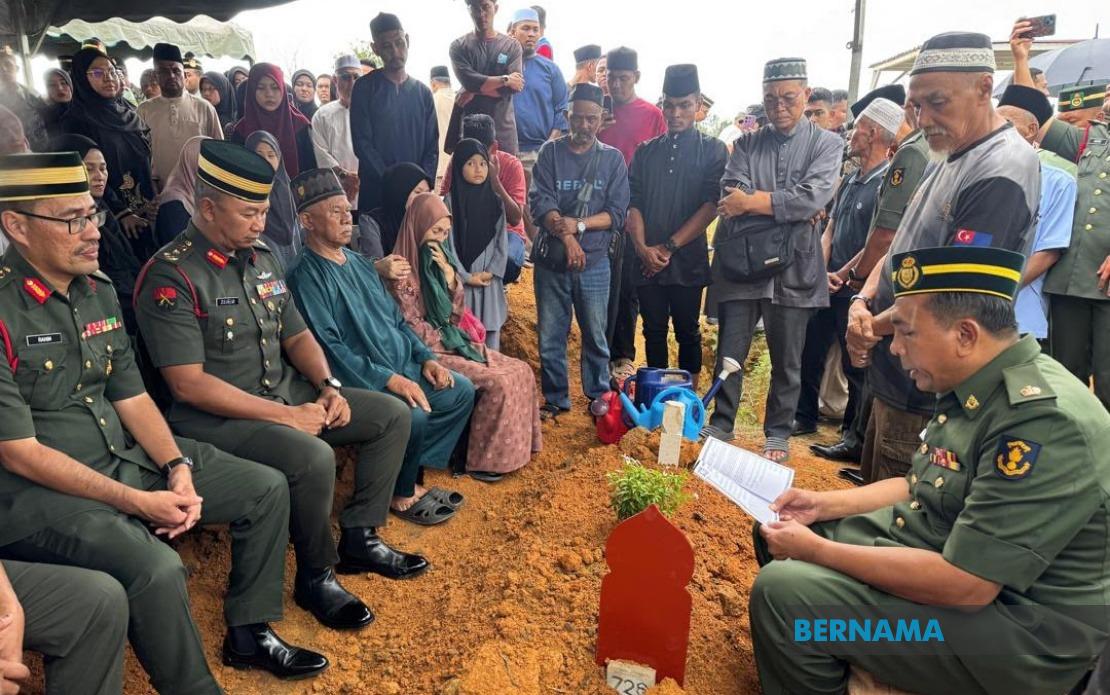
The hopes of a retired soldier to see his youngest daughter uphold the family's military heritage were shattered when Private Siti Khadijah Sungip, 24, was killed during a grenade exercise at Hobart Camp in Gurun, Kedah. The tragic incident, which claimed the life of another serviceman, Corporal Norazmi Abu Bakar, has left the close-knit Sungip family grappling with the sudden loss of a young woman whose dedication to military service had only recently begun to flourish.
Sungip Jais, now 65, had spent much of his career serving with the Royal Artillery Regiment, establishing a professional legacy that his daughter chose to emulate rather than reject. In an emotional recounting to local media at his residence in Taman Sri Lambak, Kluang, he described how Siti Khadijah had harboured military ambitions since childhood, inspired by witnessing her father's commitment to national service. Her decision to join the Malaysian Army represented not merely a career choice but a deliberate continuation of familial bonds forged through shared purpose and patriotic duty.
The path to military service had not been a hasty one. After completing her Diploma in Civil Engineering, specialising in Highways and Transportation, at the Mara Higher Skills College in Sri Gading, Siti Khadijah made the conscious decision to pursue a different trajectory. Rather than immediately capitalising on her engineering credentials, she applied to join the armed forces, a choice that puzzled some but reflected her genuine passion for military life. Her father's testimony reveals a young woman secure in her identity and unswayed by conventional expectations of what a civil engineer with her qualifications ought to pursue.
Beyond her professional aspirations, Siti Khadijah demonstrated a maturity and family-centredness that extended to her personal relationships and domestic responsibilities. She had explicitly told her father that marriage could wait; her priority was ensuring the wellbeing of her aging parents. This commitment transcended mere words, as she maintained close bonds with all seven of her siblings and made deliberate efforts to return home whenever her military duties permitted, demonstrating the balance she sought between personal ambition and familial obligation.
The final communication from Siti Khadijah came at midnight on June 15, when she sent her sister Siti Zaihah a photograph captured during a shooting practice session. The image showed her in her element, engaged in the practical aspects of military training that she clearly found most fulfilling. In that message, she mentioned that additional training lay ahead, including a grenade exercise scheduled to commence around 8 am the following morning. This routine operational communication would become the family's last tangible memory of her alive.
What transpired hours later at approximately 10.57 am on June 16 remains under investigation, but the outcome was catastrophic. Both Siti Khadijah and Corporal Norazmi Abu Bakar sustained injuries so severe that they could not survive the journey to Sultan Abdul Halim Hospital in Sungai Petani. The grenade exercise, intended as a controlled training scenario, evolved into a fatal incident that claimed two lives and devastated their respective families.
Siti Khadijah's brief military career had already been marked by distinction. In January, merely months after commencing her service at the Army Basic Training Centre in Port Dickson, Negeri Sembilan, she received the Best Female Recruit (Academic) Award. This recognition was not merely ceremonial but testament to her intellectual rigour, discipline, and commitment to mastering the theoretical foundations of military service. She had demonstrated that a career in the armed forces was not incompatible with academic excellence, a message that resonated particularly for women seeking to join Malaysia's defence establishment.
Following her basic training, Siti Khadijah was posted to the Royal Army Engineers Regiment, a significant posting that recognised her potential and suggested a promising career trajectory within the institution. Her superiors evidently saw qualities in her that warranted placement in a specialised unit, yet her journey in that posting would be curtailed before it had truly begun. Born on September 19, 2002, in Kluang, she would not live to see her twenty-fifth birthday.
The impact of her death extends beyond the immediate grieving family. Her sister Siti Zaihah recalled that when Siti Khadijah returned home for the recent Aidiladha holidays, merely a week before the tragedy, she displayed no visible distress or premonition of danger. She appeared her customary cheerful self, giving no indication that her military service carried the kind of inherent risks that would culminate in her death. For military families across Malaysia, this tragedy underscores the real hazards embedded within even routine training exercises, raising questions about safety protocols and the measures in place to protect personnel during operations.
The incident also highlights a broader reality for women in the Malaysian Armed Forces. As barriers to female military service have progressively diminished, more young Malaysian women have chosen to follow career paths once predominantly closed to them. Siti Khadijah's decision to join the army, supported by her father's example and her own conviction, represented a small but significant shift in how Malaysian families view military service across gender lines. Yet this tragedy serves as a sobering reminder that gender equality in professional opportunities does not eliminate the attendant risks of military work.
Sungip Jais now faces a reality dramatically different from what he had envisioned when his youngest daughter donned her uniform. The family legacy he hoped would continue through her service has instead been marked by loss. Yet those who knew Siti Khadijah appear determined to remember her not as a victim of circumstance but as a dedicated soldier who pursued her calling with enthusiasm and academic distinction, embodying the values of service and commitment that her father had spent decades cultivating.
The burial of Siti Khadijah at Taman Sri Lambak Islamic Cemetery brought a tragic chapter to a close, yet the questions surrounding the grenade exercise incident remain open. For the Malaysian Army and the defence establishment more broadly, the incident demands a thorough examination of training protocols to prevent similar tragedies. For the Sungip family and the relatives of Corporal Norazmi Abu Bakar, June 16 will remain a date that divides their lives into before and after, a permanent reminder of the price sometimes exacted by service to nation.