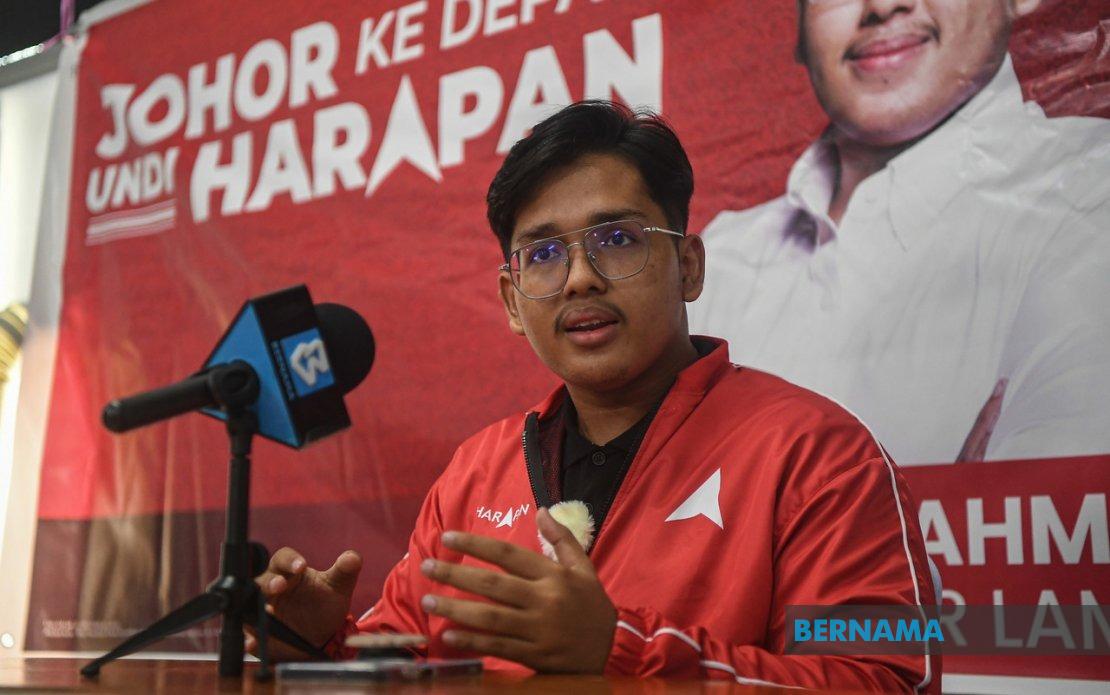
Danish Hossman Abd Rahman, at 23 the youngest participant in the 16th Johor state election, is riding a wave of grassroots enthusiasm as he campaigns for the Johor Lama seat under the Pakatan Harapan banner. The UTHM Information Technology student has characterised the warmth of his reception among constituents as an energising force that validates his decision to enter this competitive three-way contest, where he faces incumbent Norlizah Noh of Barisan Nasional and Aisah Esa representing Perikatan Nasional.
Hostman's extended presence in the field has allowed him to develop genuine insight into the concerns affecting various demographic groups within Johor Lama, from working families to retirees. This ground-level engagement appears to have resonated particularly with an older electorate that, by his account, views his youthful commitment as a refreshing alternative to incumbents perceived as disconnected from community needs. The veteran population, according to Hossman, appreciates encountering a candidate willing to undertake repeated door-to-door outreach rather than relying on institutional machinery alone.
His electoral pitch centres on bridging generational perspectives rather than replacing accumulated wisdom with youth alone. Hossman frames himself as an intermediary figure capable of synthesising the institutional knowledge of established political figures with the aspirational energy of younger voters dissatisfied with conventional governance approaches. This positioning reflects a broader dynamic across Malaysian politics, where youthful candidates increasingly seek to challenge the dominance of long-serving office holders by emphasising accessibility and responsiveness.
The candidate has prioritised engagement with diverse constituencies during the campaign's final week, scheduling extensive ground meetings across urban centres, rural villages, and Felda settlements. This tactical focus on high-contact campaigning suggests recognition that his primary advantage lies in direct voter interaction rather than media dominance or factional endorsement. His emphasis on meeting constituents repeatedly, rather than single token appearances, underscores an attempt to build familiarity and trust through sustained presence.
Hostman identifies affordable housing scarcity and employment shortages as the constituency's most pressing challenges. These interconnected issues have driven youth migration from Johor Lama as younger residents seek economic opportunities elsewhere, draining the area of human capital and entrepreneurial energy. His proposed solutions pivot on attracting industrial investment aligned with local comparative advantages, particularly in agriculture-related downstream processing and livestock development that could generate employment while capitalising on existing land use patterns.
Economic development forms the substantive core of his campaign messaging. Rather than appealing primarily to partisan allegiance or identity politics, Hossman emphasises capacity-building initiatives designed to retain young professionals within the constituency. His stated objective is enabling Johor Lama's youth to establish careers, families, and futures locally rather than seeking advancement in larger urban centres. This framing addresses a genuine concern in many Malaysian regions where demographic decline and brain drain undermine long-term prosperity and political influence.
Hostman's campaigning philosophy explicitly rejects what he characterises as personalised attacks and divisive rhetoric, calling instead for evaluation based on demonstrated capability. This messaging appeals to voter fatigue with acrimonious political discourse while positioning his campaign as substantive-focused. Whether this rhetorical stance translates into actual electoral advantage remains uncertain, particularly given the established organisations and networks mobilised by his Barisan Nasional and Perikatan Nasional opponents.
The Johor Lama contest exemplifies broader patterns in the 16th state election, where 172 candidates compete across 56 seats in a landscape marked by three-way fights in numerous constituencies. This fragmented competitive environment creates unpredictability, potentially benefiting challengers like Hossman who can mobilise committed grassroots support. The absence of a clear two-candidate dynamic reduces the tactical advantage of established machinery while potentially rewarding intensive ground engagement.
Polling is scheduled for this Saturday, with early voting commencing the preceding day. For a constituency like Johor Lama, where economic anxieties and generational frustrations appear acute, Hossman's campaign offers an outlet for voters dissatisfied with both the incumbent administration and established opposition alternatives. His youth, while potentially disadvantageous in some contexts, appears to function as a proxy for change in an electorate experiencing demographic and economic stress.
The extent to which Hossman's campaign momentum translates into electoral success will depend partly on turnout dynamics and partly on whether voters prioritise the symbolism of generational change over institutional experience. His opponents can be expected to emphasise their track records and organisational depth, potentially countering the freshness narrative that constitutes his primary asset. Nevertheless, his intensive engagement strategy and economic focus address genuine constituency concerns that resonate beyond personality-driven politics.

