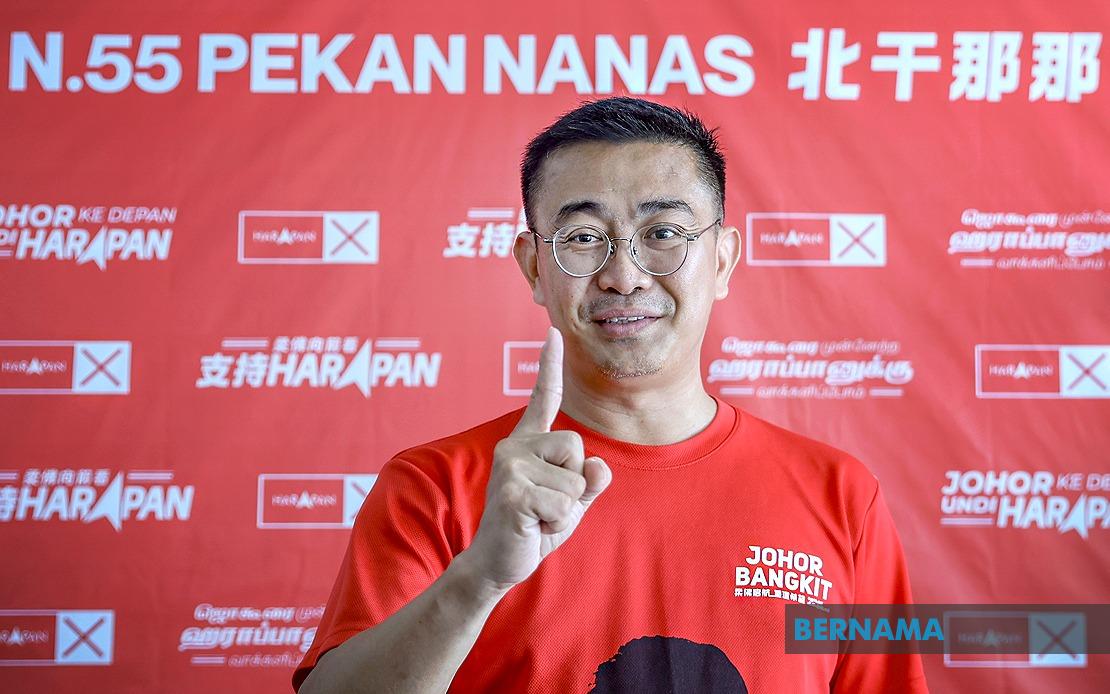
Yeo Tung Siong, the Pakatan Harapan nominee contesting the Pekan Nanas state constituency in the ongoing Johor election, believes his decade as a sitting representative gives him the strongest foundation to recover a seat he held until 2022. The former assemblyman, who served the constituency through two consecutive terms beginning in 2013, has built his campaign strategy on the tangible outcomes he delivered during his tenure and the relationships he has cultivated with thousands of constituents.
During extensive campaigning across the Pontian-based constituency, Yeo has connected with approximately 60 per cent of voters through a diversified engagement approach. His ground-level outreach encompasses informal walkabout sessions, organised talks and group meetings, direct house-to-house canvassing, and informal visits to public gathering spots including markets and food establishments. The breadth of this grassroots strategy reflects a deliberate effort to move beyond conventional political messaging and establish one-on-one contact with the electorate.
Yeo's pitch emphasises accessibility and responsiveness to constituent needs, hallmarks he claims distinguished his earlier tenure. Rather than emphasising protocol or formal distance, the former vice-principal and discipline teacher positions himself as approachable and action-oriented, promising that anyone seeking assistance can reach him directly for personal intervention. This approach contrasts sharply with more hierarchical models of representation and appeals to voters valuing personalised service from their elected officials.
His concrete achievements during his two terms provide measurable evidence for this campaign narrative. Among his credited accomplishments is securing RM500,000 in government allocation specifically directed toward rectifying the Pulai River's course to mitigate chronic flooding problems that have long plagued the area. Additionally, he collaborated with private sector partners to implement drainage infrastructure improvements in Kampung Melayu Raya, addressing another persistent local grievance.
Conversations with residents throughout the campaign have illuminated the constituency's prevailing concerns, with traffic congestion and employment scarcity emerging as dominant themes. These issues reflect broader challenges facing Johor's transport networks and economic opportunities, particularly for younger residents seeking viable career pathways. Yeo's response to these priorities shapes his platform for potential re-election.
Addressing traffic challenges, Yeo has prioritised two infrastructure projects designed to alleviate congestion between Pontian and Johor Bahru. The first involves establishing a shortcut connecting Ulu Pulai to Pekan Nanas, whilst the second targets a junction linking Pulai to Sri Bunian. Both projects aim to substantially reduce travel times for residents commuting between these population centres, addressing a quality-of-life concern affecting daily routines and economic productivity.
On employment generation, Yeo proposes reviving the career carnival initiative he previously organised whilst in office, partnering with multinational corporations and major enterprises operating within and around Pekan Nanas. Such events function as intermediaries between job seekers and employers, directly expanding employment pathways for constituents whilst stimulating local business activity. This mechanism demonstrates how local representatives can leverage existing networks to address economic hardship without requiring substantial government expenditure.
Beyond infrastructure and employment, Yeo has pledged to strengthen constituent access to social safety nets administered through government institutions including the Social Welfare Department and the Social Security Organisation (SOCSO). These commitments reflect recognition that unemployment and economic stress require complementary support mechanisms ensuring vulnerable populations receive appropriate assistance during difficult periods.
The Pekan Nanas contest represents a direct rematch of political visions between Yeo and the current assemblyman Tan Eng Meng, who carries the Barisan Nasional banner. This polarised competition presents voters with a clear choice between the incumbent's continued stewardship and a return to previous leadership, with campaign dynamics ultimately turning on whether continuity or restoration of past administration appeals more powerfully to the electorate.
Yeo's campaign strategy reflects broader patterns within Malaysian electoral politics, where local representatives emphasise personal accessibility, specific constituency achievements, and concrete policy proposals over abstract ideological messaging. His confidence, grounded in positive constituent feedback and tangible past performance, suggests substantial support among sections of the voting population, though electoral outcomes remain inherently uncertain regardless of campaign intensity or candidate experience.
The Pekan Nanas contest sits within the broader context of Johor's state election, a jurisdiction containing multiple constituencies with distinct local priorities yet interconnected through statewide governance. Results across these diverse communities will collectively determine which coalition controls state apparatus and resource allocation over coming years, making individual races like Pekan Nanas consequential for regional political direction.

