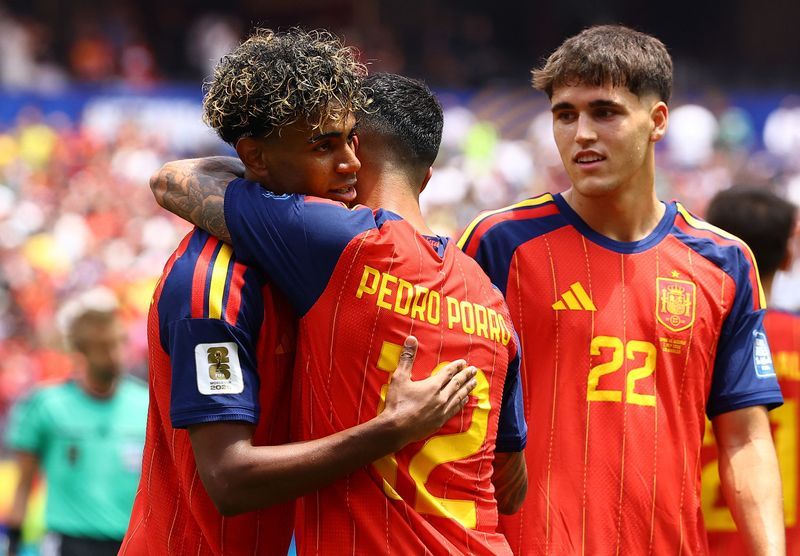
Spain's seemingly inevitable stumble into the World Cup—a goalless draw against Cape Verde that left doubters wondering whether their continental dominance was fading—has given way to something altogether different: a team rediscovering its identity through the precocious influence of an 18-year-old winger. Lamine Yamal's growing involvement in Spain's campaign, culminating in a commanding 3-0 victory over Austria, represents far more than a single match triumph. It marks the moment when Spanish football's devotion to collective harmony found an unlikely complement in youthful individual flair, a tension that is beginning to generate something rather more formidable than either could produce alone.
Yamal arrived in North America carrying the burden of a troublesome hamstring injury that forced Luis de la Fuente to deploy him cautiously from the bench during Spain's opening fixture. That choice, reasonable as it seemed at the time, coincided with a performance that stripped bare the dangers of over-reliance on template football without the incisive personnel to execute it. Against Cape Verde, with Gavi and Ferran Torres deployed across the flanks, Spain's midfield mastery felt bloodless. They controlled possession with the customary Spanish precision, yet lacked the cutting edge that transforms territorial supremacy into goals and tournament advancement. The absence of attacking urgency raised legitimate questions about whether the European champions could generate sufficient menace against more formidable opponents.
The narrative shifted measurably once Yamal accumulated meaningful minutes and the Barcelona prodigy began operating at something approaching his full capacity. Spain's performances in subsequent matches took on a different character—sharper, more penetrative, infused with the pace and directness that had defined their excellent run through the European Championship in Germany. What makes this development analytically interesting is that Spain's improvement cannot be attributed solely to one player's presence. Rather, Yamal's fitness and confidence created a cascade effect throughout the team's shape and tactical function. The introduction of Alex Baena on the left flank, working in tandem with an increasingly sharp Yamal on the right, constructed multiple attacking avenues that Austria simply could not efficiently manage.
Against the Austrians, Spain's approach revealed a sophisticated understanding of how to weaponise Yamal's individual qualities within a structured framework. Repeatedly, the Spanish midfield executed long, precise switches that isolated the teenager on the right wing, inviting him into one-on-one confrontations with defenders who, no matter how prepared they seemed, consistently found themselves out-positioned and outpaced. Yamal's movement, his willingness to receive the ball in tight spaces and immediately create separation through explosive acceleration, drew opposition defenders toward him like magnetised objects. This gravitational pull benefited Spain's overall shape because it compressed Austria's defensive structure and opened passing lanes for Rodri and Pedri, the orchestrating midfielders who could exploit the space Yamal's presence generated. Yet what distinguished Spain's display was their capacity to adapt when direct wing play became crowded. When Yamal drifted infield, the narrow spaces tightened further, allowing Spain's midfield to recover its traditional rhythm and tempo, the measured circulation of possession that remains their foundational principle.
The most revealing statistic from Spain's victory underscored a fundamental tactical reality: Yamal was named player of the match despite neither scoring nor registering an assist. In an era when attacking accolades typically flow toward players accumulating goals and primary assists, this recognition reflected Spain's matured understanding of how championship football actually functions. Rather than depending on a young individual to guarantee attacking returns through direct involvement in the scoresheet, Spain won comfortably through Yamal's capacity to unsettle Austria's defensive architecture, to stretch the pitch horizontally, and to create the structural conditions enabling teammates to flourish. This approach proved devastatingly effective: Austria failed to record a single shot on target across the entire match, a defensive suffocation not achieved by any team in World Cup knockout football since Germany's 2014 final victory over Argentina.
The defensive resilience Spain demonstrated extends beyond a single match. The team has maintained an extraordinary record of not conceding World Cup goals dating back to their 2022 defeat by Japan, during which they have compiled an unbeaten run spanning 34 matches. This consistency, when combined with their newly restored attacking potency, constructs the profile of a tournament favourite beginning to deliver on its fundamental promise. Spain's early vulnerability, their goalless opener against Cape Verde, now appears less a harbinger of decline than a temporary misalignment—a team waiting for key personnel to reach full readiness while their squad depth and tactical intelligence held the structural integrity intact.
Full-back performances merit particular attention in understanding Spain's resurgence. Marc Cucurella and Pedro Porro delivered commanding displays, their positioning and distribution providing the defensive stability that allowed Yamal and Baena to operate with genuine attacking freedom. Rodri's contribution intensified noticeably after halftime, his range and tempo-setting becoming increasingly influential as the midfield gained control. Mikel Oyarzabal, deployed as a substitute, made decisive contributions that reinforced the bench strength supporting De la Fuente's selections. This depth and collective competence, layered across multiple positions, remains Spain's enduring foundation.
For Malaysian and Southeast Asian observers, Spain's trajectory carries broader implications for how elite football teams construct championship campaigns. The balance Spain is striking—between preserving collective principles that have defined Spanish football for two decades whilst integrating generational talent capable of decisive individual brilliance—offers an instructive model. Young players entering elite competition often struggle to function within rigid positional frameworks, yet Yamal's seamless integration suggests that thoughtful coaching, patience during recovery periods, and tactical flexibility create environments where youthful exuberance strengthens rather than threatens team coherence.
The 3-0 scoreline against Austria barely captures the substantive shift in Spain's competitive trajectory. More importantly, this performance represented Spain finally assembling the personnel and collective rhythm to validate their status as European champions. With Yamal fit, his confidence growing with each involvement, and his teammates increasingly attuned to maximising the opportunities his presence creates, Spain appear genuinely dangerous. The early vulnerability that characterised their World Cup beginning has given way to something altogether more ominous for future opponents—a championship team rediscovering its menace.

