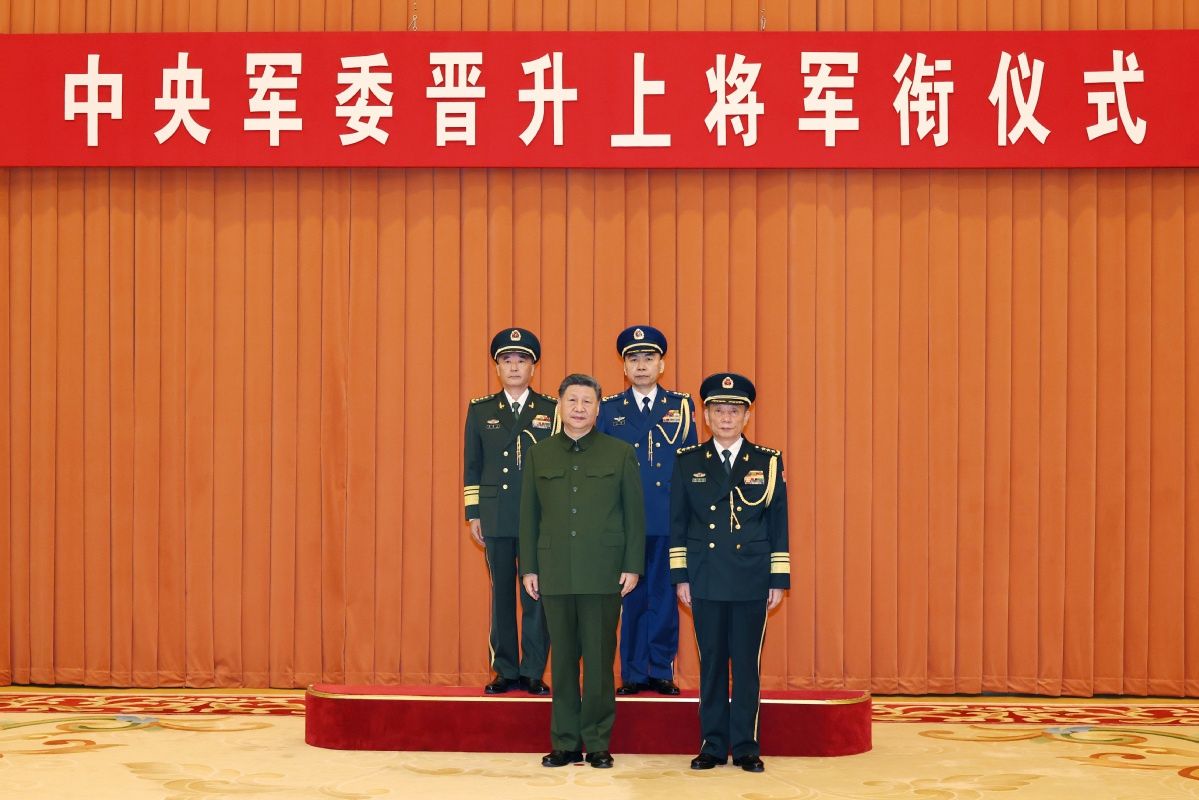
President Xi Jinping has appointed Zhang Shuguang as the new secretary of the Central Military Commission's discipline inspection commission, signalling an intensification of the corruption crackdown that has fundamentally reshaped China's military leadership over the past year. The appointment, announced through state-run Xinhua News Agency at a ceremony in Beijing on Friday (July 3), represents a major reorganisation of the anti-graft apparatus within the People's Liberation Army as Xi continues to consolidate control over the armed forces ahead of a critical decade for Chinese defence policy.
The changes extend beyond anti-corruption oversight. Wang Gang has been elevated to commander of the People's Liberation Army Air Force, replacing Chang Dingqiu whose next assignment remains unconfirmed. Both Zhang Shuguang and Wang Gang were promoted to the rank of general, China's highest active service rank for military officers. Meanwhile, Zhang Shengmin, the previous head of military anti-corruption efforts, has been repositioned as vice chairman of the Central Military Commission, a lateral move that maintains his seniority while removing him from the frontline of corruption investigations.
The cascade of leadership changes points to a military establishment in flux. Since Xi initiated his sweeping corruption campaign in mid-2023, the armed forces have experienced an unprecedented level of upheaval that rivals, and in some analysts' assessments exceeds, the scale of military purges following the Cultural Revolution. The timing of this campaign—unfolding immediately after Xi secured an unprecedented third term as China's paramount leader—suggests these moves serve dual purposes: eliminating potential rivals whilst simultaneously rooting out genuine institutional corruption that had accumulated during the tenure of his predecessors.
The scale of the purge has been remarkable by any standard. Xi has already removed two vice chairmen of the Central Military Commission, three additional CMC members, a former defence minister, and at least a dozen senior military commanders overseeing major regional commands. These are not minor bureaucratic adjustments; they represent the removal of officers who occupied some of the most strategically sensitive positions within China's defence establishment. Such wholesale turnover would be disruptive under any circumstances, yet Xi has managed to execute these changes whilst maintaining apparent organisational stability and military readiness.
The most dramatic moment in this purge occurred earlier this year when Xi launched an investigation into Zhang Youxia, his long-time ally and one of China's top military officials. The move shocked observers who expected Zhang to remain a trusted confidant, suggesting that no relationship—no matter how long-standing or personally close—offers immunity from Xi's consolidation efforts. Zhang's fall from grace demonstrated that the anti-corruption campaign transcends simple factional politics; it reflects Xi's determination to remake the military hierarchy according to his vision of meritocratic governance and personal loyalty.
Last week, Beijing escalated its actions further by stripping six military lawmakers of their seats in the National People's Congress. This move represents an unusually public act of disgrace for Chinese officials, signalling that the purge extends beyond senior uniformed officers into the political representation structures linked to the military establishment. By removing these parliamentarians, Xi sends an unmistakable message that military connections provide no shelter from accountability and that institutional positions can be revoked swiftly when political winds shift.
For Malaysia and Southeast Asia, these internal Chinese military developments carry significant implications. A Chinese military leadership in transition raises questions about continuity in regional security policy and the trajectory of disputes in the South China Sea. Officers newly appointed to their positions may seek to establish credentials through assertiveness, whilst those feeling politically vulnerable might take calculated risks to demonstrate loyalty to Xi. The consolidation of anti-corruption authority in fresh hands, moreover, could signal shifts in military procurement patterns and defence spending priorities that ripple throughout regional supply chains and military-to-military relationships.
The appointment of Zhang Shuguang specifically merits attention because anti-corruption commissioners effectively become Xi's eyes and ears within the military structure. As secretary of the discipline inspection commission, Zhang will investigate high-ranking officers, determine which cases warrant political action, and influence which military factions gain or lose influence. This position carries disproportionate power relative to its formal rank, making Zhang one of Xi's most important lieutenants despite the technical nature of his role.
The broader pattern emerging from these changes suggests Xi is creating a military leadership cohort composed primarily of officers proven loyal to him personally, rather than a meritocratic military hierarchy drawn from established command structures. This approach consolidates Xi's personal authority but potentially sacrifices institutional experience and creates dependencies on his continued health and political fortune. Military officers appointed primarily for loyalty rather than expertise can present governance risks, particularly during crises when technical competence matters most.
China's military modernisation agenda, which remains central to Beijing's strategic ambitions in Asia, must proceed despite this leadership turmoil. The new appointments will inherit responsibility for managing defence innovation, personnel development, and operational capabilities whilst simultaneously navigating the political minefields of a purge environment. How effectively Zhang and Wang navigate these competing demands will shape not only China's internal military development but also the character of Chinese military behaviour in regional waters and borders during the remainder of Xi's tenure.
The appointment of Zhang Shuguang thus represents far more than a routine leadership rotation. It encapsulates Xi's approach to power consolidation—decisive, comprehensive, and relentless in eliminating potential challengers whilst simultaneously addressing genuine institutional problems. Whether this formula ultimately strengthens Chinese military capacity or undermines it through politicisation will take years to assess fully, but the regional implications merit close monitoring from Southeast Asian governments seeking to understand Beijing's trajectory.

