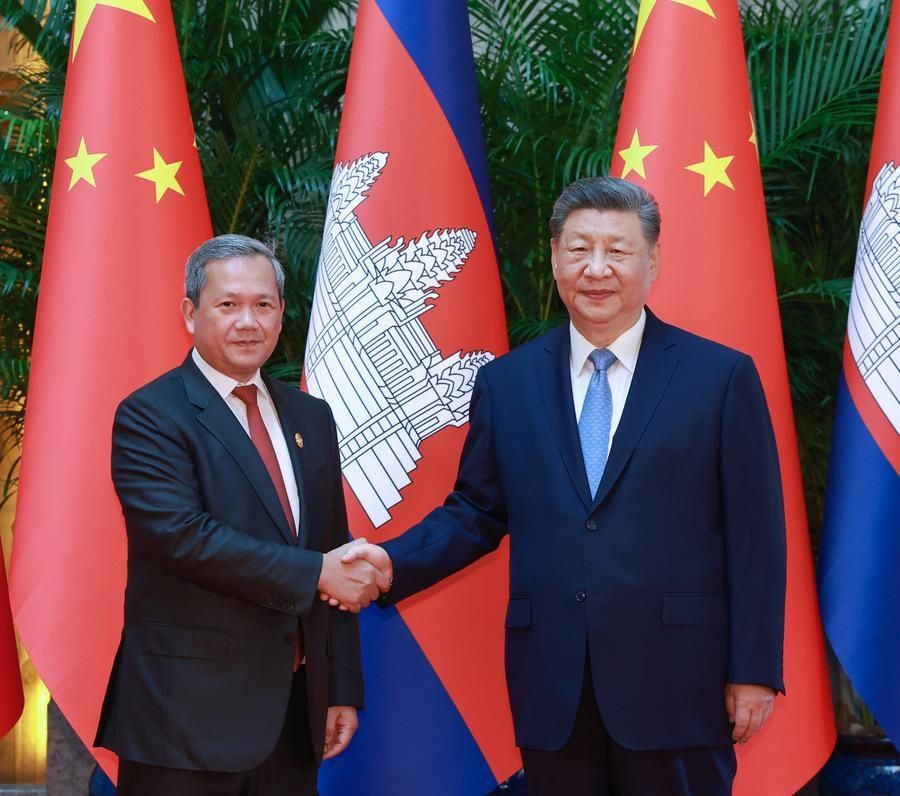
Chinese President Xi Jinping has called for Cambodia and China to preserve and strengthen the robust friendship that successive generations of leaders from both nations have cultivated, during a high-level meeting in Shanghai on Friday. The remarks underscored Beijing's commitment to maintaining Cambodia as a cornerstone ally in Southeast Asia, particularly as regional dynamics shift and new powers vie for influence across the region. Xi's emphasis on the enduring bond between the two countries reflects the strategic importance China places on its relationship with Cambodia, which has consistently supported Beijing's regional interests.
Cambodian Prime Minister Hun Manet is in Shanghai attending the 2026 World Artificial Intelligence Conference and High-Level Meeting on Global AI Governance, combining his participation in the tech summit with an official working visit to China. The timing of his presence in the Chinese city provided the opportunity for substantive bilateral discussions on multiple fronts, from economic cooperation to regional security concerns. Hun Manet's attendance at the AI governance conference also signals Cambodia's interest in positioning itself within the evolving landscape of technology development and digital innovation across Asia.
During their meeting, Xi proposed elevating the relationship through what Beijing terms the "Diamond Hexagon" cooperation framework, a multi-dimensional partnership model designed to address shared challenges and opportunities. The framework represents a more structured approach to bilateral relations than in previous years, encompassing political dialogue, economic integration, and security cooperation. By formalising cooperation under this umbrella, both nations aim to insulate their partnership from external pressures and demonstrate commitment to a sustained, comprehensive engagement.
The two leaders discussed ambitious infrastructure and economic initiatives that could reshape the region's development trajectory. Xi highlighted the Industrial Development Corridor and the Fish and Rice Corridor as priority projects that would deepen economic interdependence and foster prosperity for both nations. These corridors are particularly significant for Cambodia, as they promise to unlock new markets for Cambodian agricultural products while attracting Chinese investment into manufacturing and food processing sectors. The initiatives also position Cambodia as a crucial node in China's broader Belt and Road expansion across Southeast Asia.
Beyond traditional sectors, Xi emphasised the importance of emerging industries, particularly artificial intelligence and the digital economy, areas where China possesses significant technological advantages. By introducing these modern sectors into the bilateral partnership, China seeks to upgrade Cambodia's economic base while creating opportunities for Chinese technology companies to establish themselves in Cambodian markets. This approach reflects Beijing's broader strategy of leveraging technological prowess to deepen economic ties across the region and create dependencies that extend beyond raw materials and manufacturing.
The two sides also addressed the pressing issue of cross-border criminal networks that plague the region. Xi stressed the need for coordinated action against counterfeiting operations, smuggling rings, online gambling syndicates, and telecom fraud schemes that originate from or transit through both nations. These criminal enterprises have become increasingly sophisticated and have drawn international attention, with several countries accusing Cambodia of harbouring operators engaged in telecom scams targeting people across Asia. Joint law enforcement initiatives represent a mutual benefit, as both nations suffer economic losses and reputational damage from these activities.
A particularly sensitive issue in the bilateral relationship involves the border dispute between Cambodia and Thailand, which has periodically flared into military tensions. Xi indicated that China views the maintenance of a ceasefire and gradual confidence-building measures between Cambodia and Thailand as essential to regional stability and the long-term interests of all parties involved. Rather than taking sides, China positioned itself as a constructive mediator willing to support dialogue-based solutions. This diplomatic posture allows Beijing to maintain influence with both countries while appearing as a neutral arbiter of regional peace.
Hun Manet, who assumed the premiership following Hun Sen's decades-long leadership, used the platform to reaffirm Cambodia's unwavering commitment to the Chinese partnership regardless of international fluctuations. His explicit assurance that Cambodia's alignment with China remains unshakeable provides Beijing with confidence that its regional strategy remains on track. The new prime minister's early prioritisation of the China relationship signals continuity in Cambodia's foreign policy orientation, despite generational shifts in leadership.
The Cambodian premier also reiterated his nation's firm adherence to the one-China policy, a position that carries diplomatic weight given ongoing tensions over Taiwan. By explicitly reaffirming this stance, Hun Manet reinforces Cambodia's credentials as a reliable ally from Beijing's perspective and distinguishes Cambodia from regional neighbours that have attempted to balance relationships between China and the West. This commitment holds particular significance in the context of intensifying great power competition in Southeast Asia, where countries are under pressure to choose sides on contentious issues.
Hun Manet pledged to expand bilateral trade volumes and accelerate cooperation on major infrastructure projects that would further bind the two economies together. These commitments suggest that Cambodia views deepening economic integration with China as the pathway to sustained development, a calculation that shapes its broader geopolitical alignment. The emphasis on infrastructure collaboration reflects the reality that Chinese investment and expertise remain essential to Cambodia's modernisation ambitions, from highways to ports to telecommunications networks.
The commitment to intensified efforts against telecom fraud represents perhaps the most concrete outcome of the bilateral talks, as both nations face mounting pressure from international partners to dismantle criminal networks. Cambodia, in particular, has faced criticism from the United States and other Western nations for allegedly providing safe havens for scam operations. Joint action with China could demonstrate Cambodia's seriousness about combating these crimes, though implementation challenges and corruption concerns may limit effectiveness.
The meeting underscores the depth of China-Cambodia ties at a moment when regional realignment remains fluid. Unlike some Southeast Asian neighbours that have sought to diversify partnerships and reduce dependence on China, Cambodia has doubled down on its commitment to Beijing. For China, this reliability is invaluable as it navigates strategic competition with the United States and seeks to maintain influence across Southeast Asia. For Cambodia, the partnership offers economic opportunities and security assurances that alternatives cannot currently match, though the long-term costs of such concentrated alignment remain subjects of regional debate.

