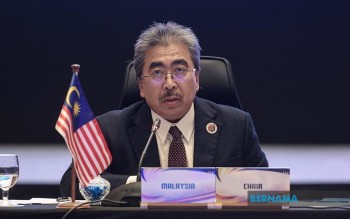
The World Trade Organization faces an existential challenge that demands urgent structural reform, according to Malaysia's Investment, Trade and Industry Minister Datuk Seri Johari Abdul Ghani. Speaking at the 39th Asia-Pacific Roundtable in Kuala Lumpur, Johari argued that the 30-year-old institution must radically rethink its operating principles to stay relevant as the global economic landscape undergoes seismic shifts driven by geopolitical tensions, technological rivalries, and supply chain vulnerabilities.
The WTO was conceived in an earlier epoch when international policymakers shared broad consensus that lowering trade barriers and expanding market access would automatically generate prosperity and strengthen stability across borders. That foundational logic underpinned two decades of progressive liberalisation and integration. Yet the environment in which trade ministers and corporate strategists now operate bears little resemblance to the 1990s. Johari observed that today's economic decision-making reflects an entirely different set of priorities and anxieties, ones that the multilateral institution has yet to adequately acknowledge or accommodate within its framework.
At the heart of this shift lies a reorientation of national economic strategy. Rather than debating how far markets should be opened, governments increasingly focus on which capabilities are strategically vital and must be shielded from external dependence or disruption. Resilience—the ability to withstand shocks—has displaced growth as the paramount concern for many policymakers. Technological leadership and the capacity to innovate in critical sectors like semiconductors, artificial intelligence and clean energy have become matters of national security. Supply chain security, particularly regarding raw materials and advanced manufacturing, ranks alongside defence spending in strategic planning. These considerations fundamentally alter the calculus of trade policy and create tensions with the WTO's traditional emphasis on non-discrimination and open access.
The minister highlighted a paradox at the heart of contemporary multilateralism. At precisely the moment when geopolitical competition is intensifying and economic nationalism gaining momentum, the demand for credible, binding international rules has arguably never been more pressing. Without robust mechanisms to mediate disputes and constrain escalatory behaviour, trade tensions could easily metastasize into broader geopolitical conflict. The WTO's core function—providing a forum where countries can resolve differences and negotiate compromises—remains indispensable. Yet the institution's current structures and negotiating frameworks appear increasingly inadequate to address the types of conflicts that now dominate: state subsidies for strategic industries, data governance restrictions, technology export controls, and forced technology transfer allegations.
Johari's remarks reflect broader Southeast Asian anxieties about the rules-based trading system. For mid-sized economies like Malaysia, which depend heavily on foreign trade and investment, the erosion of multilateral discipline creates profound uncertainty. Larger powers can rely on bilateral negotiations and regional blocs to advance their interests. Smaller nations require functioning international institutions that constrain the exercise of raw power and protect smaller players from arbitrary treatment. If the WTO continues to decline in relevance and authority, countries in the region risk being squeezed between competing blocs and subjected to the whims of larger trading partners.
The call for WTO reform is not new, but Johari's articulation carries particular weight given Malaysia's position as an active trader deeply embedded in global value chains. Unlike countries that can achieve autarky or regional self-sufficiency, Malaysia's prosperity depends on access to multiple markets and fair treatment across borders. The electronics and semiconductors industry alone illustrates the vulnerability: if key trading partners restrict component flows or discriminate against Malaysian suppliers, entire production networks face disruption. Multilateral rules provide insurance against such scenarios.
Yet reform of the WTO faces formidable obstacles. The institution operates by consensus, meaning any member can block changes. Both developed and developing nations have reasons to resist overhaul: some fear that modernising the rulebook will constrain their preferred policy instruments, while others suspect that reforms will entrench the dominance of already-powerful economies. China views certain WTO modernisation proposals as targeting its development model. The United States has blocked appointments to the dispute resolution body for years. This institutional gridlock means that even when consensus exists about problems, converting that agreement into concrete reforms proves extraordinarily difficult.
The practical implications for Malaysia and the broader region are substantial. Over the coming decade, divergent regulatory standards, technology restrictions, and strategic trade barriers are likely to proliferate regardless of WTO reform. Companies operating in Southeast Asia will face increasing fragmentation of global markets, rising compliance costs, and unpredictable policy changes. Supply chain diversification—a strategy many regional manufacturers are already pursuing—will accelerate, potentially benefiting countries that can position themselves as reliable alternatives to the United States or China. However, without stronger multilateral rules, competition for investment and market access could turn destructive, damaging efficiency and raising costs for consumers.
Johari's position also signals Malaysia's commitment to defending the multilateral system despite its imperfections. Rather than abandoning the WTO or retreating into regionalism, Malaysian leadership argues for pragmatic evolution. This stance reflects both principle and self-interest: as a nation with limited leverage in bilateral negotiations, Malaysia benefits from a functioning rules-based order. The alternative—a world of shifting blocs, economic coercion, and discriminatory practices—poses far greater risks for smaller trading nations.
The challenge before the WTO, then, is to modernise its dispute resolution mechanisms, develop tools to address state-directed industrial policy, and create frameworks that acknowledge legitimate national security concerns while preventing them from becoming pretexts for protectionism. Whether the institution can execute such reforms while maintaining consensus remains deeply uncertain. Johari's intervention suggests that at minimum, major trading nations must begin serious conversations about what multilateralism looks like in an era of great power competition, and how institutions designed for a more integrated world can still serve the cause of peace and prosperity.

