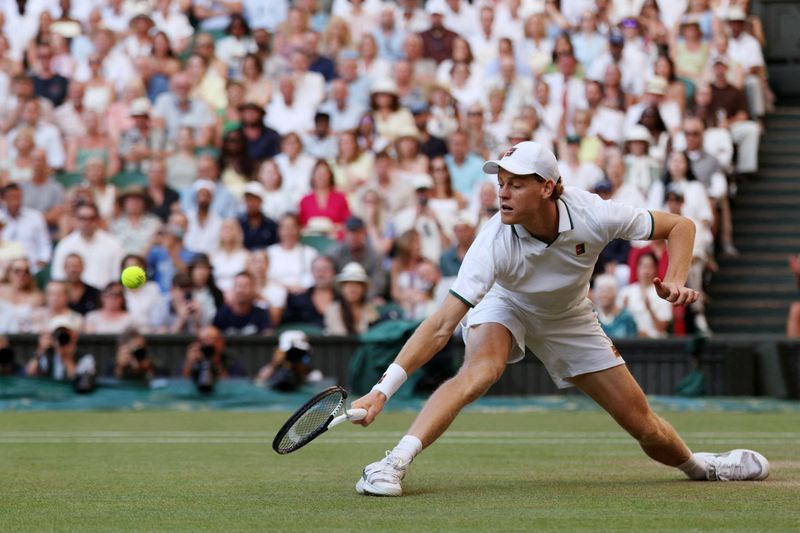
The men's tennis calendar has suffered a significant blow with the withdrawal of world number one Jannik Sinner from the U.S. Open, one of the sport's four most prestigious tournaments. The Italian star announced on Friday that a nagging right knee injury has forced him to sit out the final Grand Slam of the season, dealing a substantial setback to what promised to be a competitive field at Flushing Meadows. Sinner's decision represents a notable shift in the tournament dynamics, removing from contention a player who has dominated much of the professional circuit in recent months.
At just 24 years old, Sinner has established himself as a formidable force in international tennis, evidenced by his capture of his fifth Grand Slam title at Wimbledon only weeks before the U.S. Open withdrawal. His rapid ascent through the rankings and string of victories across different surfaces underscored his status as a genuine threat to win any tournament he enters. The timing of his injury proves particularly unfortunate given his recent form and the momentum he had built heading into the American hardcourt season.
Sinner sustained the knee injury earlier this month, an ailment that has effectively ended his participation in competitive matches since that point. The injury's persistence became increasingly apparent as he assessed his fitness status over the following days. In a statement posted to his social media accounts, the Italian acknowledged the collective effort he and his support team had invested in attempting to return to match fitness. Despite intensive rehabilitation work and medical supervision, the reality of his condition ultimately necessitated a difficult choice: prioritise long-term recovery over competing in a single tournament.
The scope of Sinner's absence from competition extended beyond merely skipping the U.S. Open itself. He opted out of the Cincinnati Open, traditionally viewed as a crucial preparatory event for American hardcourt tournaments, as well as the Canadian Open—both competitions serving as important tune-ups for players heading to New York. These withdrawals signalled the seriousness of his injury and the cautious approach his medical team adopted regarding his return to the circuit.
Sinner's recovery process appears to have included some recent court work in Monte Carlo, where he and his team undertook assessment of his physical readiness. However, this preliminary testing revealed that additional recovery time remained necessary before he could safely return to competitive play. The assessment highlighted the difference between training practice and match readiness, a distinction that undoubtedly influenced the decision-makers' determination that pushing forward with U.S. Open participation posed unacceptable risks to his long-term health.
The world number two position now passes to Spain's Carlos Alcaraz, who announced his intention to compete at the U.S. Open after an extended four-month hiatus from competitive tennis. Alcaraz himself has dealt with injury challenges in recent months, making his return to Grand Slam competition a noteworthy development. The timing of Alcaraz's comeback, coinciding with Sinner's withdrawal, creates an intriguing subplot for the tournament, particularly given their recent competitive history.
Alcaraz's previous meeting with Sinner in a U.S. Open final resulted in a victory for the Spanish competitor, establishing his ability to defeat Sinner on this particular stage. With Sinner absent from the draw, Alcaraz now heads to New York as the highest-ranked competitor in the field and among the primary favourites to claim the championship. His path to a potential title has been materially eased by his rival's absence, removing what would otherwise represent one of the most formidable obstacles to winning the crown.
The tournament structure itself will undoubtedly be affected by the absence of such a prominent figure. Sinner's withdrawal creates ripple effects throughout the draw, altering seedings and potential matchup scenarios that organisers and analysts had anticipated. For broadcasters and the tournament itself, the loss of a charismatic, rising star competing at the highest levels of the sport represents a diminished draw, though the presence of Alcaraz and other top competitors ensures the event retains substantial star power and sporting interest.
Looking toward the broader implications for professional tennis, this situation underscores the delicate balance elite athletes must maintain between ambition and physical sustainability. The decision to prioritise recovery over competing in even the most prestigious tournaments reflects an evolving understanding within the sport regarding injury management and player longevity. For the Southeast Asian tennis community and followers of the sport in Malaysia and the region, Sinner's absence removes an opportunity to witness the world's premier talent competing at the highest level, though the tournament itself will provide compelling competition among the remaining top-seeded players.
The U.S. Open, scheduled to run from August 23 through September 13, will proceed without its highest-ranked male competitor. This presents unprecedented circumstances for a major championship and raises questions about how the field will respond to the alteration of competitive expectations. While Alcaraz's presence ensures compelling storylines and world-class tennis, the absence of a defending world number one represents a notable gap in what would have been one of the sport's most captivating tournaments of the season.

