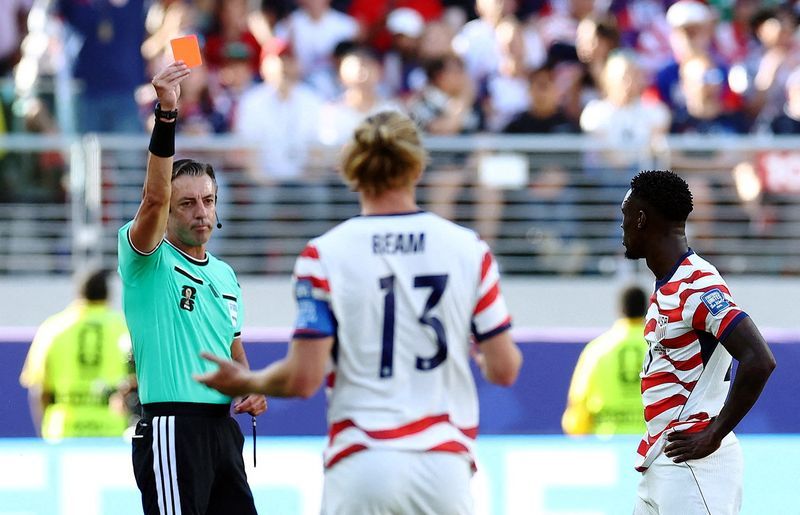
The fallout from FIFA's decision to permit American forward Folarin Balogun to compete despite incurring a World Cup red card poses a genuine risk to the integrity of football's disciplinary machinery, according to Howard Webb, who heads the Premier League's refereeing operations, and Richard Masters, the league's chief executive. The controversy surrounding Balogun's case has touched a nerve at the highest levels of English football administration, with both officials expressing concern that the episode could poison public perception of how decisions are made and enforced across the sport.
The episode involving Balogun became one of the tournament's most polarising moments after U.S. President Donald Trump publicly intervened in the matter. FIFA subsequently reversed the dismissal through proceedings that observers argue lacked transparency and proper procedure. The intervention by a sitting head of state in a sporting disciplinary matter proved extraordinarily unusual and set off alarm bells for officials responsible for maintaining standards in the domestic game.
Webb and Masters worry that the damage from this affair extends well beyond the World Cup itself. As the Premier League season commenced on Friday, both cautioned that the controversy threatens to create lasting suspicion about how decisions are made, potentially affecting public perception of referees' calls throughout the domestic campaign and beyond. The timing of their warnings proved significant, arriving precisely as the new season began, meaning fans and clubs would be watching officials' performance with heightened scrutiny.
Webb, a former referee who oversaw the 2010 World Cup final, articulated particular concern not with the original dismissal decision itself but with the murky process that followed. He acknowledged what he viewed as the central problem: acknowledged political pressure from a government figure combined with a reversal of the suspension through a mechanism that apparently did not exist before the tournament started. This sequence of events troubled Webb most because it suggested that political influence could penetrate football's supposedly protected sphere, regardless of the sport's stated independence from political interference.
The refereeing head expanded on his anxieties about the broader implications. Contemporary social media culture, he observed, frequently seizes on controversial decisions as evidence of systemic corruption, even when such claims lack factual grounding. When legitimate doubts emerge about whether decisions are being made fairly and independently, as the Balogun case appeared to suggest, it provides oxygen to those seeking to portray all officiating errors as symptoms of hidden corruption. Webb expressed frustration that his professional experience suggests such behind-the-scenes manipulation remains exceptionally rare, yet public perception increasingly reflects a suspicion of the contrary.
When pressed on whether the World Cup episode might contaminate the Premier League season, Webb delivered a terse response indicating his pessimism. The fundamental problem troubling him most was not primarily about individual decisions but about the principle that political influence could be successfully wielded upon an international sporting body. This principle, he emphasised, contradicts everything he understands about how professional football should operate, where technical merit and rules rather than political pressure should determine outcomes.
Masters articulated a different but complementary concern. He lamented that discourse surrounding the World Cup has become dominated by administrative and political issues rather than the sport's on-field action. The tournament produced genuinely noteworthy football, with Spain emerging as the competition's most impressive team and England suffering an agonising semi-final exit. Instead of celebrating these developments, Masters noted with evident disappointment, the conversation has fixated on the Balogun matter and what it reveals about FIFA's governance structures.
Masters highlighted a specific structural weakness that the Balogun case exposed: FIFA's disciplinary framework lacks the mechanisms available in most domestic competitions to review and potentially overturn red card decisions. This regulatory gap created the opening for the extraordinary process through which the suspension was ultimately reversed. Unlike the Premier League and other established leagues that have evolved sophisticated review procedures, FIFA apparently possessed no established protocol for reconsidering dismissals, meaning the decision to overturn Balogun's suspension required inventing an ad hoc solution. Masters characterised the entire episode as difficult to comprehend and suggested that better-designed regulations could have prevented the controversy entirely.
The implications for the Premier League become apparent when considering the intensified scrutiny that refereeing and VAR decisions face heading into the season. Webb acknowledged that every significant call in England's top flight would likely undergo intense examination from fans, analysts, and social media commentators over the coming months. The Balogun controversy provides additional ammunition to those predisposed toward questioning officials' integrity, precisely at a moment when the league seeks to implement new technical rules designed to accelerate play and reduce time-wasting.
These fresh regulations, arriving for the 2024-25 season, represent an unusually comprehensive rules overhaul aimed at increasing match tempo. Webb explained that referees will adopt a more proactive approach, issuing fewer cautions and instead penalising offences more frequently. This strategy differs from traditional practice, where warnings typically precede actual sanctions. Webb projected that fans should anticipate more stoppages early in the season as officials apply the new standards, though he expressed confidence that this increased enforcement would encourage tactical adjustments from players, ultimately reducing the incidents requiring intervention.
The convergence of these two challenges—the reputational damage from the Balogun case and the demands of implementing new regulations—creates a complex environment for Webb and his officials. Players and clubs must adapt to stricter enforcement while public confidence in officiating systems faces potential erosion. Webb's professionalism and extensive experience provide some reassurance, but the damage inflicted by FIFA's handling of Balogun's suspension threatens to complicate an already demanding transition period. The Premier League's leadership has effectively signalled that restoring and maintaining public trust in officials' decision-making represents a priority matching the technical implementation of new rules.

