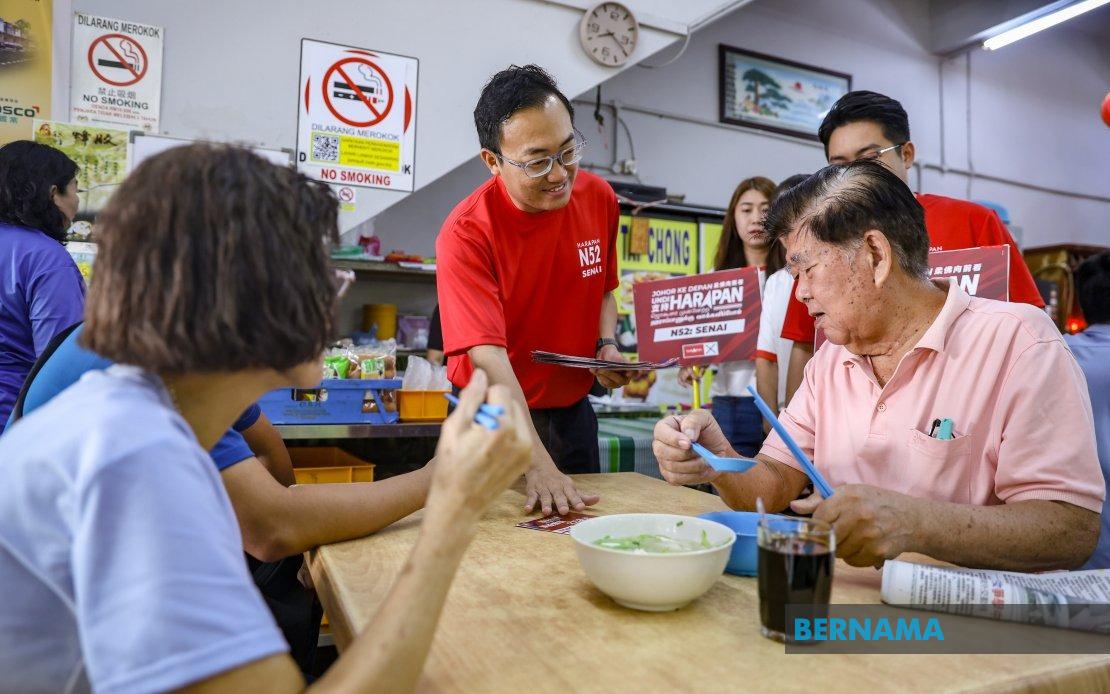
Wong Bor Yang, the incumbent assemblyman for Senai, has made his government credentials and practical achievements the centrepiece of his bid to retain the seat for Pakatan Harapan in the 16th Johor state election scheduled for July 11. The candidate, who will contest a three-way race against Barisan Nasional's Tai Chee Chee and independent Bersama's Tew Chien How in a constituency with 66,635 registered voters, believes his tenure demonstrates a commitment to constituent welfare that transcends party politics.
Wong's campaign narrative centres on a decade-long trajectory through Malaysia's shifting political landscape. Beginning as a special officer in the Kulai Member of Parliament's office in 2014, he has navigated roles across opposition and government benches, serving as a local councillor from 2018 before securing election as state assemblyman. This varied experience, he contends, has equipped him with pragmatic problem-solving skills rather than ideological rigidity, making him uniquely positioned to serve the diverse needs of Senai residents who value concrete results.
Flood management stands as the cornerstone of Wong's achievements during his previous term. He points to sustained efforts to address long-standing drainage problems affecting multiple neighbourhoods, securing RM1 million from the state government to upgrade the drainage system in Taman Aman and redirect water flows into Sungai Skudai. In collaboration with Kulai MP Teo Nie Ching, he also channelled RM3 million towards drainage improvements in Peladang Kulai Besar and Saleng, effectively removing both areas from the district's flash flood danger list. These interventions carry particular significance for Malaysian constituencies where monsoon flooding remains a recurring threat to property and livelihoods.
Beyond infrastructure, Wong has also championed heritage conservation and community recreation. His administration transformed a defunct cinema into a community operations centre and upgraded a deteriorating badminton court into the Tiny Lake family recreational facility under the Sejati MADANI programme. These initiatives reflect an understanding that constituent satisfaction extends beyond addressing immediate crises to encompass quality-of-life improvements that strengthen social cohesion and property values.
Healthcare emerges as Wong's stated priority should he secure a second term. The Shih Hsin University journalism graduate has consistently advocated for upgrading Kulai Hospital, whose current 93-bed capacity he argues will prove inadequate for the district's projected population of 500,000 by 2030. He has also identified bureaucratic delays affecting the construction of a new Health Clinic in Taman Mewah, which he pledges to resolve by pressing state-level authorities to clear the land issue preventing the Health Ministry from beginning work.
Wong's emphasis on practical track record reflects a calculated wager about electorate priorities in Johor. He implicitly argues that Senai voters, characterised as politically mature and dynamic, will prioritise demonstrated competence and delivery over partisan messaging or unsubstantiated promises. This positioning may resonate particularly in a state known for its swing-voting tendencies and where multiple recent elections have seen marginal victories and seat changes between coalitions.
The three-cornered contest format introduces strategic complexity. While Wong must defend his Pakatan Harapan majority among voters who elected him previously, he also faces the challenge of distinguishing his record from potential criticism that his achievements came despite rather than because of his party affiliation. Simultaneously, the presence of two opposing candidates may fragment anti-PH sentiment if both BN and Bersamit votes split, or conversely mobilise conservative voters dissatisfied with the incumbent.
Wong's background as a journalist adds a communicative dimension often underutilised in Malaysian electoral campaigns. His familiarity with media and public narrative-building may provide advantages in articulating his accomplishments and framing local governance challenges. This skillset becomes particularly valuable in a media environment where candidates compete for narrative control and public perception substantially influences voting behaviour.
The timeline compressed between announcement and polling—with early voting on July 7 and general polling on July 11—leaves limited opportunity for Wong or opponents to substantially alter voter preferences. Consequently, his campaign depends heavily on reminding existing supporters of his tenure's concrete benefits while persuading marginal voters that continuity outweighs change. The emphasis on flood management addresses a particular pain point that transcends partisan boundaries, as all residents regardless of political affiliation suffer damage during flooding episodes.
For Pakatan Harapan, retaining Senai contributes to broader state-level calculations in Johor, where the coalition seeks to improve its parliamentary and state assembly representation. Wong's victory would signal continued voter confidence in PH's governance approach at constituency level, while a loss would indicate either coalition fatigue or particular dissatisfaction with local representation. The outcome thus carries implications beyond Senai itself, informing broader analyses of PH's electoral trajectory in peninsular Malaysia's largest state.

