For nearly a century and a half, Wimbledon has stood as the custodian of tennis tradition, where the pristine All England Club grounds and strict dress codes define the tournament's public face as much as the play itself. Yet photographers capturing the 2024 edition revealed something equally powerful beneath the pageantry: a raw, emotionally intense competition where the highest stakes in professional tennis play out between moments of silence and explosive athleticism. The 149-year-old tournament, hosting approximately 675 matches across all categories, represents sport at its most refined and simultaneously most brutally competitive.
The aesthetic markers that define Wimbledon remain unmistakable and deliberately cultivated. Players dress entirely in white, right down to their footwear, while spectators don elaborate hats and consume strawberries with cream in the grass courts' enclosures. Members of the royal family grace the stands, and the tournament's two-week calendar has long been treated as a fixture of the British social season rather than merely a sporting event. This careful preservation of customs contrasts sharply with the simultaneous FIFA World Cup, which dominated sporting attention with its own distinct visual identity and cultural imprint. Yet the fundamental reality underlying Wimbledon's genteel presentation remains unchanged: the world's greatest tennis players converge to contest for sport's most coveted title.
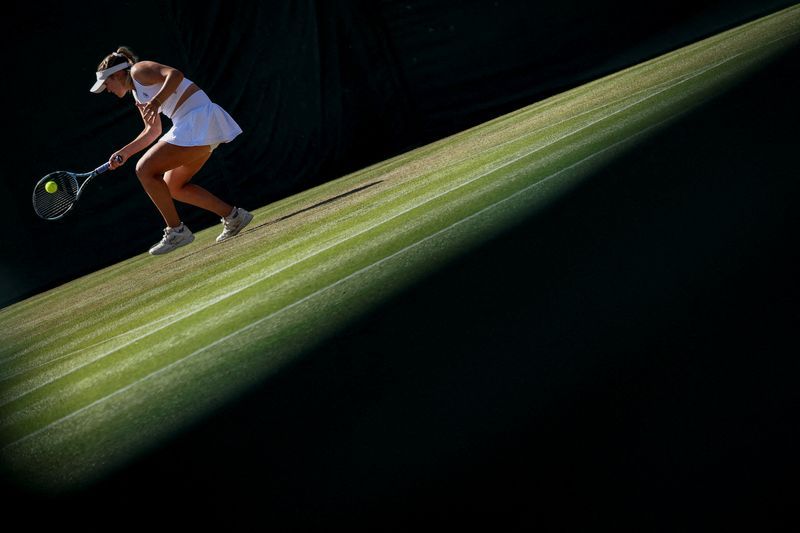
The tension between tradition and competition manifested powerfully in moments captured by tournament photographers, who documented not just the victories but the internal struggles that define elite sport. One striking instance involved Alexandra Eala, the 21-year-old player, during her contest against third seed Iga Swiatek, a six-time major champion. As Eala fell attempting a forehand return, photographer Toby Melville managed to frame both her determination and her physical struggle in a single image. The moment revealed more than technical tennis; it showed the grinding reality of competing against the sport's established elite. Melville had positioned himself expecting to capture celebration, but instead witnessed and recorded one of the tournament's most visceral competitive moments, illustrating how genuine sporting drama often escapes planned sequences.
The emotional toll of Wimbledon's intensity manifested in other ways throughout the fortnight. Otto Virtanen, navigating a hard-fought first-round match, approached the courtside barrier during a moment of acute frustration, his body language suggesting he wished to vanish entirely into the green canvas surrounding him. Photographer Jaimi Joy's documentation of this episode captured something rarely acknowledged in mainstream tournament coverage: the psychological weight that accompanies high-stakes professional tennis, even for players in early rounds. These moments of despair offer counterpoint to victory celebrations, reminding observers that every match produces both elation and devastation.
Of course, Wimbledon also showcased players who thrived visibly under the Grand Slam spotlight. Naomi Osaka, the two-time major winner, commanded attention as she progressed to the quarter-finals for the first time in recent competition. Photographer Marko Djurica captured Osaka striding across Centre Court in a kimono-inspired dress, the image seeming to distil her fearless, self-assured approach to the tournament. Her presence and performance demonstrated that for some competitors, the Wimbledon environment—with all its tradition and ceremonial weight—can become a canvas for confident self-expression rather than a constraint.
Yet the tournament's most visually compelling moments often emerged from the interplay between triumph and strain. Melville's photograph of men's champion Jannik Sinner mid-air during his final against Alexander Zverev exemplified this dynamic. Stretched to his maximum reach, Sinner's elongated shadow appeared to extend his physical boundaries, suggesting the superhuman effort required to claim the title. This image encapsulated why Wimbledon's competitive heart beats so fiercely: the tournament demands not just technical excellence but the ability to summon extraordinary physical and mental reserves under pressure.
Doubles competition provided its own narratives of intensity and resolution. Djurica documented Guo Hanyu and Kristina Mladenovic embracing after securing the women's doubles title, their shadow cast against the grass courts creating an optical illusion of a single player raising her fist in triumph. Such moments underscore how Wimbledon's traditional format—including its relatively rare celebration of doubles achievements—allows multiple stories to unfold simultaneously across the tournament's grounds.
The passage of time through Wimbledon's fortnight left its own archaeological record. Photographer Andy Couldridge captured Centre Court through a time-lapse sequence that revealed the toll of two weeks of elite-level tennis: patches of worn grass marked the pathways where countless players' shoes had traced their decisive movements. These physical traces functioned as a testament to the tournament's intensity, more eloquent than any scorecard in demonstrating the sheer volume and vigour of competition that Wimbledon contains.
For Malaysian and Southeast Asian observers, Wimbledon represents a global sporting institution that balances heritage with ruthless competition. The tournament's traditions—which sometimes seem quaint to audiences outside the United Kingdom—actually serve a deeper function: they create a dignified, controlled environment within which extraordinary athletes can push themselves to unprecedented limits. The pageantry is not frivolous decoration but rather the formal structure within which sport's most authentic dramas unfold. Alexandra Eala's appearance itself demonstrated that Wimbledon's competitive standards remain utterly uncompromising regardless of ceremonial presentation, a reality that aspiring players from the region must confront as they seek to compete at the highest levels.

