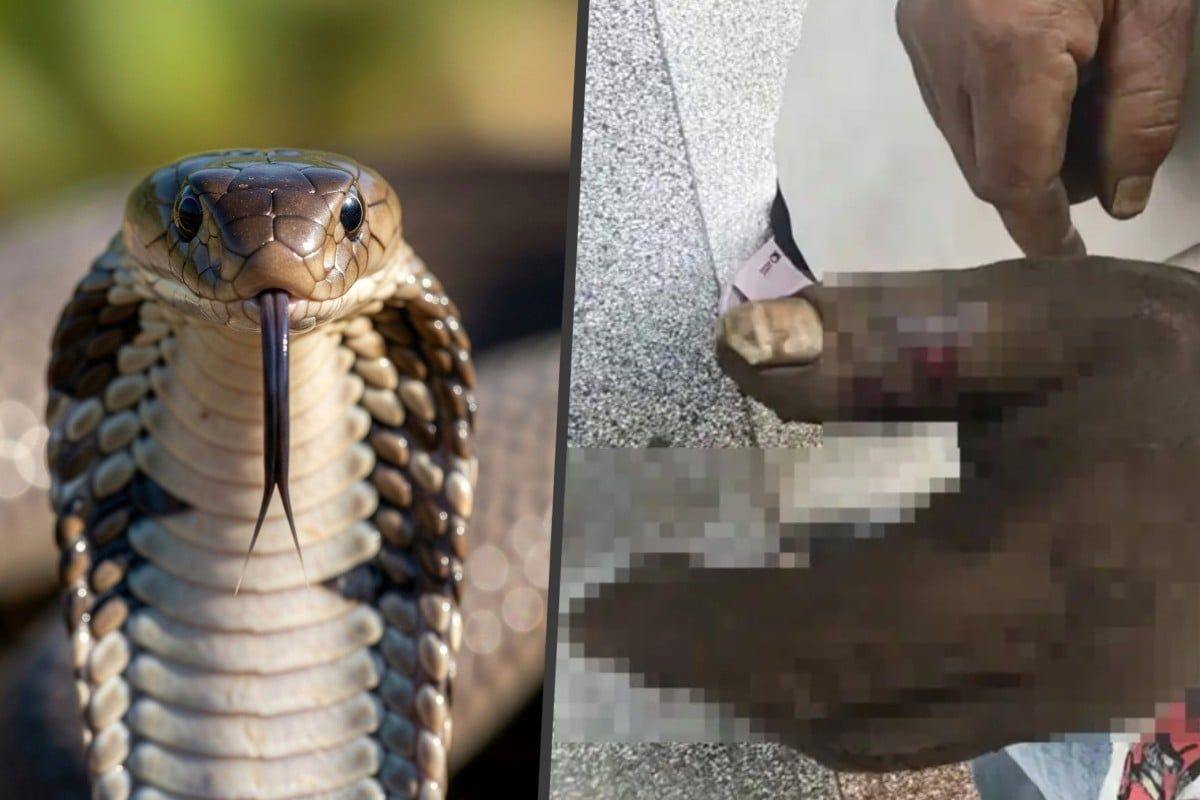
A routine day in the fields of southwestern China turned into a medical emergency when a farmer in Yuanyang county, Yunnan province, encountered a cobra that bit his finger. His wife's instinctive response to save his life, drawn from what she had witnessed on television, ultimately endangered her own health and highlighted the dangerous gap between entertainment portrayals of medical emergencies and clinical reality.
Following the bite, the farmer's condition deteriorated rapidly. His finger swelled considerably and he experienced dizziness and weakness—classic symptoms of cobra envenomation. Seeing her husband's distress, his wife acted with desperate urgency, applying what seemed like a straightforward rescue technique. Without any protective measures whatsoever, she placed her mouth directly on the wound and began sucking, attempting to extract the venom before it could spread through his system.
The couple's crisis deepened hours later when the farmer was hospitalised. While doctors began treating him with antivenom serum, his wife developed alarming symptoms of her own. Numbness crept through her mouth, tongue, face and limbs. By the following day, she had developed severe fatigue that forced her family to seek emergency care for her as well. What had begun as a rescue attempt had become a two-patient medical crisis at Honghe Prefecture No 3 People's Hospital, where doctors confirmed both had been poisoned by the local cobra species.
Medical professionals at the Yunnan facility used this incident to debunk a persistent myth that has claimed countless victims across Asia and beyond. The oral mucosa—the delicate lining inside the mouth—contains an exceptionally rich network of blood vessels and capillaries. When venom contacts this tissue, it enters the bloodstream with remarkable speed, causing poisoning in the person attempting rescue. Television dramas and action films persistently depict heroic characters sucking venom from snakebites, a trope so visually compelling that it has become embedded in public consciousness despite being medically catastrophic.
Physically, the extraction method fails for another fundamental reason. Snake fangs typically create puncture wounds that appear deceptively small—barely larger than a pinhole. Contrary to popular belief, venom does not pool in the wound waiting to be scooped out. Instead, it rapidly disperses into subcutaneous tissues and enters the bloodstream within minutes, making it virtually impossible to recover through suction. The venom's toxins work systemically, attacking the nervous system and cardiovascular function from within, not from the surface where a rescuer might reach it.
The Yunnan doctors further cautioned against several other dangerous first-aid myths that circulate widely. Cutting the wound to encourage bleeding, while intuitively appealing as a supposed drainage method, creates severe complications. Such incisions risk excessive blood loss in an already compromised patient and introduce infection into an open wound during a moment when the victim's immune system is overwhelmed. Applying heat to the wound, sometimes attempted with fire or heated objects, accelerates venom absorption and tissue damage. Similarly, ice application, though seemingly logical for swelling, can cause additional tissue injury and fails to address the systemic nature of envenomation.
The correct protocol, according to medical professionals, prioritises preventing further venom circulation and ensuring rapid access to specific antivenom. Upon being bitten, the victim should immediately call emergency services. Movement must be minimised because physical activity increases circulation and accelerates venom distribution throughout the body—a reason why bitten individuals should ideally remain still and keep the affected limb immobilised. Critical information helps doctors provide appropriate treatment: the snake's appearance, including its colouration, markings and head shape, enables identification and selection of the correct antivenom, since different snake species require different serums.
The couple's case resonates particularly within China, where snakebite incidents periodically capture public attention on social media platforms. A case from May in Guangdong province illustrated the severe consequences of delayed recognition and treatment. A fourteen-year-old middle school student was bitten by an unidentified reptile while in grassland near his school. Critically, he felt no immediate pain and could not see what had attacked him, leading him to minimise the incident. Hours later, when numbness and blurred vision emerged, he finally reported the bite to teachers. Doctors treating him later revealed that had medical intervention been delayed by merely one to two hours, his respiratory system would have failed fatally.
These cases underscore a broader challenge across Southeast Asia and beyond: the persistent influence of entertainment media on public understanding of medical emergencies. Television dramas and films provide memorable but incorrect visual narratives that become embedded in cultural memory, particularly among individuals without formal medical training. When genuine emergencies occur, people default to these dramatised protocols, often with tragic consequences. The Yunnan incident's circulation on social media prompted reflection among observers, with one online commentator noting that television depictions frequently diverge from medical reality, while another sentiment acknowledged the wife's devotion despite the tragic outcome.
For regional audiences in Malaysia and Southeast Asia, where cobra encounters occur and similar entertainment-driven first-aid myths circulate, the implications are direct and urgent. Snake envenomation demands rapid hospitalisation and antivenom administration, not improvised extraction attempts. Public health messaging should explicitly counter the visual narratives of film and television with clear, accurate guidance. The boundary between good intentions and harmful outcomes in medical emergencies often rests on whether people follow evidence-based protocols or entertainment-derived mythology.

