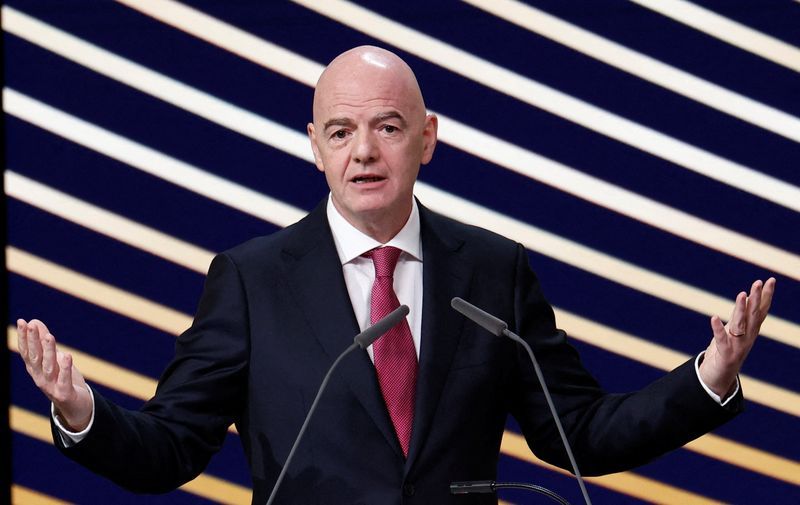
Gianni Infantino's grip on the FIFA presidency has loosened considerably following his failed attempt to privatise portions of football's most prestigious tournament. National federations from Serbia, Sweden and Wales have withdrawn their backing, signalling deepening discontent within world football's governing body. The contentious proposal to sell private equity stakes in the World Cup has triggered what observers describe as the most significant internal challenge to Infantino's leadership since he assumed office. As momentum builds against the incumbent, five prominent figures have emerged as potential challengers for the FIFA presidency, with the election scheduled for March 18 in Morocco to determine the leader for the 2027-2031 term.
The most immediate challenger appears to be Victor Montagliani, who leads CONCACAF, the confederation overseeing football in North America, Central America and the Caribbean. The Canadian businessman commands significant influence over a confederation that will host the 2026 World Cup, the first time the tournament returns to the region since 1994. While CONCACAF rejected Infantino's private equity scheme, the confederation has refrained from calling for a complete boycott of FIFA leadership structures, positioning Montagliani as a moderate alternative rather than a revolutionary outsider. His continental authority, combined with his apparent willingness to engage constructively with FIFA's institutional framework, makes him a credible transitional figure for those seeking change without radical disruption.
European football carries considerably more weight in global football politics, and UEFA President Aleksander Ceferin of Slovenia has positioned himself as a leading voice of institutional resistance. Ceferin's dramatic boycott of the recent World Cup final symbolised UEFA's profound rupture with Infantino's leadership. The European confederation has emerged as perhaps the most consistent and vocal critic of the FIFA president, with Ceferin spearheading opposition to what UEFA views as governance failures and inadequate consultation processes. His willingness to take confrontational stances and his control over the world's wealthiest and most influential football confederation give Ceferin formidable leverage, though his confrontational approach may limit support among federations seeking diplomatic resolution.
From Asia's perspective, AFC President Salman bin Ibrahim Al Khalifa of Bahrain represents an alternative power centre. As a senior vice president on FIFA's Council, Sheikh Salman carries significant institutional credibility and represents Asia's growing prominence in global football. His public opposition to Infantino's World Cup expansion proposals and his critical assessment of FIFA's decision-making processes position him as someone willing to challenge the incumbent while maintaining technical competence. For Malaysian and Southeast Asian football stakeholders, Salman's potential candidacy offers representation from their own continental confederation, though his influence remains secondary to that wielded by UEFA or CONCACAF leaders.
The entry of Nasser Al-Khelaifi, president of Paris Saint-Germain and a prominent Qatari sports executive, introduces a different dynamic entirely. According to reporting from major European media outlets, senior UEFA officials have begun rallying around Al-Khelaifi as a leading alternative to Infantino. His background in managing one of world football's most prestigious clubs, combined with his experience navigating complex relationships between European football establishments and Middle Eastern investments, positions him as a bridge between competing interests. However, Al-Khelaifi's close ties to wealth and influence may alienate grassroots football advocates who view his candidacy as representing continuity with FIFA's existing power structures rather than genuine reform.
Norwegian football federation president Lise Klaveness rounds out the potential successor list, representing a starkly different political vision from her male counterparts. As one of world football's most prominent female leaders, Klaveness was among the most vocal opponents of Infantino's privatisation scheme, signalling her alignment with federations prioritising governance integrity. Norway's previous attempt to lodge ethics complaints against FIFA regarding the Folarin Balogun suspension and alleged improper political interference by United States President Donald Trump demonstrates Klaveness's willingness to challenge FIFA on matters of principle. Her candidacy would represent a generational and gender shift in FIFA leadership, though her federation's relatively modest global influence compared to continental powerhouses could constrain her broader appeal.
The underlying crisis driving these succession discussions extends beyond personality conflicts or governance disagreements. Infantino's attempt to commercialise the World Cup through private equity partnerships fundamentally threatened the institution's traditional operational model and raised serious questions about FIFA's decision-making apparatus. Multiple confederations criticised the proposal as being proposed without adequate consultation, suggesting that institutional dysfunction rather than a single controversial policy may be driving the challenge to Infantino's leadership.
For Malaysian football observers, this succession battle carries significant implications. As a member of the AFC, Malaysia's FA will participate in the March 2027 presidential vote, making engagement with these potential candidates strategically important. The outcome will likely determine FIFA's governance priorities over the next four years, potentially affecting infrastructure investment, tournament allocation, and regulatory standards that directly impact Southeast Asian football development. Should Salman bin Ibrahim Al Khalifa advance as AFC's preferred candidate, Malaysian football could benefit from closer alignment with Asia's formal power structures within FIFA. Conversely, if a European candidate prevails, the power imbalance between UEFA and AFC may become even more pronounced.
The five potential successors represent competing visions for FIFA's future direction. Montagliani suggests continental solidarity and rotating leadership; Ceferin embodies European institutional power and confrontational governance reform; Salman offers Asian representation and Council-level credibility; Al-Khelaifi bridges commercial interests with traditional football establishments; and Klaveness symbolises gender diversity and ethical governance. None represents a genuine alternative to FIFA's fundamental power structure, yet each would govern differently based on their constituencies and ideologies. The March 2027 vote will ultimately determine whether world football chooses incremental change or more substantial institutional transformation.

