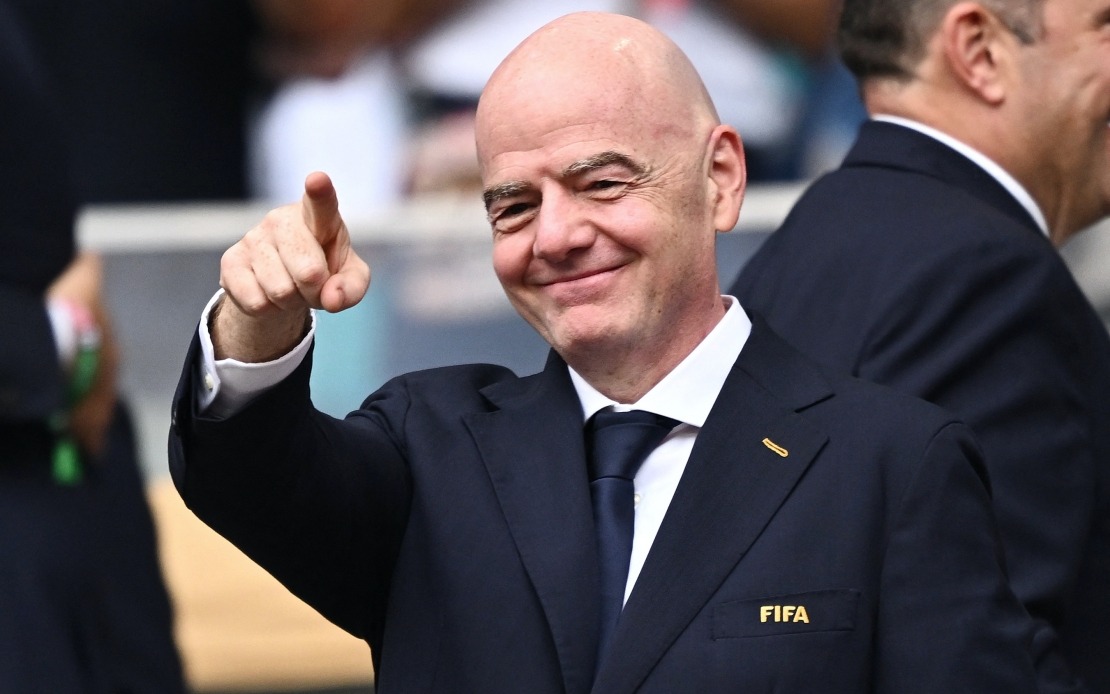
The Football Association of Wales has formally withdrawn its backing for FIFA president Gianni Infantino's planned re-election next year, marking a significant blow to the embattled administrator's efforts to secure another term. The FAW's decision follows Infantino's shelved proposal to establish FIFA Forward Enterprise, a controversial scheme that would have transferred stakes in the World Cup to private investors—a plan that faced rejection from three major continental confederations and sparked widespread condemnation across the global football community.
Infantino announced only days earlier that he was abandoning the privatisation scheme, but the damage to his standing has proven extensive. The FAW statement issued on Monday was unsparing in its criticism, asserting that recent failures spanning governance, processes, leadership values, stakeholder management, and communications had fundamentally eroded the organisation's confidence in his ability to lead world football. The Welsh federation made clear that accepting a leadership structure willing to compromise on putting football's interests first was simply untenable.
The withdrawal of Welsh support reflects a broader erosion of confidence among European football authorities. England's Football Association, while initially appearing more measured, has also communicated to FIFA that it no longer supports Infantino's candidacy. On Saturday, the English FA issued a statement expressing full alignment with UEFA's assessment that confidence in the FIFA president has been lost over the failed FFE proposal. This coordinated European response demonstrates how thoroughly Infantino's governance misstep has alienated the continent's football establishment.
UEFA's position, articulated through a Saturday statement, notably kept open the possibility of more dramatic intervention. By insisting that "no option should be off the table," the continental confederation hinted that national associations could potentially trigger an extraordinary vote of no confidence in Infantino. Such a procedural mechanism exists within FIFA's statutes and would require just 43 of FIFA's 211 member associations to initiate. However, analysts note that triggering such a vote would be strategically risky without confidence that a genuine majority exists to remove Infantino at the resulting Extraordinary FIFA Congress.
The CONCACAF confederation, representing football associations across North America, Central America, and the Caribbean, added weight to the mounting pressure over the weekend by calling for a comprehensive review of Infantino's leadership. Combined with UEFA's 55 member associations, the two confederations represent 96 votes within FIFA—a substantial bloc capable of influencing the broader membership. Interestingly, CONCACAF president Victor Montagliani, who currently serves as a FIFA vice-president, has indicated through sources that he would be willing to stand as a challenger should the situation evolve toward a contested election.
The uprising against Infantino does not appear universal, however. Several African and Asian football associations issued statements supporting the FIFA president over the weekend, including federations from Morocco, Egypt, and Qatar. This geographical split in sentiment reflects deeper divisions within FIFA's membership and suggests that any effort to remove Infantino would face meaningful resistance from parts of the developing world. These divisions raise questions about whether the growing European and North American coalition possess sufficient numerical strength to effect change without broader consensus building.
Infantino's decade-long tenure at FIFA has been marked by significant modernisation efforts and expansion of competition formats, yet his leadership style has increasingly come under scrutiny. The World Cup privatisation scheme represented a dramatic escalation of controversy, departing so sharply from established FIFA governance norms that even allies questioned his judgment. That the FAW, which had explicitly indicated support for his re-election prior to the FFE announcement, felt compelled to reverse course within days underscores how severely the proposal damaged his credibility.
For Malaysian and Southeast Asian football observers, these European manoeuvres carry particular significance. Asian Football Confederation members will likely find themselves courted by multiple camps as the situation develops. The positioning of these associations could prove decisive should a genuine contest emerge. Malaysian football officials will need to carefully weigh their confederation's interests against broader governance concerns, recognising that FIFA's internal politics increasingly reflect ideological differences between developed and developing football nations.
The governance failures that the FAW cited extend beyond the simple mechanics of the failed FFE proposal. They encompass broader questions about decision-making processes, transparency, and the degree to which FIFA's leadership consults properly with constituent associations before pursuing transformative policies. These institutional concerns may prove more durable than any single controversial proposal, potentially framing the narrative around Infantino regardless of whether formal removal proceedings materialise.
As the situation continues to evolve, the critical question remains whether opposition to Infantino will crystallise into a formal challenge or remain as pressure for change. The threshold for initiating an extraordinary Congress appears low enough that determined opponents could force the issue. However, the absence of a consensus alternative candidate and uncertainty about whether 106 of FIFA's 211 members would vote for removal creates strategic ambiguity. Infantino's government enjoys the advantage of incumbency and existing machinery, even as his authority faces unprecedented questioning from major football confederations worldwide.

