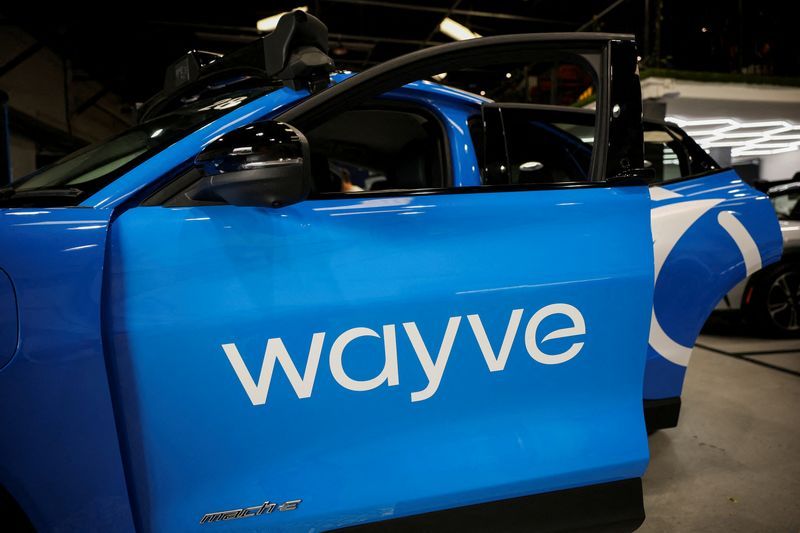
Wayve, a London-based autonomous driving startup, is capitalizing on renewed investor momentum in the driverless vehicle sector. The company has assembled a formidable funding round of $2.8 billion that brings together heavyweight names spanning both technology and automotive industries—Nvidia, Mercedes-Benz, and Nissan among them. A June partnership announcement revealed that Wayve's autonomous driving system will be integrated into Stellantis-manufactured Jeep vehicles destined for Uber's ride-hailing network, signalling a major commercial breakthrough for the ambitious venture founded in 2017 by CEO Alex Kendall, a New Zealand-born AI researcher who completed his doctorate in deep learning at Cambridge University.
At the heart of Wayve's competitive advantage lies its distinctive technological approach: end-to-end machine learning, a methodology that processes raw sensor data and translates it directly into driving decisions without relying on extensive pre-programmed rules or detailed digital maps. This contrasts sharply with the conventional framework that dominated the autonomous vehicle sector for years—one combining software coding, high-definition mapping, and artificial intelligence to establish predetermined responses for various driving scenarios. By mimicking how human drivers intuitively process road conditions and adapt to unforeseen circumstances, Wayve's system represents a fundamentally different philosophy about how machines should learn to navigate complex urban environments.
The company's technological stance finds parallel with Tesla's autonomous driving evolution, though with a crucial difference in sensor architecture. While Tesla's full self-driving capability relies exclusively on camera vision, Wayve has engineered its system to remain agnostic toward specific sensor configurations and computing hardware. This flexibility opens significant commercial opportunities. Rather than requiring every vehicle manufacturer to adopt identical sensor suites and processors, Wayve can license its AI engine to virtually any automaker, essentially democratizing access to autonomous driving technology across the industry. Kendall has articulated this vision clearly: making full self-driving accessible for any vehicle brand and any geography globally.
The timing of Wayve's expansion reflects a broader industry inflection point triggered partly by Alphabet's Waymo. After more than a decade of development and repeated delays, Waymo has successfully deployed paying robotaxi services across approximately a dozen cities, demonstrating that commercial autonomous vehicle operations are finally viable at scale. This tangible progress has reignited investor confidence in the entire sector, breaking a cycle of broken promises and unmet timelines that had plagued the industry through the 2010s. Wayve is positioned to capture a portion of this renewed interest by offering a technologically distinct pathway to autonomous driving that could theoretically reach profitability faster than alternatives.
The debate surrounding end-to-end AI versus traditional programmed systems remains fundamentally unresolved, however. A decade ago, this machine learning approach existed only as theoretical research pursued by academic pioneers like Kendall himself. Today, most serious autonomous vehicle developers have incorporated at least some end-to-end learning elements. Yet the methodology introduces a persistent challenge: opacity. The decision-making process within end-to-end neural networks remains notoriously difficult to interpret and explain—a phenomenon researchers call the "black box" problem. When a traditional rules-based system decides to brake, engineers can trace the logic backwards through the code. When an end-to-end AI makes the same decision, understanding precisely why remains murky, complicating safety validation and regulatory approval.
Wayve's engineering team counters that this apparent weakness is actually a strength. The company's vice president of AI, Vijay Badrinarayanan, argues that the brittleness inherent in pre-programmed systems becomes particularly acute when facing genuinely novel situations—scenarios engineers never anticipated during code development. Human drivers navigate such unpredictability through adaptive caution rather than rigid rules. End-to-end systems, trained on vast datasets of diverse driving conditions, should theoretically handle unusual cases better because they learn pattern recognition rather than memorizing specific prescribed responses. Wayve's safety layer generates situational awareness maps identifying viable driving paths in real time, attempting to address safety concerns while maintaining the approach's flexibility.
Nevertheless, industry scepticism persists. Waymo, despite pioneering end-to-end AI adoption, maintains parallel rules-based safeguards, suggesting that machine learning alone remains insufficient for comprehensive safety assurance at scale. This hedged approach reflects deep uncertainty about whether end-to-end systems truly offer superior safety or merely different safety tradeoffs. Partners like Nissan remain cautious evaluators. Eiichi Akashi, Nissan's technology chief, characterises Wayve's system as "most advanced" yet acknowledges the difficulty in understanding how the AI actually formulates driving decisions—a concern that will persist until regulators and engineers develop robust frameworks for validating opaque AI decision-making in safety-critical applications.
Wayve's commercial strategy leverages its technological approach's presumed advantages in speed and global scalability. Because the system doesn't require exhaustive road mapping or location-specific coding, the company claims successful testing across hundreds of cities worldwide without extensive preparatory work. Nissan plans deployment in Japan using Wayve's technology in its Elgrand people-mover van by March 2028, with operations established in Tokyo, Stuttgart, and Vancouver positioning the startup for rapid geographic expansion. This represents a significant competitive edge: faster time-to-market through reduced localization requirements could translate into substantially lower development costs compared to traditional mapping-intensive approaches.
Academic perspectives introduce additional nuance to the emerging consensus. Siddartha Khastgir, a safe autonomy professor at the University of Warwick, suggests that end-to-end approaches should indeed enable faster commercial development cycles than conventional methods, though he resists declaring either approach categorically safer. Phil Koopman, an autonomous systems expert at Carnegie Mellon University, characterizes Wayve's methodology as one viable solution among several potential paths forward, none yet proven definitively superior. Both researchers anticipate that safe nationwide autonomous vehicle deployment across major markets will require at least another decade and likely demand technological innovations still unforeseen.
For Malaysian and Southeast Asian readers, Wayve's trajectory carries particular significance given the region's rapid urbanization and transportation challenges. Autonomous vehicle technology could eventually address urban congestion, safety, and mobility access across major cities like Kuala Lumpur, Bangkok, and Singapore. However, the technical debate between end-to-end and traditional approaches remains unsettled, suggesting that regional adoption decisions won't occur until one methodology demonstrably proves superior in real-world deployment. Wayve's technology represents a genuine alternative to the Tesla-Waymo approaches dominating headlines, potentially offering Southeast Asian automotive manufacturers and tech companies different pathways into autonomous vehicle development without requiring massive proprietary datasets or exclusive sensor ecosystems. The coming years will reveal whether this AI-centric learning approach delivers on its transformative promise or encounters fundamental limitations that rule-based systems avoid.

