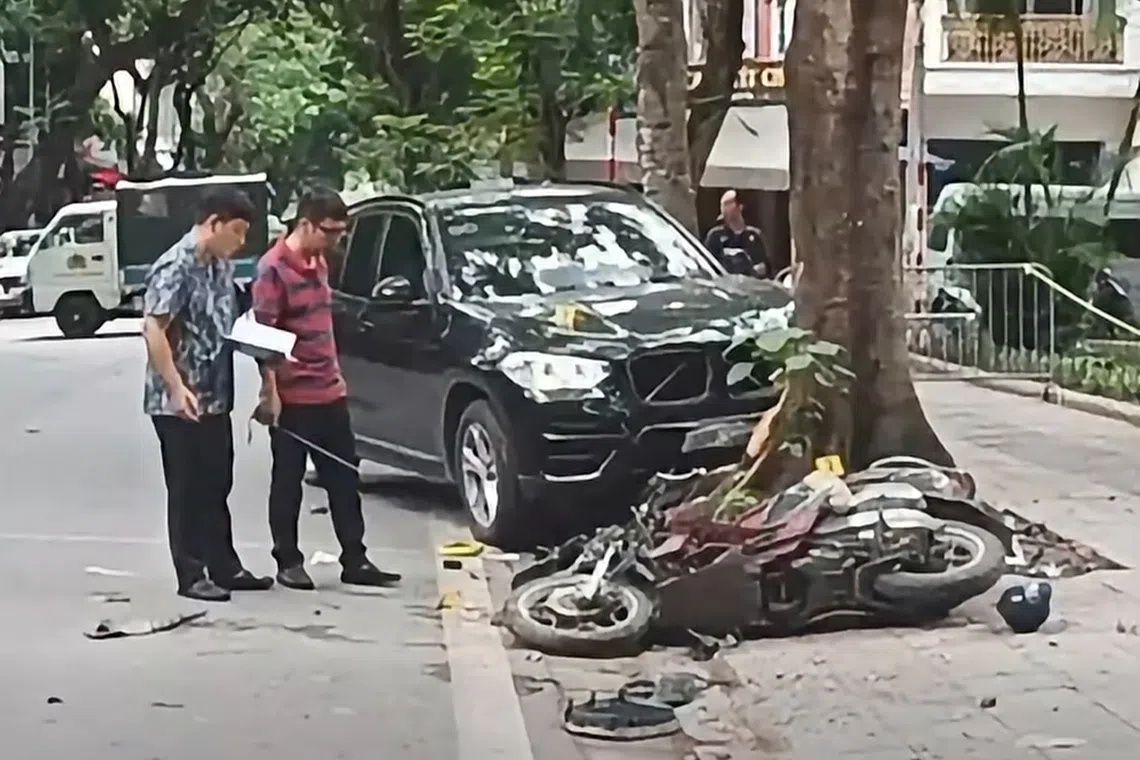
Over a year of silence surrounding a fatal traffic collision in Hanoi shattered dramatically when Vietnamese state broadcaster Vietnam Television devoted a full six-minute segment to the incident on its flagship news programme, marking an extraordinary acknowledgment that underground youth pressure had successfully breached the country's tightly controlled information environment. The case centred on the May 2025 death of Do Ngoc Phuong Thuy, an 18-year-old girl who was struck by a luxury car driven by Nguyen Sy Cuong, a 64-year-old former deputy of the National Assembly, whose vehicle veered across lanes at high speed during a collision with the motorbike she was riding with her father. The teenager survived the initial impact but lost her right leg in the collision; she died in hospital ten days later, just before her high school graduation examinations, leaving behind a family and a community still grappling with the tragedy.
For more than a year, the incident disappeared from public discourse entirely. Despite Vietnam experiencing over 10,000 traffic fatalities annually, a statistic that typically generates minimal media attention in a nation where such incidents are disturbingly commonplace, this particular accident involved a politically connected figure whose involvement might ordinarily have been quietly resolved through administrative channels. The Hanoi Police investigation proceeded without public updates, and domestic media made no further mention of the case after May 31, creating a vacuum that would ultimately prove untenable in an age of interconnected digital activism. The absence of transparency became the crucial catalyst that would eventually mobilise an entire generation, transforming what authorities likely expected to be a contained matter into a nationwide reckoning with accountability and governance.
The dormant case ignited suddenly more than a week before Vietnam's National Day celebration on September 2, when millions of posts proliferated across social media platforms, particularly the increasingly popular Threads application, with hashtags including #NguyenSyCuong and #BMW identifying both the driver and his vehicle brand. Anonymous users, primarily Gen Z individuals and young adults in their late teens and twenties, began collectively demanding transparency about the circumstances surrounding the collision, the investigation's findings, and the mechanisms by which justice had been determined. The campaign demonstrated remarkable organisational sophistication as tech-savvy participants circumvented apparent censorship attempts by distributing content across multiple platforms including Facebook, Instagram and X, ensuring the message reached broader audiences despite official efforts to contain the narrative. Young people physically gathered at the accident site, leaving flowers at a tree marked as location number 55 on Google Maps, which became symbolically rebranded as the "Justice Tree," transforming a geographic coordinate into a focal point of collective grief and demands for accountability.
The authorities' initial response revealed the discomfort with which the establishment confronted youth-driven activism outside traditional power structures. Officials dispatched workers to remove physical flowers from the accident site, only to discover that the symbolic gesture had evolved into a virtual phenomenon, with the online memorial accumulating hundreds of thousands of tributes. Simultaneously, the government made claims that hostile foreign forces were attempting to exploit the incident for subversive purposes, a familiar rhetorical framework deployed whenever grassroots movements challenge official narratives. A senior police official cited in the VTV report asserted that the Ministry of Public Security had "uncovered highly dangerous plots and intentions by hostile forces, reactionaries and bad actors to incite unrest and cause disorder," language that suggested the state perceived the youth campaign as potentially destabilising rather than merely seeking closure for a specific tragedy.
Social activists offered deeper analysis of why an 18-year-old victim's death had catalysed unprecedented youth mobilisation. Nguyen Hoang Vi, a social activist and blogger who focuses on educational issues, suggested that peer identification proved crucial to the campaign's momentum. "The victim was an 18-year-old girl, a peer to many of the young people speaking out. This naturally fosters deep empathy, as they can easily put themselves in her shoes," she explained, identifying the psychological mechanism through which abstract justice concerns became personally urgent. However, she equally emphasised that the year-long information blackout itself became the breaking point, a manifestation of growing Gen Z frustration with institutional opacity. "Young people no longer want to simply hear adults say, 'Trust in justice', they want to see justice actually served," she observed, capturing a generational shift toward demanding tangible evidence of accountability rather than accepting assurances grounded in institutional authority.
When VTV finally reported on the case, the official narrative framed the resolution as legally concluded and ethically sound. The broadcaster cited police and prosecution sources claiming that Nguyen Sy Cuong had "sincerely confessed and actively and fully remedied the consequences of his actions," circumstances that purportedly led the victim's family to decline pursuing criminal charges and resulted in exemption from criminal liability. Do Viet Hung, the father of the deceased teenager, appeared on the programme to express gratitude for public sympathy while requesting privacy for his family to grieve without further scrutiny. The statement created a delicate positioning in which a bereaved family member appeared to endorse the official conclusion, potentially deflating the moral force of youth demands for justice by suggesting that those most affected by the tragedy had accepted the resolution.
Yet lawyer Tran Dai Lam from the ANVI law firm in Hanoi articulated why the official explanation, despite appearing to address public questions, was unlikely to satisfy the movement's underlying concerns. "An incident would not simply disappear just because it has dropped out of mainstream media while questions remain about it," he argued, identifying how information vacuums create conditions for renewed scrutiny when minor details resurface. More critically, he expressed doubt that the VTV report would "fully put Gen Z at ease," explaining that the generation demanded not merely conclusions but detailed transparency about legal processes, specific statutes applied, and rationales for official decisions. "Gen Z is not easily satisfied with answers stating simply that authorities acted 'in accordance with the law', they want to know which laws, what specific decisions were made, and why those decisions were reached," he elaborated, highlighting a generational expectation gap between institutional transparency and procedural opacity.
The continued placement of flowers at the virtual memorial tree, albeit in reduced numbers following the official broadcast, and persistent online comments expressing dissatisfaction with the explanation, demonstrated that the government's public statement had not entirely quelled the campaign. The youth movement revealed patterns of political consciousness that challenged prevailing stereotypes about Gen Z passivity and self-absorption. Nguyen Hoang Vi herself acknowledged a fundamental transformation in her perspective, noting that she had previously harboured "a rather unkind stereotype of Gen Z, viewing them as a generation inclined towards self-indulgence and lacking in patience, diligence or effort, often appearing indifferent to the world around them." However, the activism surrounding Do Ngoc Phuong Thuy's death demonstrated that "Gen Z is not truly indifferent to society. Rather, they engage with issues in a way that differs vastly from my own generation," she recognised, identifying how digital platforms and peer networks created distinctly modern modes of political participation.
The incident illustrated broader dynamics of governance in Southeast Asia where digital activism increasingly challenges traditional state control over information and narrative formation. Vietnam's authorities, confronted with coordinated youth mobilisation that transcended individual platforms and official censorship attempts, reluctantly validated the campaign's significance by providing the official explanation through national television. This dynamic, while maintaining state authority and framing the resolution as definitive, simultaneously acknowledged that ignoring youth concerns entirely had become untenable. For Malaysian observers and regional analysts, the Vietnamese case demonstrated how generational shifts in digital literacy and political consciousness were reshaping accountability mechanisms across Southeast Asia, particularly among populations with limited faith in institutional transparency. The campaign suggested that youth in the region were developing increasingly sophisticated strategies for collective action and information dissemination, capabilities that governments would need to accommodate rather than suppress if they sought to maintain social stability without resorting to escalating repression.

