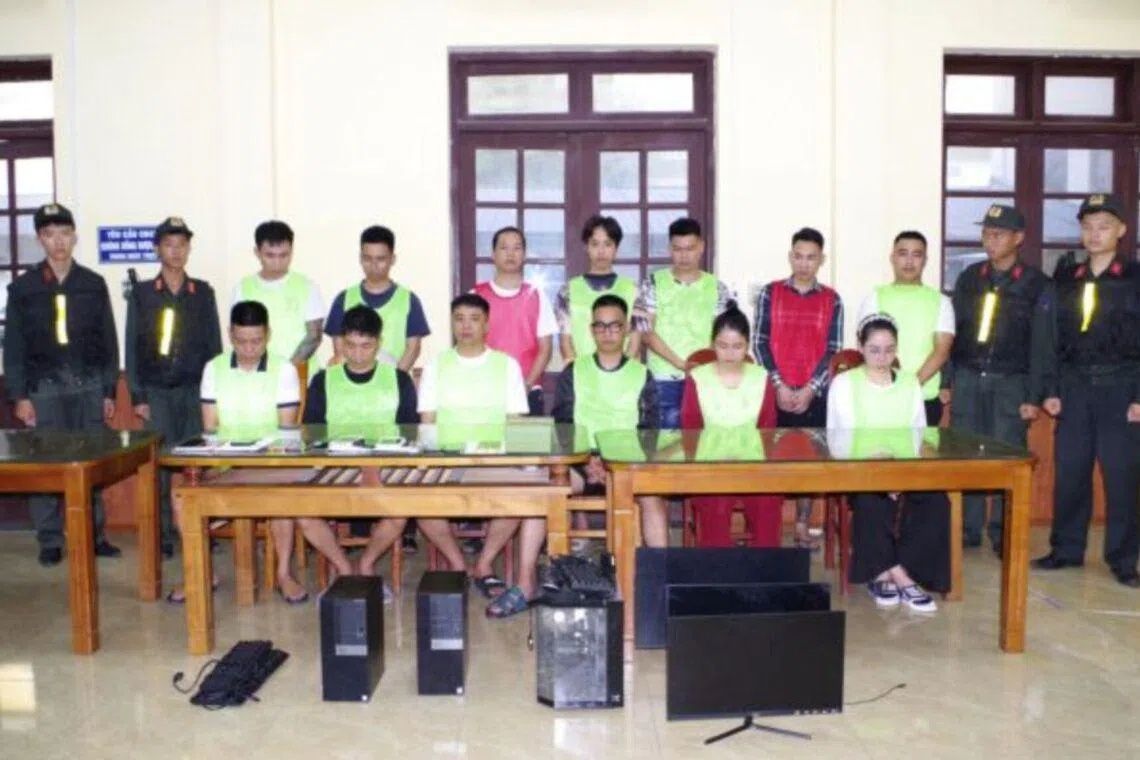
Police in Vietnam's Ninh Binh province have successfully dismantled a sophisticated transnational cyberfraud operation responsible for fleecing victims of more than 250 billion dong—equivalent to RM39.2 million. The operation culminated in the arrest of 12 suspects, with authorities seizing substantial assets including cash, vehicles, electronic devices, jewellery and extensive documentation connected to the criminal enterprise.
The investigation identified Nguyen Van Cuong, 28, and Nguyen Van Phuong, 34, as the principal architects of the fraud network. Their organizational structure demonstrates the increasingly professional nature of cross-border cybercrime in Southeast Asia, where criminal operations now employ clear hierarchies and specialised roles. This level of sophistication suggests that such networks likely pose an ongoing threat to communities across the region, including Malaysia, where online fraud victimization has similarly escalated in recent years.
Central to the group's modus operandi was the recruitment and transportation of Vietnamese nationals to Cambodia, where they established their operational base. This geographic separation—situating criminal activities in a neighbouring jurisdiction—represents a calculated strategy to complicate law enforcement coordination and evade detection by authorities in their home country. The Cambodia location provided the network with operational safety while maintaining access to Vietnamese-language victims and banking infrastructure.
The criminal enterprise deployed an arsenal of deceptive tactics that targeted victims through impersonation. Fraudsters posed as police officers, prosecutors, judges, bank employees and tax officials—authority figures whose legitimacy victims would naturally trust. By leveraging the psychological weight of official authority, the network substantially increased their success rate in convincing targets to comply with financial demands. This approach exploits a fundamental vulnerability in human psychology that transcends national borders.
Technologically, the operation showcased considerable sophistication in creating counterfeit digital infrastructure. The group developed fake websites and mobile applications meticulously designed to replicate genuine government agencies and established commercial entities. These counterfeit platforms served as convincing gateways through which victims could be systematically manipulated into surrendering sensitive financial information or making fraudulent transfers. Such technological capabilities indicate that members possessed genuine technical expertise, likely making them valuable assets to criminal networks even if apprehended.
The scam repertoire encompassed multiple schemes tailored to different victim profiles and circumstances. Fraudulent recruitment schemes targeted job seekers by offering lucrative part-time opportunities, while investment scams leveraged widespread enthusiasm for cryptocurrency and financial markets. Romance scams exploited emotional vulnerabilities through fabricated relationships designed to build trust over time. Additionally, the network engaged in account hijacking—compromising legitimate social media profiles to solicit loans from victims' genuine contacts, thereby adding a layer of social engineering manipulation.
One particularly cunning variant involved network members posing as military officers contacting commercial establishments with purported orders for substantial quantities of goods. Victims were then persuaded to procure additional merchandise on the fraudsters' behalf and remit deposits or advance payments to designated accounts. This scheme cleverly exploited the natural respect and compliance that business owners typically extend toward uniformed military personnel, converting that deference into a mechanism for financial loss.
The scale of victimization became apparent during the investigation. Since October 2024, the network had successfully defrauded approximately 500 individuals across Vietnam, accumulating losses exceeding 250 billion dong. This figure suggests that the operation remained active for roughly four months before law enforcement intervention, indicating either a relatively recent establishment or successful evasion tactics that eventually proved inadequate against determined investigative efforts.
Legal proceedings have progressed swiftly following the arrests. Six of the detained suspects have been formally charged with fraudulent appropriation of property and remain in custody pending trial. The remaining six suspects are subject to ongoing procedural measures as investigations expand to identify additional network participants. Vietnamese authorities have recognized that the arrested individuals likely represent only a fraction of the entire criminal organization, particularly given the transnational nature of operations and the recruitment networks that extend across both countries.
Asset recovery operations are simultaneously underway, with police pursuing freezing and seizure actions against bank accounts and property connected to the criminal proceeds. This recovery process—challenging under optimal circumstances—becomes considerably more complex when funds have been distributed across multiple jurisdictions or converted into difficult-to-trace assets. Nevertheless, such action represents an essential component of combating organized online fraud, as it directly reduces the financial incentives driving criminal participation.
The dismantling of this network carries important implications for the broader Southeast Asian region. Malaysian authorities and citizens should recognize that such transnational fraud operations frequently target multiple countries simultaneously or sequentially, adapting tactics and victim profiles based on perceived vulnerabilities. The sophistication demonstrated by this Vietnamese network—encompassing technological competence, psychological manipulation, organizational structure and cross-border logistics—reflects evolving capabilities within regional cybercriminal ecosystems.
Coordination between Vietnamese and Cambodian law enforcement agencies proved crucial in this case, and similar cooperation mechanisms remain essential as cybercrime increasingly transcends national boundaries. For Malaysian residents, the case underscores the persistent risks associated with online interactions involving financial transactions, particularly when involving unfamiliar parties claiming official authority or offering unusually attractive opportunities. The continued expansion of the investigation suggests that additional perpetrators and victims may yet emerge, potentially including individuals across other Southeast Asian nations.

