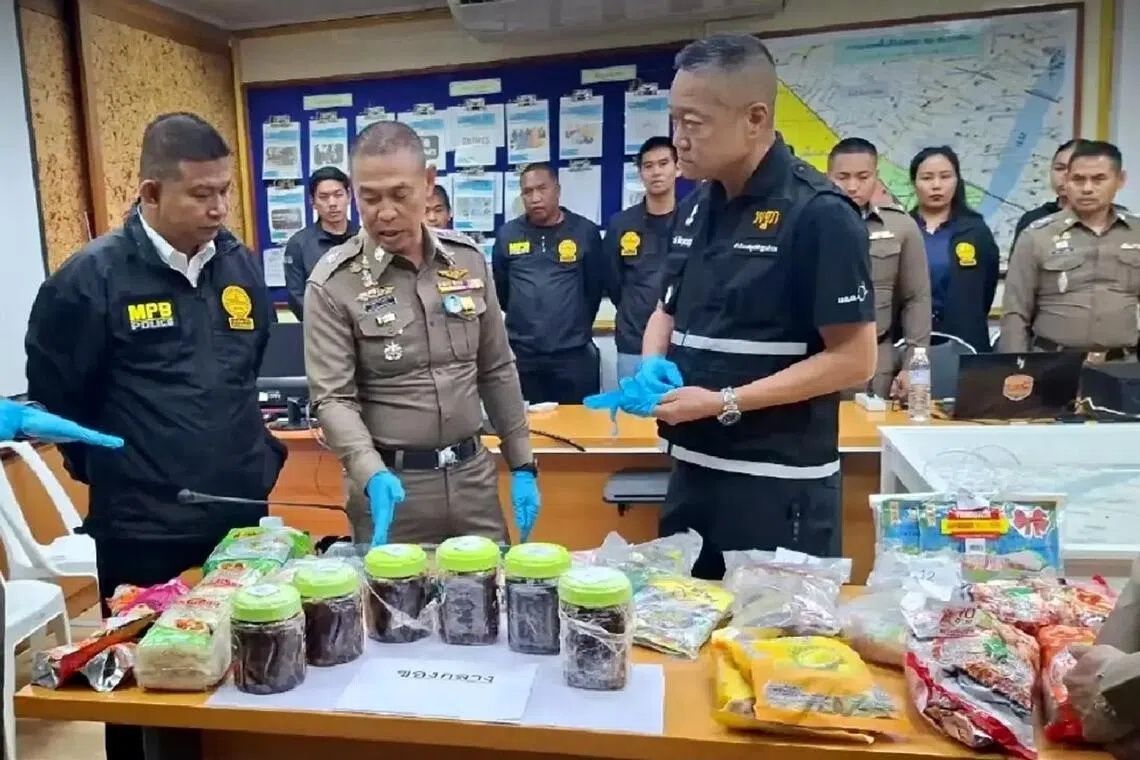
Thai authorities have uncovered a sophisticated international drug smuggling operation orchestrated by Vietnamese nationals, with the investigation revealing how the network exploited Thailand's location as a strategic transit point for moving methamphetamine destined for Japan. The breakthrough came after a courier became suspicious of unusually heavy tamarind paste containers bound for Tokyo, leading Metropolitan Police Bureau officials and investigators from Bang Yi Khan Police Station to a major discovery that has prompted the issuance of multiple arrest warrants.
The operation came to light on July 13 when a courier hired to transport goods overseas contacted police after noticing something amiss with the shipment. The six sealed containers felt considerably heavier than expected for what was ostensibly just tamarind paste, a common Southeast Asian ingredient used in traditional cooking and beverages. Rather than proceeding with delivery, the suspicious courier decided to report the matter to authorities, a decision that proved pivotal in unravelling the entire network.
Forensic examination of the jars revealed an elaborate concealment method. Investigators discovered six foil-wrapped packages nestled inside the tamarind containers, containing more than 2 kilogrammes of crystal methamphetamine, a potent stimulant drug commonly referred to as ice. The choice of tamarind paste as a cover demonstrates the network's understanding of common trade items that would attract minimal scrutiny at customs checkpoints, reflecting the sophistication of their operational planning.
Law enforcement officials, led by police lieutenant-general Siam Boonsom and supported by police major general Chaiya Phetpanya, determined that the network operated through a carefully compartmentalised structure designed to insulate senior organisers from direct involvement in physical logistics. A senior figure believed to be directing operations from Hanoi relied on multiple intermediaries to execute each stage of the smuggling chain, creating deliberate distance between command and execution.
The recruitment strategy employed anonymous Facebook accounts as the primary means of hiring individuals to participate in the operation. Rather than hiring established trafficking networks, the organisers contacted delivery riders to collect packages from residences occupied by Vietnamese nationals scattered throughout Thailand. These riders, likely unaware of the packages' contents, then handed them to Thai couriers specifically retained for international transport. This layered approach intended to prevent investigators from establishing direct links between individual facilitators and the overall network structure.
Financial analysis proved instrumental in connecting the dispersed elements of the operation. Bank records revealed that payments and operational expenses flowed through an account belonging to Sompong, a Thai national arrested in connection with the conspiracy. Vietnamese members of the network reportedly took turns withdrawing cash amounts ranging from 20,000 to 50,000 baht before returning to Vietnam shortly thereafter. This rotating withdrawal pattern appeared deliberately designed to minimise the likelihood of any single individual attracting attention from financial investigators or banking systems monitoring large suspicious transactions.
The investigation suggests that at least four people maintained active roles within the network, though authorities believe the actual number of participants could be substantially higher given the distributed nature of its operations. Arrest warrants have been issued for Sompong alongside three Vietnamese nationals implicated in money withdrawals, social media account management, and operational coordination. Sompong maintains his innocence regarding the allegations, even as the evidence points toward his integral role in the financial infrastructure sustaining the smuggling enterprise.
Investigators are also examining the potential involvement of Sompong's girlfriend, though she has not been included in the formal arrest warrants at this stage. Her awareness of the operation remains under scrutiny, as authorities seek to determine whether she possessed knowledge of the arrangement and, if so, what role she may have played in facilitating or concealing the conspiracy.
This case exemplifies a troubling pattern observed by Thai police in recent years, whereby unwitting or partially aware couriers are recruited to transport narcotics across international borders. The vulnerability of individuals seeking supplementary income through courier work remains a persistent weakness exploited by trafficking organisations operating throughout the region. The tamarind paste method reflects how smugglers continuously innovate their concealment techniques, adapting to law enforcement capabilities and leveraging ordinary commercial items to move contraband across borders.
For Malaysia and the wider Southeast Asian region, this investigation underscores the critical importance of cross-border cooperation in combating transnational drug trafficking. The Mekong region and Southeast Asia remain central to global methamphetamine production and distribution networks, with numerous syndicates utilising Thailand as a crucial hub for moving products to markets throughout Asia-Pacific. The reliance on anonymous digital platforms and cryptocurrency-adjacent money movement techniques reflects how criminal organisations have modernised traditional smuggling infrastructure.
The compartmentalised structure identified in this case represents a significant challenge for law enforcement, as it allows networks to continue operations even when individual components are disrupted. Unless authorities can trace the conspiracy upward to the senior figure allegedly directing from Hanoi, the network may simply activate alternative chains while key personnel face prosecution. Intelligence sharing between Thai, Vietnamese, and Japanese authorities will be essential for pursuing this upstream dimension of the investigation and preventing the network from reconstituting with new facilitators.

