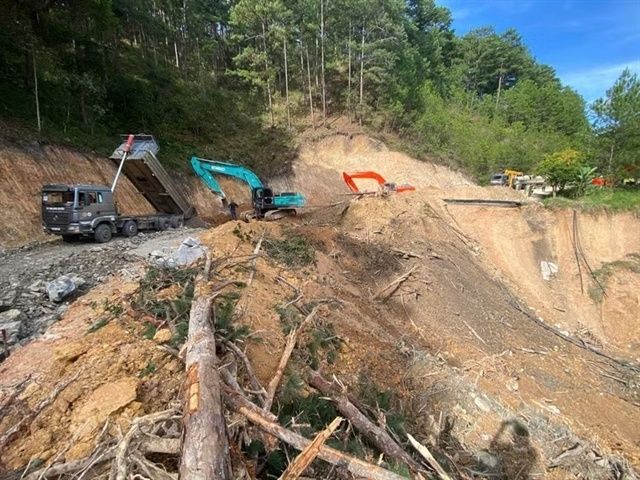
Vietnam's Ministry of Construction has formally declared a natural disaster emergency affecting Ho Chi Minh Road in Tuyen Quang Province, following extensive infrastructure damage caused by relentless heavy rainfall throughout June. The declaration focuses on a particularly vulnerable section at kilometre marker 115 plus 000, where the main highway intersects with National Highway 2C and falls under the management authority of Road Management Zone I. The decision reflects official concern over the structural integrity of the road network and the potential risks posed to the thousands of vehicles and commuters who traverse this critical transport corridor daily.
The string of torrential rain events that battered the region between June 1 and June 30 exceeded normal seasonal patterns, according to data compiled by the Tuyen Quang Provincial Hydrometeorological Station and corroborated by the National Centre for Hydrometeorological Forecasting. Multiple successive storms transformed localised flooding into widespread infrastructure collapse, with the road surface experiencing significant deformation that compromised both safety standards and structural stability. The cumulative effect of these weather events overwhelmed the existing drainage systems and exposed vulnerabilities in the road construction that had apparently gone unaddressed in previous maintenance cycles.
In response to the crisis, the Ministry of Construction has activated a coordinated emergency response protocol designed to stabilise the situation and restore reliable transport services. The Department for Roads of Vietnam, alongside Road Management Zone I, has received explicit directives to lead a comprehensive damage assessment of the affected infrastructure sections. These agencies must evaluate the full extent of structural compromise, formulate technically sound repair strategies, and move swiftly towards issuing an Emergency Construction Order that will authorise expedited repairs under special provisions designed for natural disaster recovery.
The scope of the emergency extends beyond the primary damage zone at kilometre 115 plus 000. A secondary section of Ho Chi Minh Road spanning from kilometre marker 124 plus 600 to kilometre 128—where the highway overlaps with National Highway 2—has also been designated as a priority area requiring immediate intervention. This stretch has experienced localised flooding that creates additional congestion and traffic management complications. Officials recognise that without swift action to address water accumulation and surface damage in this zone, congestion will intensify and create dangerous driving conditions.
The accountability framework established by the Ministry of Construction places direct responsibility on senior officials for managing the crisis response. The Director General of the Department for Roads of Vietnam and the Director of Road Management Zone I face explicit answerability to the Minister of Construction for comprehensive reporting on the damage sustained at the primary damage zone. Beyond damage documentation, both officials must immediately mobilise resources to mitigate the consequences of the natural disaster, implement traffic management solutions that maintain vehicular flow, and prevent secondary complications from extended road closures or restrictions.
The Ministry's Transport and Road Safety Division has been assigned the broader supervisory role of coordinating all remedial activities across relevant agencies and units. This division will monitor implementation of damage mitigation strategies, verify compliance with repair timelines, and ensure that traffic safety protocols are maintained throughout the reconstruction process. The centralised coordination structure aims to prevent gaps in communication and eliminate the bureaucratic delays that could further disrupt regional transport networks.
Once emergency construction works reach completion, the Department for Roads of Vietnam is obligated to submit detailed reports to the Ministry documenting all repair activities undertaken and the restored condition of the infrastructure. This documentation will serve as the foundation for a formal assessment of whether emergency conditions can be formally lifted. The structured process reflects Vietnam's commitment to transparency and systematic disaster recovery, ensuring that infrastructure restoration meets established standards before normalcy is declared.
For Malaysian and Southeast Asian observers, Vietnam's response model illustrates the challenges that regional economies face when extreme weather events damage critical transport corridors. Ho Chi Minh Road functions as a vital artery for commercial traffic and regional trade connectivity, making swift restoration essential for economic continuity. The case underscores how climate variability and increasingly intense rainfall patterns pose escalating threats to infrastructure systems designed for historical weather parameters rather than contemporary extremes.
The incident also highlights the interconnected nature of Southeast Asia's transport networks, where disruptions in one country can ripple across the region through delayed shipments, increased logistics costs, and supply chain complications. Malaysia, as a major regional trading hub with significant Vietnamese commercial ties, faces indirect impacts whenever critical Vietnamese infrastructure undergoes extended repair cycles. The scale of the emergency declaration suggests repair timelines could extend beyond initial forecasts, potentially affecting cross-border trade flows through the coming months.
Vietnam's reliance on rapid emergency construction procedures to address disaster consequences reflects a pragmatic approach to climate-related infrastructure crises, yet also raises broader questions about long-term resilience planning across Southeast Asia. Highway systems throughout the region face similar vulnerabilities to intense rainfall events, suggesting that coordinated regional investment in climate-resilient infrastructure could deliver significant economic and security benefits. Malaysia, Thailand, and other ASEAN neighbours might learn from Vietnam's emergency response mechanisms while simultaneously recognising that reactive emergency protocols, however well-structured, remain less efficient than proactive infrastructure hardening.
The immediate priority for Vietnamese authorities remains completing damage assessments and initiating repairs to restore full functionality on both affected sections. Traffic diversions and potential temporary capacity reductions will persist until construction concludes, affecting commercial movements and ordinary commuters throughout the region. Regional logistics operators and businesses dependent on Vietnamese transport corridors should prepare contingency plans until official clearance is issued.

