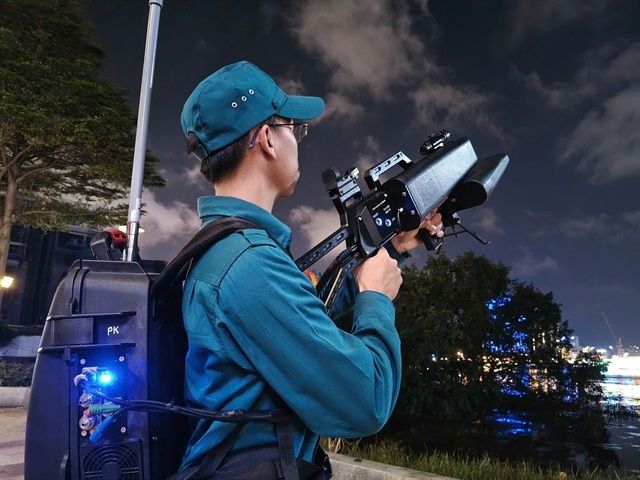
Vietnam's authorities are escalating their crackdown on illegal drone operations near airports, responding to what they characterise as an alarming spike in unauthorised aerial incursions that threaten aviation safety and impose staggering financial penalties on the sector. The Immigration Department, operating under the Ministry of Public Security, has issued a public warning emphasising that drone flights in airport restricted zones without proper authorisation represent an increasingly serious threat to the orderly movement of aircraft and the safety of passengers and crew across the nation.
The scale of the problem has become impossible to ignore. Official data reveals that Vietnam recorded 34 cases of drones or other unauthorised aircraft penetrating restricted airspace around airports during 2025, a figure that appears alarming enough until compared with the accelerated pace in 2026, when 17 additional incidents occurred in just the first six months. This trajectory suggests the situation is worsening rather than stabilising, placing pressure on regulators to enforce existing rules more strictly and consider additional protective measures at critical infrastructure sites.
When a drone breaches airport airspace, the response is immediate and disruptive. Air traffic controllers must interrupt normal operations, compelling them to halt aircraft preparing for departure, suspend incoming landings, or redirect planes already in flight to alternative airports to eliminate any possibility of a mid-air collision. These emergency protocols, while essential for safety, create cascading delays and operational chaos that ripple through the aviation network, affecting hundreds of passengers on each affected flight and straining the logistics capabilities of airlines and ground services.
The financial consequences have become substantial enough to alarm industry stakeholders. Vietnam Airlines reported that drone-related disruptions occurring between February 17 and 24 alone inflicted losses of approximately VNĐ5.6 billion, equivalent to roughly US$215,000 in a single week, while simultaneously upending travel plans for approximately 9,200 passengers who experienced either significant delays or schedule changes to their reservations. Meanwhile, Danang International Airport calculated its direct losses from such incidents at more than VNĐ10 billion, or approximately US$384,000, though officials acknowledged this figure excludes the indirect economic damage sustained by airlines, freight operators, travel agencies and individual travellers forced to absorb the consequences of operational disruptions.
Beyond the quantifiable economic toll lies a more profound concern: the potential for catastrophe. Officials emphasise that if a drone were to strike an aircraft during the vulnerable phases of takeoff or landing, when planes are moving slowly and near the ground with limited manoeuvrability, the consequences could be devastating. A collision at such moments could compromise aircraft structural integrity or disable critical systems, potentially causing a serious accident with loss of life among both passengers and crew members whose safety depends on uninterrupted flight operations.
Vietnam's legal framework governing drone operations is comprehensive, though clearly not sufficiently respected or enforced. Drone owners are required by law to register their aircraft with authorities and obtain a flight permit before any operation, with registration alone providing no authorisation to fly. The permits issued to compliant operators specify precisely where flights may occur, the maximum altitude permissible, the time windows during which operations are allowed, and the scope of activities authorised, creating a structured system designed to prevent conflicts with commercial air traffic and protect sensitive airspace.
Violators face consequences calibrated to match the severity of their breach. Administrative and civil penalties apply to lesser infractions, while more serious violations trigger criminal liability. A government decree enacted in 2025 authorises authorities to impose financial penalties, seize drones, and suspend the flight privileges of individuals who violate regulations. However, the most significant legal exposure applies to those whose drone operations create genuine risks to aviation safety rather than merely technical infractions.
Criminal charges can be brought in cases where a drone obstructs air traffic or represents a serious threat to aviation safety, and notably, prosecution does not require an actual accident to have occurred. An operator who deliberately or recklessly flies a drone into the approach path, takeoff path, or landing path of an aircraft—creating measurable risk of collision—can face criminal charges. Penalties for such offences range from administrative fines of between VNĐ10 million and VNĐ50 million (US$384 to US$1,920), to non-custodial reform of up to two years, to imprisonment for three months to two years depending on circumstances and intent.
Beyond incarceration and fines, convicted individuals lose additional privileges. Courts can impose professional disqualifications, barring the offender from holding certain employment positions or government roles for between one and five years, effectively limiting their livelihood options and creating a genuine career consequence for illegal drone operation. This multi-layered penalty structure demonstrates the seriousness with which Vietnamese law treats aviation safety threats.
The authorities have appealed to drone operators to strictly adhere to permit conditions, flying only within authorised times, locations and operational parameters. Simultaneously, they have launched a public campaign requesting citizens to report suspicious or unauthorised drone activity near airports to police, military forces, or airport security personnel, effectively creating a broader surveillance net that encourages community participation in enforcing aviation safety standards.
From a regional perspective, Vietnam's approach to drone regulation mirrors growing concerns throughout Southeast Asia about the intersection of consumer technology and critical infrastructure security. As drone ownership becomes more affordable and accessible, aviation authorities across the region face similar challenges managing risk without stifling legitimate recreational and commercial use. Malaysia and other ASEAN nations facing comparable issues may observe Vietnam's enforcement escalation with considerable interest, particularly regarding how clearly defining criminal thresholds and imposing substantial penalties influence public compliance.
Vietnam's government has framed aviation safety as a shared societal responsibility, arguing that irresponsible drone use carries implications extending far beyond the individual operator. The rhetoric emphasises cascading effects on human life, the smooth functioning of air transport networks essential to economic activity, and national security interests. This framing suggests that authorities intend to maintain pressure on enforcement while seeking to cultivate greater public awareness of the genuine risks posed by unauthorised drone operations near busy airports.

