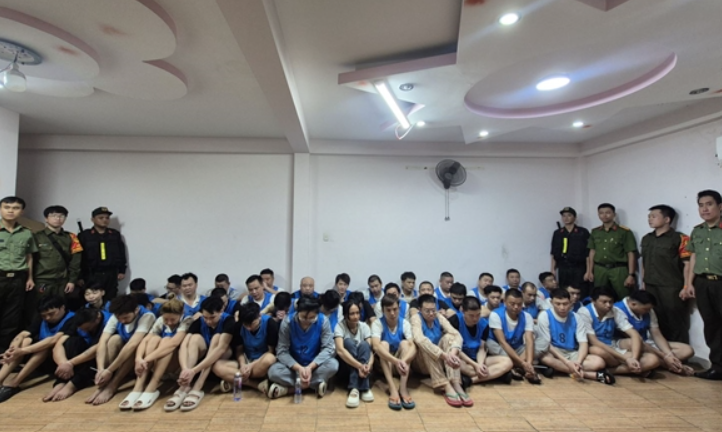
Ho Chi Minh City's security forces have successfully dismantled an organized smuggling and cybercrime network that was deliberately importing foreign nationals to establish sophisticated online fraud operations targeting victims across multiple countries. The crackdown, involving 22 coordinated task forces working alongside specialist units and district-level law enforcement, has resulted in charges against 26 suspects across eight criminal cases and the seizure of hundreds of electronic devices. The operation represents a significant enforcement victory against transnational organized crime and highlights the vulnerability of major Southeast Asian hubs to being exploited as bases for international cybercriminal enterprises.
The investigation began when authorities conducted systematic inspections of accommodation facilities across Ho Chi Minh City, examining nearly 1,616 establishments to identify foreign nationals operating in violation of immigration and residency regulations. Inspectors discovered 160 facilities that had failed to properly register temporary residence for their foreign guests and identified 311 foreign nationals engaged in various legal violations, ranging from immigration offenses and undocumented employment to unlawful residence and activities bearing hallmarks of criminal conduct. These inspections, conducted with meticulous attention to detail, revealed a troubling pattern of accommodation operators either deliberately overlooking their obligations or willfully assisting foreign nationals to evade proper documentation procedures.
A May 18, 2026 administrative inspection of an establishment in Thuan Giao Ward provided the initial breakthrough that would unravel the entire smuggling operation. Authorities discovered 85 Chinese nationals residing at the location without having completed mandatory immigration registration. The subsequent seizure of nearly 200 computers, approximately 550 mobile phones, and numerous other sophisticated electronic devices immediately signaled that this was no ordinary immigration violation. Further investigation revealed that these individuals had been deliberately dispatched from abroad to reconnoiter suitable locations, arrange accommodation, establish secure network infrastructure, and assemble technical equipment necessary to launch a transnational online fraud operation center. The suspects had structured detailed plans to recruit additional personnel through formal training programs and systematically defraud foreign victims.
The investigation team's deeper analysis uncovered a sophisticated organizational structure operating with clearly compartmentalized responsibilities. Different individuals specialized in distinct functions, including locating and leasing premises, arranging accommodations for incoming operatives, installing encrypted communication networks, maintaining computers and servers, and overseeing personnel management to sustain criminal activities. This hierarchical model reflected professional criminal enterprise architecture rather than ad-hoc fraudulent activity. Police determined that accommodation operators, motivated primarily by substantial financial returns, had deliberately compromised their oversight responsibilities and knowingly facilitated illegal entry and residence arrangements for foreign nationals engaged in criminal enterprise.
Subsequent discoveries reinforced investigators' understanding of the operation's scale and sophistication. On June 8, police identified a gathering of 83 additional Chinese nationals at a hotel in Binh Duong Ward, where equipment and devices had been systematically assembled for fraudulent online operations. Days later, on June 17, authorities conducting a residency compliance check at a residence in Hiep Bình Ward apprehended 42 foreign nationals occupying the premises in contravention of regulations. Electronic devices and digital data recovered at this location contained evidence directly linking occupants to online fraud activities. These sequential discoveries indicated that the criminal network operated through multiple simultaneously active cells, allowing compartmentalization of operations and mitigation of risks posed by law enforcement intervention.
The criminal conduct targeted by prosecutors falls under Article 348 of Vietnam's Penal Code, which specifically addresses organizing or enabling others to remain illegally in the country. The eight cases brought against 26 suspects encompassed not only the foreign nationals directly engaged in fraud operations, but also domestic accommodation operators and intermediaries who facilitated the smuggling arrangements. This comprehensive charging strategy reflects prosecutors' recognition that international criminal enterprise cannot succeed without corrupt domestic actors providing logistical support and local operational infrastructure. Authorities have moved to place suspects in pre-trial detention pending judicial proceedings.
For Malaysia and other Southeast Asian nations, this enforcement action carries significant implications regarding transnational cybercrime threats. Vietnam's vulnerability as a staging ground for international fraud operations suggests similar risks exist throughout the region, particularly in major commercial and tourism hubs where large volumes of transient foreign populations provide cover for criminal operators. The sophistication evident in this network—with pre-positioned equipment, trained personnel, and organized command structures—indicates that online fraud has evolved beyond loose collections of individual scammers into structured criminal enterprises comparable to traditional organized crime syndicates. Regional law enforcement agencies must anticipate increased attempts to exploit their territories for similar purposes.
The Ho Chi Minh City Police have emphasized that accommodation operators motivated by profit incentives represent a critical vulnerability in border and internal security frameworks. Establishments that have relaxed identity verification procedures or failed to complete mandatory temporary residence registration create predictable entry points for criminal networks to embed themselves within legitimate hospitality sectors. Police warnings specifically cited instances where operators had knowingly permitted foreign nationals to enter illegally, demonstrating active complicity rather than negligent oversight. Prosecution authorities have signaled that accommodations and operators facilitating such arrangements face severe criminal penalties under Vietnamese law, establishing deterrence against future involvement.
The police have issued detailed guidance to accommodation facilities, hotels, guesthouses, and rental apartment operators throughout Ho Chi Minh City, demanding strict compliance with residency management regulations, thorough identity document verification, and timely completion of temporary registration procedures. Critically, authorities have requested that suspicious activities be reported immediately to law enforcement, attempting to transform the hospitality sector into an extended surveillance network for detecting criminal enterprises. This represents a significant expansion of law enforcement's reliance on commercial operators to function as de facto border agents and security monitors, a practice that presents both practical and civil liberties considerations for the broader regional tourism industry.
Vietnam's police leadership has explicitly acknowledged the connection between the nation's integration into regional and global economic systems, its attractive investment environment, and its substantial tourism sector to criminal exploitation. Officials have pledged to deploy heightened screening and management protocols for foreign nationals within Ho Chi Minh City and have committed to early-stage risk identification for crime involving foreign elements, particularly high-technology and transnational fraud schemes. This enforcement commitment reflects international organized crime's increasing sophistication and willingness to exploit economic liberalization and cross-border connectivity as operational resources.
The crackdown occurs against a backdrop of escalating fraud victimization throughout Vietnam and the broader Southeast Asian region. Police have specifically warned the public about increasingly refined criminal methodologies, particularly fraudulent schemes marketed under deceptive "holiday ownership" frameworks that extract substantial financial commitments from victims through false promises. Authorities have explicitly appealed to individuals who have knowingly participated in or provided assistance to criminal enterprises to voluntarily surrender and cooperate with investigators, offering potential consideration for lenient treatment. This appeal represents recognition that dismantling organized networks requires intelligence from insiders familiar with operational structures and participant networks.
Beyond the immediate enforcement victory, this operation underscores the necessity for enhanced cooperation among Southeast Asian law enforcement agencies in addressing transnational cybercrime. Criminal networks that deliberately import operatives across borders demonstrate the inadequacy of single-nation responses. The involvement of Chinese nationals being directed from abroad to establish Vietnam-based operations suggests international criminal coordination extending across multiple jurisdictions and requiring multilateral investigation frameworks. Regional governments must strengthen information-sharing mechanisms, establish joint task forces focused on emerging transnational threats, and coordinate visa and immigration policies to constrain the mobility that such enterprises depend upon for operational sustainability and personnel rotation.