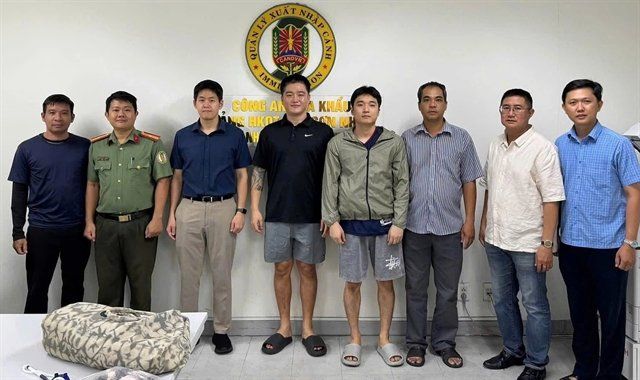
Vietnamese law enforcement agencies have intensified cross-border cooperation with South Korean authorities, securing the arrest and extradition of four individuals implicated in elaborate online fraud operations. The most recent coordinated action saw Ho Chi Minh City police apprehend three South Korean suspects on August 3, marking a significant breakthrough in combating transnational cybercrime that has plagued East Asian victims in recent years.
The arrested individuals—Wang Taesan, Han Joonhee, and Bang Giseong—were wanted internationally on Interpol red notices following complaints lodged by South Korean law enforcement. These suspects allegedly orchestrated a sophisticated criminal network that targeted South Korean citizens through multiple deceptive schemes coordinated across digital platforms. The arrests represent collaboration between the Ho Chi Minh City Police Investigation Office, the Ministry of Public Security's Police Investigation Agency, and various supporting units, demonstrating Vietnam's commitment to regional security cooperation.
One particularly insidious scheme employed by the criminal network involved threatening victims with alleged compromising videos. The perpetrators would contact targets, falsely claiming to possess intimate or sensitive recordings and demanding substantial payments under threat of public release. However, investigators determined that the suspects never actually possessed such materials, making the extortion purely based on psychological manipulation and fear. This modus operandi exploited the vulnerability of individuals concerned about their privacy and reputations in an increasingly connected digital environment.
The criminal operation became more sophisticated through the second layer of their deception strategy, which relied on impersonation of legitimate authority figures. Suspects assumed identities of South Korean prosecutors, law enforcement officials, and other government representatives, initiating contact with victims via telephone and electronic communication. They provided fraudulent documentation, including forged arrest warrants and official-looking communications bearing the victims' names, lending apparent legitimacy to their false claims.
The psychological manipulation escalated when perpetrators informed victims that their bank accounts had been connected to criminal investigations or money laundering operations. Seized by panic and believing themselves to be subject to legal scrutiny, victims complied with demands to transfer funds to accounts designated by the criminals as part of supposed account "verification" procedures. This variation of advance-fee fraud leverages victims' fear of legal consequences and loss of financial access to compel payment cooperation.
The three suspects were transferred to South Korean custody at Tan Son Nhat International Airport in Ho Chi Minh City, following formal extradition procedures that underscore strengthening law enforcement coordination between Vietnam and South Korea. This handover demonstrates the practical application of international criminal justice mechanisms in managing cross-border criminal activity, particularly within Southeast Asia and Northeast Asia.
The cooperation extends beyond this single case. Earlier in the year, Hanoi-based police units working with immigration authorities at Noi Bai International Airport successfully apprehended and extradited another South Korean national, Lee Sammin, who was similarly flagged on Interpol red notices. Lee Sammin's criminal operation employed a distinct but equally deceptive methodology, targeting individuals through social media platforms and internet channels by assuming false identities as investment professionals and financial experts.
Lee Sammin's fraud ring disseminated misleading information regarding shares allegedly preparing for stock market listing, encouraging victims to invest capital under the premise of securing positions in high-potential companies. The network systematically collected funds from multiple victims under false pretenses, ultimately misappropriating approximately US$10,693,343. This large-scale investment fraud demonstrates how cybercriminals exploit public enthusiasm for financial opportunities and investment growth, particularly among individuals seeking alternative income sources.
These cases illustrate how transnational criminal networks have adapted their methodologies to exploit digital communication channels and cross-border banking systems. The perpetrators deliberately selected Vietnam as an operational base, likely recognizing advantages including accessibility to international financial networks, less stringent regulatory oversight in certain jurisdictions, and distance from direct law enforcement attention in their home country. By operating from Southeast Asian locations, these criminals created geographical separation between themselves and investigative authorities in South Korea.
For Malaysian readers and Southeast Asian observers, these cases carry significant implications regarding cybercrime vulnerability across the region. Malaysia, with its developed banking infrastructure and large population of active internet users, represents a potentially attractive target for similar criminal networks. The sophistication of these fraud operations—including identity spoofing, forged documentation, and psychological manipulation—suggests that local communities face comparable threats regardless of nationality or location.
The successful prosecutions also highlight the importance of public awareness regarding common fraud tactics employed by international criminal syndicates. Individuals should exercise extreme caution when receiving unsolicited communications from purported government officials, particularly requests involving urgent financial transfers or verification procedures. Legitimate law enforcement rarely initiates contact through unconventional channels or demands immediate payment.
Vietnam's proactive approach to investigating these cases and facilitating extradition sends a message that Southeast Asian nations are increasingly serious about combating cybercrime and supporting international justice mechanisms. The collaboration between Vietnamese and South Korean authorities suggests emerging protocols for managing digital-era criminal activity that transcends traditional borders. As cybercriminal networks continue evolving their tactics and expanding their reach throughout Asia-Pacific, similar cooperative frameworks will become essential for maintaining regional security and protecting citizens from exploitation.

