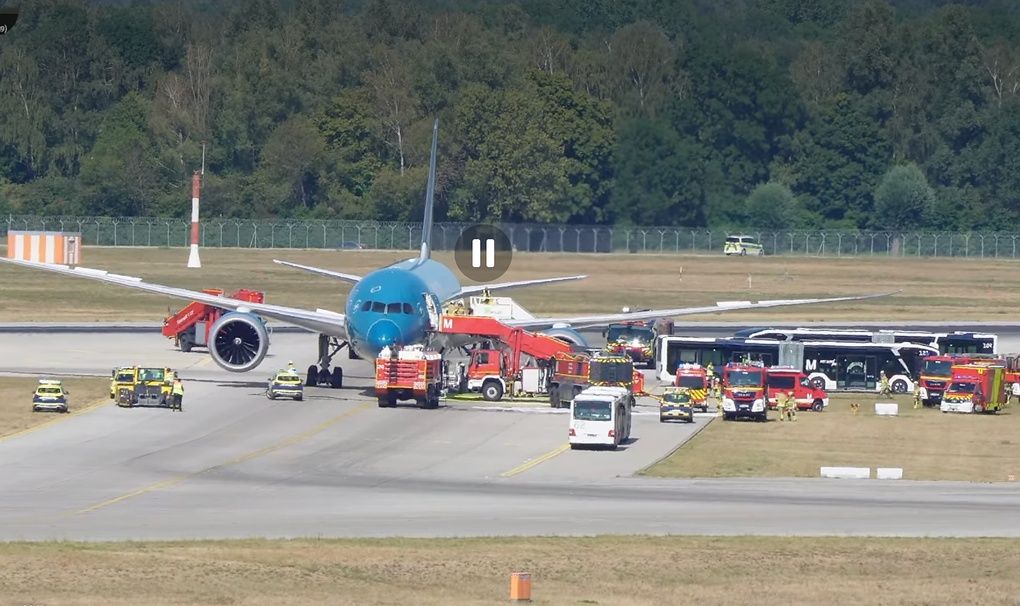
Vietnam Airlines executed an emergency return to Munich Airport on August 15 after a Boeing 787-9 aircraft experienced a technical problem during its ascent toward Southeast Asia. The wide-body jet, which had just departed for Hanoi carrying several hundred passengers and crew, climbed initially before the crew detected the issue and initiated procedures to bring the aircraft back to the German airport. The decision to reverse course came after the aircraft had already become airborne, a move that required coordination with air traffic control and emergency response teams on the ground.
According to aviation tracking reports, the incident unfolded with considerable urgency. The Boeing 787 appeared to have rotated at an unusually late point during its takeoff run, with observers near the airport noting that the aircraft lifted off very close to the end of the runway. This late rotation maneuver, captured in videos by witnesses at the airport, raised immediate concerns among aviation professionals monitoring the event. The Aviation Herald, a respected independent aviation incident database, documented that the aircraft subsequently experienced a tailstrike—where the rear fuselage makes contact with the runway—and a partial runway overrun before fully clearing the surface.
The physical evidence of the incident became apparent as the aircraft climbed away from Munich. The contact with the runway surface caused damage to the aircraft's tires, producing visible smoke and indicating the severity of the ground contact. Despite these complications, the crew maintained control of the aircraft and initiated a climbing turn to establish what would become a holding pattern at approximately 9,000 feet. This altitude allowed the flight crew to assess the damage, consult with maintenance specialists on the ground, and make decisions about the aircraft's airworthiness.
Emergency protocols activated swiftly at Munich Airport as the situation developed. Ground personnel and emergency services were placed on standby in anticipation of the aircraft's return, a precautionary measure standard in such circumstances. The crew spent roughly two hours executing a controlled descent and approach, circling to either burn excess fuel or allow sufficient time for ground teams to prepare recovery procedures. This measured response reflected professional airmanship and adherence to established safety protocols during an unusual situation.
When the aircraft touched down for the second time at Munich, it did so under controlled conditions with emergency services standing ready. The transition from an operational crisis to a managed landing demonstrated the effectiveness of crew training and international aviation safety standards. All passengers and crew members disembarked safely into the terminal, with no reports of injuries or casualties throughout the incident. Vietnam Airlines immediately began accounting for all individuals aboard and establishing their status.
The airline's response to the incident emphasized its commitment to passenger care and transparency. Vietnam Airlines activated its passenger assistance protocols, arranging alternative accommodations and rebooking passengers on subsequent flights to complete their journeys to Hanoi and other destinations. The carrier coordinated with airport authorities and relevant German aviation regulators to preserve evidence and conduct a comprehensive investigation into what had triggered the technical malfunction.
For Southeast Asian travelers, particularly those who depend on Vietnam Airlines' extensive European and Asian network, the incident underscores both the robustness of modern aircraft systems and the critical importance of maintenance culture. Vietnam Airlines operates a fleet of modern wide-body aircraft, including Boeing 787 Dreamliners and Airbus A350 jets, connecting Vietnam's major hubs in Hanoi and Ho Chi Minh City with European gateways in Munich and Frankfurt. The carrier's selection of contemporary aircraft reflects an investment in safety and efficiency, though individual incidents can shake passenger confidence regardless of overall fleet performance.
The specific technical nature of the malfunction remained under investigation as authorities gathered data and aircraft logs. Such investigations typically involve the airline's engineering team, the aircraft manufacturer Boeing, German aviation authorities, and potentially international aviation safety bodies. The focus would extend beyond the immediate cause to examine whether maintenance records, pre-flight inspections, or crew procedures contributed to the situation.
This incident comes at a time when air travel to and from Vietnam remains a significant component of the country's tourism and business connectivity with Europe. Munich Airport serves as a crucial hub for traffic between Southeast Asia and continental Europe, with Vietnam Airlines representing a major carrier on this route. Any disruption, even temporary, affects not only the passengers directly involved but also ripples through the broader travel ecosystem connecting the two regions.
Investigations of this nature typically require several weeks to months for completion, involving detailed analysis of maintenance records, flight data recorders, and cockpit voice recordings. Vietnam Airlines pledged to provide comprehensive updates once technical inspections concluded and operational plans were finalized. The transparency of such communications proves vital for maintaining traveler confidence and demonstrating the airline's commitment to safety standards expected by international aviation authorities and the traveling public.

