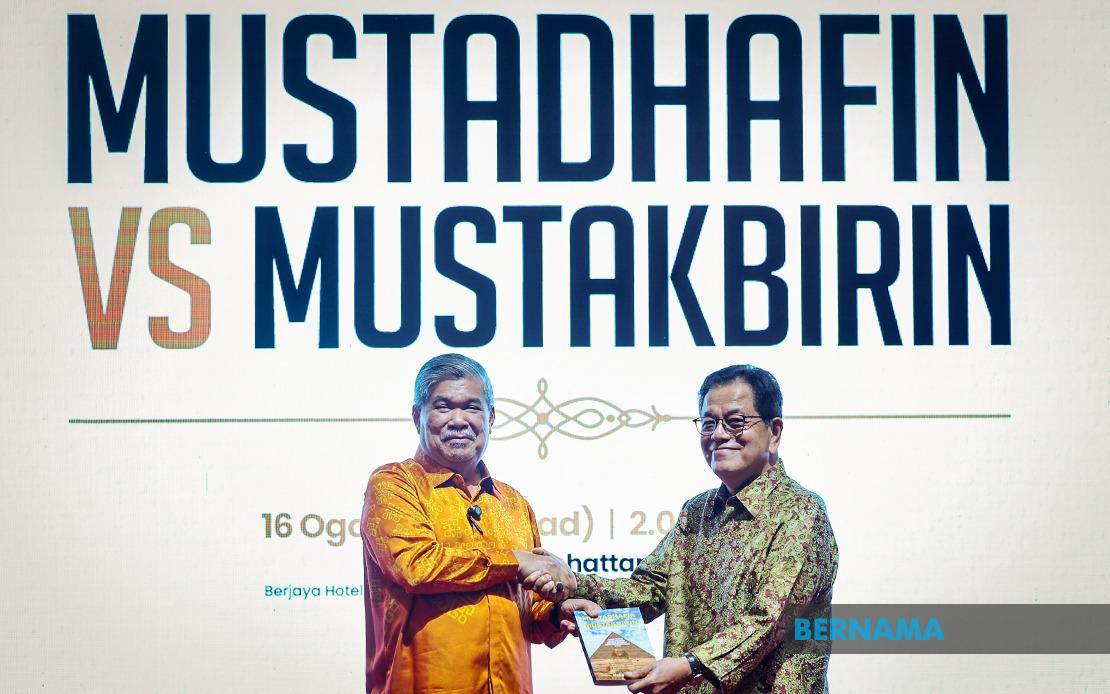
Datuk Seri Mohamad Sabu, president of the Amanah party and Minister of Agriculture and Food Security, has issued a stark warning about the dangers of accepting political allegations without proper verification, arguing that uncritical acceptance of claims feeds into tribalistic mindsets that cloud public judgment.
Speaking after launching his book in Kuala Lumpur, Mohamad stressed the importance of scrutinising information before forming opinions on contentious issues. He cautioned that blind acceptance of allegations cultivates 'asabiyyah'—a concept rooted in Islamic scholarship describing group loyalty that persists even when one's own faction is demonstrably wrong, while simultaneously dismissing the positive actions of rivals. This psychological tendency, he suggested, represents a fundamental threat to rational political discourse and informed democratic participation.
The minister's remarks carry particular weight given the recurring nature of specific accusations in Malaysian political discourse. He directly addressed persistent claims that the Democratic Action Party (DAP) harbours communist sympathies and that any political cooperation with the party constitutes implicit support for communism. Rather than dismissing such allegations outright, Mohamad posed a deliberative question: whether evidence genuinely supports the contention that DAP operates as a communist organisation. This rhetorical approach invites citizens to engage in genuine fact-checking rather than defaulting to inherited assumptions or partisan narratives.
Central to Mohamad's argument is an observation about the asymmetrical nature of how information circulates in the modern media landscape. Facts and substantive knowledge demand considerable cognitive effort to comprehend and evaluate, making them harder for audiences to absorb and retain. Conversely, accusations and suspicions require minimal intellectual processing and spread with remarkable speed, particularly through social media platforms where sensationalism often outpaces accuracy. This structural imbalance means that without deliberate effort to counter it, false or misleading claims can dominate public consciousness far more effectively than comprehensive, nuanced truths.
The Amanah leader grounded his appeal in personal testimony, recounting his longstanding practice of independently investigating matters rather than passively absorbing information circulating within his circles. From his youth, he explained, he resisted the temptation to accept hearsay uncritically, instead seeking firsthand understanding of situations. This methodology, he suggested, inoculates individuals against propaganda while building a more resilient epistemological foundation for political judgment. His philosophy reflects a broader intellectual tradition within Islamic thought that emphasises verification and personal investigation as prerequisites for justified belief.
Mohamad's book, which was formally launched by National Journalism Laureate Tan Sri Johan Jaaffar—a director of Star Media Group Berhad—documents his personal journey of seeking to comprehend political and policy issues through direct engagement rather than reliance on secondhand accounts. The work chronicles his encounters with various political actors and entities as he endeavoured to grasp complex situations based on observable reality rather than accepting circulating narratives at face value. For Malaysian readers navigating an increasingly fractious political environment, such first-person documentation of investigative thinking offers a counterweight to the polarised discourse dominating much public commentary.
Beyond domestic Malaysian politics, Mohamad's book extends into the realm of international relations and historical analysis. The publication examines global geopolitical dynamics through the lens of his experiences and observations, touching upon colonialism, the Islamic movement globally, the Palestinian conflict, and shifting distributions of global power. This broader perspective contextualises Malaysian political debates within larger historical and geopolitical frameworks, suggesting that parochial sectarianism obscures the international dimensions of contemporary challenges facing developing nations like Malaysia.
The timing of these remarks proves significant given Malaysia's ongoing experiment with multi-party coalitions and the persistent deployment of historical accusations to delegitimise political opponents. The Amanah president's intervention suggests growing frustration within certain political circles with the perpetual recycling of unexamined claims as campaign material. His call for rigorous fact-checking represents an implicit critique of political actors across the spectrum who rely on inflammatory rhetoric rather than substantive policy differentiation to mobilise supporters.
For Southeast Asian observers, Mohamad's emphasis on verification resonates beyond Malaysia. The region has witnessed the rise of disinformation campaigns affecting multiple countries, with false narratives about neighbouring states and domestic opponents spreading rapidly through social networks. His argument that citizens bear responsibility for independently verifying claims before accepting them speaks to a broader need for heightened media literacy and epistemological vigilance across the region. As digital platforms increasingly mediate political discourse, the ability to distinguish fact from fiction becomes foundational to democratic health.
The minister's intervention also touches upon the role of leadership in shaping public discourse norms. When senior political figures model critical thinking and publicly resist the temptation to exploit unverified allegations for partisan advantage, they create space for broader cultural shifts in how political communities engage with information. Conversely, when leaders consistently deploy sensationalised claims without supporting evidence, they normalise credulity and reward the most inflammatory rhetoric. Mohamad's public stand suggests a minority perspective within Malaysian politics—one that places epistemological responsibility above short-term electoral advantage.
Ultimately, the Amanah president's message advocates for a form of cognitive discipline that runs counter to contemporary political incentives. In an environment where emotional resonance often proves more electorally potent than factual accuracy, his call for systematic verification represents a countercultural position. Yet the persistence with which he articulates this message, and his willingness to ground it in personal testimony and written reflection, suggests conviction that long-term political stability requires citizens and leaders capable of resisting the siren song of unexamined allegations. For Malaysia and the broader region, whether such calls for epistemic rigour gain traction may prove determinative of whether political competition remains compatible with social cohesion.

