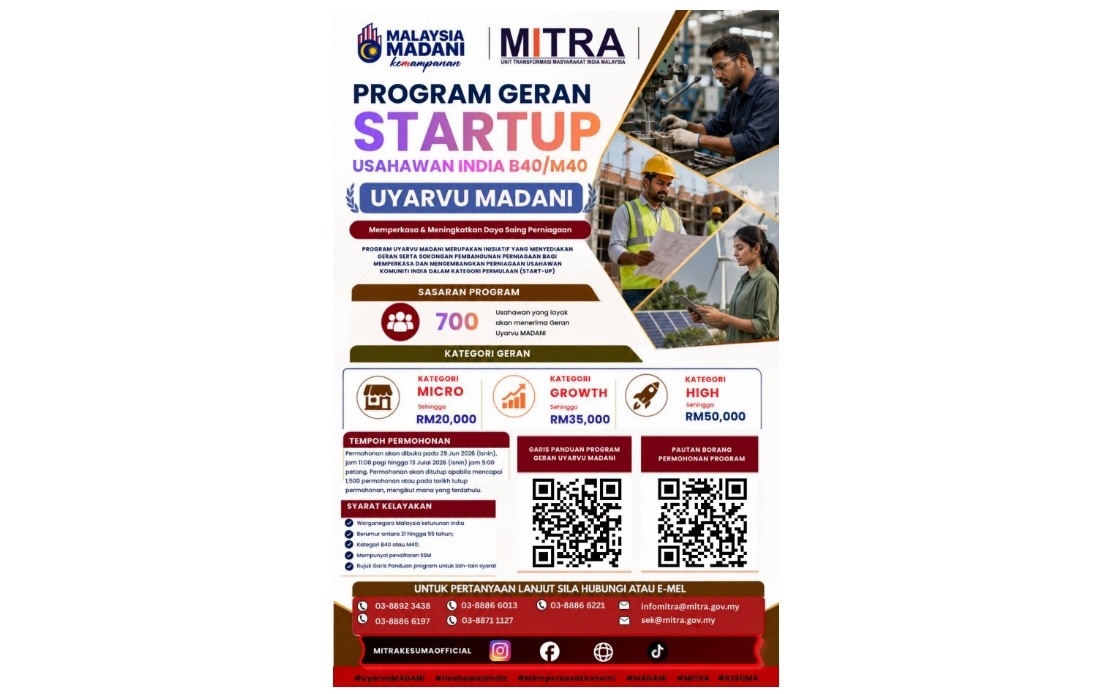
The Malaysian Indian Transformation Unit (MITRA) has opened applications for the Startup Accelerator Grant Assistance Programme, known as Uyarvu MADANI, beginning immediately and continuing through 5 pm on July 13. This initiative represents a targeted effort to support entrepreneurship within Malaysia's Indian community, particularly those earning less than the national median income.
The scheme is specifically designed for business owners and prospective entrepreneurs from the Indian community whose household incomes fall within the B40 and M40 brackets—broadly defined as those earning below RM8,000 monthly and between RM8,000 and RM15,000 respectively. Successful applicants will receive financial support ranging from RM20,000 to RM50,000, amounts intended to provide meaningful capital for business establishment or expansion without requiring repayment, as these are grants rather than loans.
MITRA aims to distribute grants to approximately 700 entrepreneurs through this programme, making it one of the larger community-focused funding initiatives in recent years. Each recipient will also gain access to structured business development support, recognising that funding alone is insufficient for startup success. This mentoring and advisory component addresses a significant gap in the Indian entrepreneurial ecosystem, where access to business expertise and networking opportunities has historically lagged behind resources available to other communities.
The application window features an accelerated closure mechanism designed to manage administrative capacity. Rather than waiting until the stated July 13 deadline, the programme will shut early if the organisation receives 1,500 applications. This approach suggests MITRA expects strong demand and wants to avoid bottlenecks in the assessment process. For potential applicants, this creates urgency—those genuinely interested should submit their applications well before the deadline to avoid missing out if the application cap is reached early.
Uyarvu MADANI forms part of a broader constellation of six new initiatives that MITRA is rolling out targeting the year 2026. The unit has allocated RM65.5 million across these six programmes, reflecting a significant institutional commitment to addressing disparities in entrepreneurial participation and wealth creation within the Indian community. This budgetary commitment indicates the government's recognition that targeted interventions are necessary to reduce economic inequality along ethnic lines.
The timing of this launch reflects ongoing policy emphasis on inclusive growth and community development. Malaysian Indian entrepreneurs have traditionally faced challenges in accessing startup capital and business support networks compared to their counterparts in other communities, despite contributing meaningfully to the broader economy. Programmes like Uyarvu MADANI seek to level this playing field by removing financial barriers and providing the guidance necessary for ventures to achieve sustainability and profitability.
For Malaysian and Southeast Asian context, this initiative mirrors regional trends toward community-specific economic programmes. Several nations in the region have implemented similar schemes targeting underrepresented groups in entrepreneurship, recognising that demographic diversity in business ownership strengthens overall economic resilience. The RM20,000 to RM50,000 grant range is pitched at a level that can meaningfully fund small retail operations, food businesses, service ventures, and light manufacturing—the sectors where Indian entrepreneurs have traditionally concentrated.
The B40 and M40 targeting is particularly significant, as it directs resources toward those with genuine difficulty accessing commercial financing from banks or other traditional lenders. These income groups typically lack sufficient collateral or credit history to qualify for conventional loans, making government grant programmes essential catalysts for business formation. By targeting these specific demographics, Uyarvu MADANI addresses a persistent structural disadvantage in wealth accumulation and entrepreneurial participation.
Potential applicants from the Indian community should note that the selection process will likely evaluate business plans, feasibility assessments, and the applicant's financial circumstances. Having a clearly articulated business concept and realistic financial projections will strengthen applications. The development support component suggests that selected entrepreneurs will be matched with mentors or advisors who can guide them through implementation, potentially improving survival rates compared to ventures launched with capital alone but without expert guidance.
The programme also signals MITRA's evolution beyond traditional welfare or affirmative action framing into a more economically productive paradigm centred on wealth creation and entrepreneurial development. This philosophical shift—from income support to capital provision and business skills development—reflects international best practices in community economic development. It assumes that community members, given appropriate resources and guidance, can generate sustainable income and employment rather than remaining dependent on government assistance.
Southeast Asian readers should understand that similar mechanisms are being tested across the region as governments grapple with inclusive growth challenges. Malaysia's approach through MITRA represents one model—community-specific units with dedicated budgets and targeted programmes. The Uyarvu MADANI scheme demonstrates how governments can use grants, rather than subsidies, to stimulate entrepreneurship while also building human capital through mentorship and business development support simultaneously.

