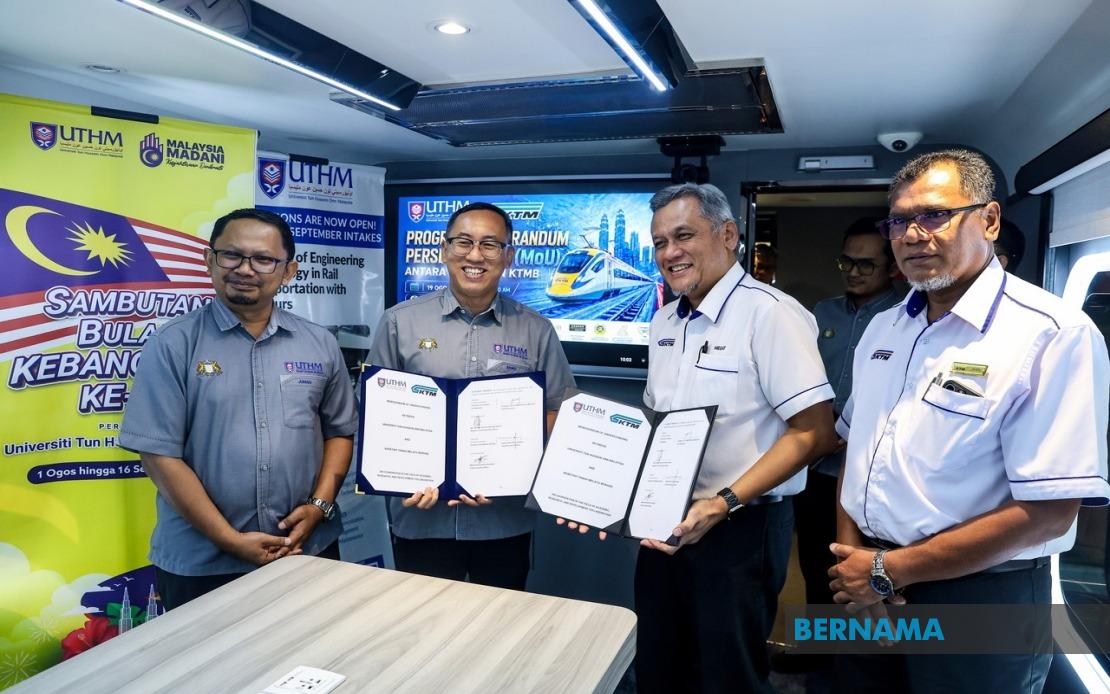
Malaysia's efforts to develop homegrown expertise in railway technology took a significant step forward as Universiti Tun Hussein Onn Malaysia (UTHM) and Keretapi Tanah Melayu Bhd (KTMB) formalised a strengthened three-year collaboration spanning from October 2026 through July 2029. The renewed partnership, which builds upon foundations laid in 2019, aims to bridge the gap between academic learning and practical industry application across multiple dimensions of rail transportation engineering and operations.
The expanded cooperation framework encompasses four primary pillars: work-based learning opportunities for students, collaborative research and development initiatives, professional competency building, and structured knowledge exchange between the institution and the national railway operator. This holistic approach reflects a broader recognition in Malaysia that sustainable competitive advantage in critical infrastructure sectors requires sustained dialogue between universities and industry partners. The arrangement was formalised during a symbolic ceremony aboard a KTMB chartered train travelling from Kluang Station to KL Sentral, coinciding with the launch of Rel Merdeka 69 and the 69th National Month Celebration at UTHM.
According to UTHM Vice-Chancellor Prof Dr Mas Fawzi Mohd Ali, the collaboration represents more than a transactional arrangement between two organisations. Instead, it exemplifies the university's commitment to its Global Technopreneur University 2030 (GTU2030) strategic vision, which seeks to weave together theoretical knowledge, cutting-edge technology, practical innovation, and entrepreneurial thinking into educational programmes that genuinely serve industry and society. The emphasis on work-based learning particularly allows students to move beyond textbooks and simulation, gaining direct exposure to rail operations, technological systems, and the real complexities that professional engineers encounter.
The track record of the previous collaboration offers compelling evidence of the partnership's effectiveness. Nearly 200 graduates from UTHM's Bachelor of Rail Transportation Engineering Technology with Honours programme have entered the workforce equipped with practical understanding of rail operations and technical capabilities developed through exposure to KTMB's systems and challenges. Notably, these graduates have secured positions not only within Malaysia's transport sector but also internationally, with employment in Singapore and Saudi Arabia demonstrating the quality and recognition of their training.
Work-based learning under the renewed arrangement provides students with opportunities to apply classroom theory directly within operational environments, develop technical and professional competencies that employers actively seek, and understand the practical constraints and priorities that shape industry decision-making. This immersive approach to education has become increasingly recognised as superior to conventional lecture-based formats for fields requiring hands-on expertise, particularly in engineering disciplines where understanding real-world conditions proves essential to professional effectiveness.
The research and development component of the partnership leverages complementary strengths from both parties. UTHM contributes academic rigour, research methodologies, and access to modern laboratory facilities, while KTMB provides operational data, technical challenges requiring practical solutions, and infrastructure knowledge accumulated through decades of railway management. This combination positions the collaboration to tackle genuine problems affecting Malaysia's rail network, from infrastructure maintenance and safety protocols to technological modernisation and operational efficiency. Such research outcomes benefit not only the immediate parties but potentially the entire domestic rail sector through disseminated findings and improved practices.
KTMB Chief Corporate Officer Megat Khairulazhar Khairodin emphasised that the partnership enables the railway operator to access UTHM's technological capabilities and research infrastructure to address operational and technical challenges systematically. Rather than treating problems in isolation, the structured collaboration creates pathways for academic investigation into issues affecting train systems and rail infrastructure. This approach facilitates evidence-based decision-making and positions Malaysia's national railway operator to adopt innovations emerging from university research rather than remaining dependent on overseas solutions.
The partnership extends beyond undergraduate education to encompass postgraduate and vocational training. Academic consultation services for diploma, bachelor's degree, and postgraduate programmes in rail transportation engineering technology at KTM Academy (MyRA) ensure that curriculum development reflects current industry needs and technological developments. Simultaneously, KTMB has supported staff development by sponsoring five employees to pursue master's degrees in rail-related fields at UTHM, signalling institutional commitment to building internal capability in strategic technical areas.
The structured exchange of industry expertise and academic knowledge through forums, academic visits, and competency development activities creates multiple touchpoints for innovation transfer and capability building. These activities extend beyond formal educational programmes to encompass professional development, allowing practitioners and academics to engage in substantive dialogue about emerging challenges, technological trends, and solutions being tested elsewhere in the global rail industry.
For Malaysia's broader transportation sector ambitions, this partnership model offers a template for how public enterprises can strengthen their technical capacity and innovation pipelines through strategic alignment with research-intensive universities. As the country pursues infrastructure modernisation and seeks to reduce technological dependency, such collaborations become increasingly vital. The rail sector particularly merits attention given its importance to urban mobility in cities like Kuala Lumpur and its role in regional connectivity across Southeast Asia.
The partnership also reflects international trends in how rail operators globally are addressing skills shortages and technological change. Many advanced rail systems have formalised university partnerships precisely to ensure pipeline continuity for specialised technical talent and to access research capabilities that individual operators cannot sustain independently. Malaysia's approach, through this UTHM-KTMB collaboration, positions the country competitively within regional and global contexts where rail technology expertise has become increasingly valuable.
Looking forward, the success of this renewed three-year partnership may serve as a foundation for even deeper integration between academic institutions and rail sector stakeholders. As Malaysia continues developing integrated transport systems and considering future technologies such as autonomous railway operations and advanced maintenance systems, the ecosystem for knowledge creation and talent development established through this collaboration will prove increasingly important to national competitiveness.

