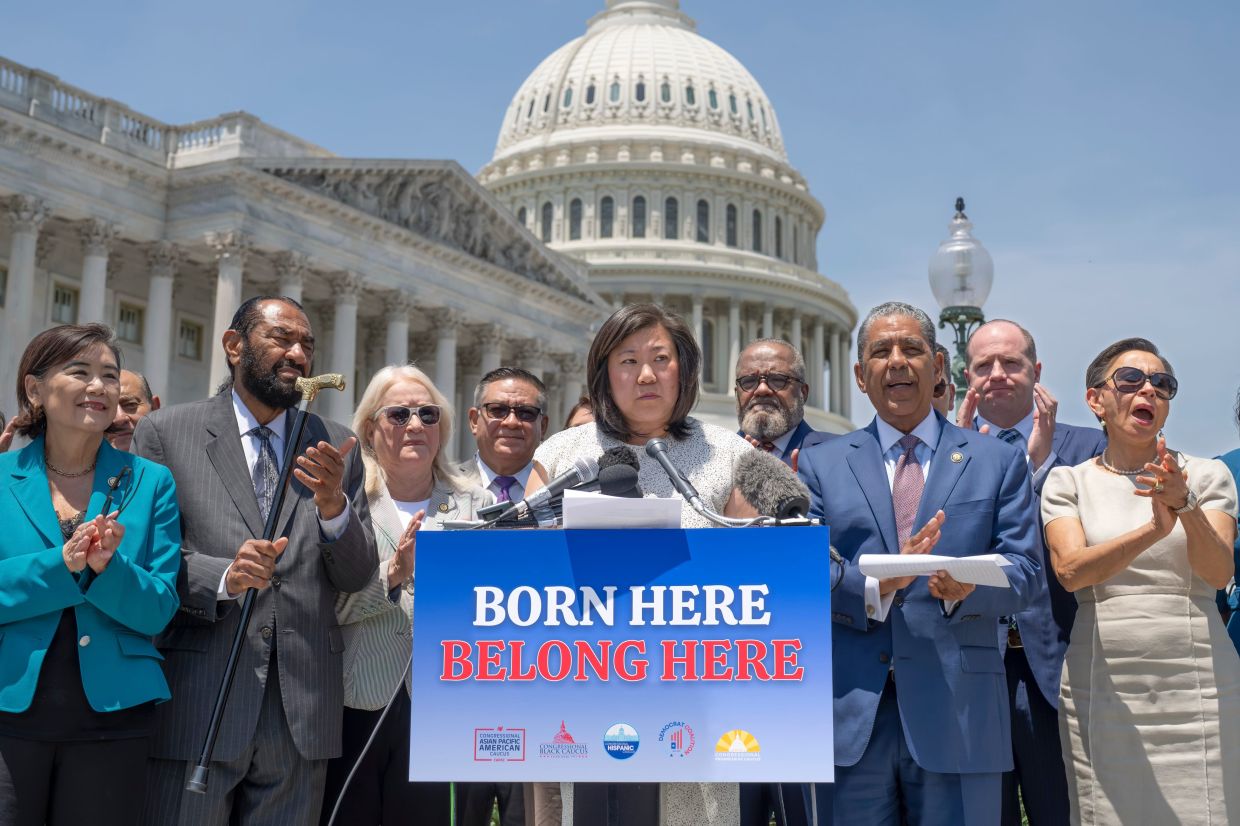
The United States Supreme Court has dealt a significant blow to one of President Donald Trump's signature second-term immigration initiatives, striking down an executive order that sought to curtail birthright citizenship. The 6-3 decision, rendered in the case Trump vs Barbara, affirmed that children born in the United States to undocumented parents or those holding temporary visas retain their constitutional right to citizenship, rejecting the administration's attempt to reshape America's foundational immigration principle.
Trump had signed the executive order in early 2025 with the intention to eliminate citizenship pathways for children born to parents lacking lawful permanent status or present on temporary visas. The policy was slated to begin implementation the following month but was ultimately struck down by the court before taking full effect. The president responded to the decision with characteristic defiance, declaring it "too bad" for the country while signalling his intention to pursue the same objective through congressional legislation rather than executive action, arguing that no constitutional amendment would be necessary for such a change.
The policy's scope was considerably broader than much public rhetoric suggested. Rather than focusing solely on undocumented immigrants, the Trump administration's order targeted individuals lawfully present in the United States and pursuing permanent legal status. This included professionals on highly skilled work visas such as the H-1B and L-1 categories, alongside student visa holders, temporary labour visa recipients, and achievement visa holders—all classified by the US Citizenship and Immigration Services as "lawful but temporary." Only children with at least one parent holding US citizenship would have retained automatic birthright status under the proposed order, creating a two-tiered system based on parental immigration classification.
The Supreme Court's majority opinion, authored by Chief Justice John Roberts, grounded its decision firmly in constitutional history and the original intent of the 14th Amendment's Citizenship Clause. Roberts wrote that "citizenship, then and now, was the right to have rights – to freely participate in our political community," emphasising that the Framers of the post-Civil War amendment extended that promise to "every free-born person in this land." The clause, ratified in 1868 to safeguard the rights of formerly enslaved persons and other minorities following the Civil War, has long been interpreted to grant citizenship to nearly all children born on American soil, irrespective of parental immigration status.
The legal foundation for modern birthright citizenship traces directly to the landmark 1898 Supreme Court case Wong Kim Ark, in which the court ruled that a child born to Chinese immigrant parents was entitled to US citizenship despite exclusionary laws targeting Chinese nationals. Wong, who had been denied re-entry to the United States after visiting China, was initially told he lacked citizenship under the Chinese Exclusion Act due to his parents' status. The Supreme Court's reversal established that nearly all persons born on US soil acquire citizenship regardless of parental nationality—a principle that has endured through successive waves of immigration restriction and racial discrimination. Norman Wong, the descendant of Wong Kim Ark, reflected on the ruling's historical significance, noting that his great-grandfather "was one man, only a cook, and yet he stood up for what was right," and that the Supreme Court's decision today affirms the continuing relevance of that 1898 victory.
The ruling carries particular resonance for Asian-American communities, which have built demographic and political influence precisely through the exercise of birthright citizenship rights. Stop AAPI Hate, an advocacy organisation tracking discrimination against Asian-Americans and Pacific Islanders, highlighted that Trump's administration deliberately targeted this pathway, noting that Asian-American communities "and other communities of colour have been able to grow in size and political power – and that is precisely why the Trump administration attempted to end it." Krish O'Mara Vignarajah, president of Global Refuge, an international non-profit working with refugees, characterised the outcome as a victory that prevented birthright citizenship from succumbing where it had previously endured threats, saying the ruling stopped an executive order that would have "essentially turned the maternity ward into a customs checkpoint."
Central to the Trump administration's case against birthright citizenship has been the allegation of "birth tourism," a controversial practice in which foreign nationals, particularly from China, allegedly enter the United States specifically to secure citizenship for their children. The administration's legal team, led by Solicitor General D. John Sauer in oral arguments before the Supreme Court in April, characterised birthright citizenship as having "spawned a sprawling industry of birth tourism," claiming that "uncounted thousands of foreigners from potentially hostile nations have flocked to give birth" in American territory. While this framing has become increasingly prominent in Trump's immigration rhetoric, the evidence cited centres on scattered prosecutions rather than systematic abuse.
The Justice Department's response to the Supreme Court decision underscores the administration's continued commitment to pursuing birth tourism prosecutions as an alternative avenue for reshaping citizenship access. In a memo distributed Tuesday afternoon, Colin McDonald, a senior Justice Department official, directed federal prosecutors to prioritise investigations into birth tourism schemes, pledging to "zealously protect the sanctity of United States citizenship by investigating and prosecuting those who fraudulently exploit our immigration system." The memorandum referenced a 2024 case in which Michael Wei Yueh Liu and Jing Dong, a married couple, were each sentenced to 41 months in prison for operating a birth tourism scheme that charged Chinese clients tens of thousands of dollars in fees to facilitate childbirth in the United States.
Yet conflating birth tourism with the broader question of birthright citizenship obscures a critical distinction. Birth tourism involves deceptive entry or fraud specifically to obtain citizenship benefits, already prosecutable under existing law. The Trump executive order, by contrast, would have categorically denied citizenship to millions of children whose parents were lawfully present through visa programmes, regardless of whether fraud or deception occurred. This broader approach represents a fundamental reinterpretation of constitutional citizenship rights rather than a targeted enforcement action against fraud—a distinction that shaped the Supreme Court's rejection of the policy.
The court's decision leaves Trump and his administration with limited options for achieving the same objective. The president has already signalled interest in pursuing legislative solutions through Congress, where Republicans hold majorities in both chambers. Amending the Constitution would require ratification by three-fourths of states and faces formidable practical obstacles, but statutory narrowing of birthright citizenship—if constitutionally permissible—could theoretically proceed through the legislative process. The Supreme Court's opinion, however, suggests that the 14th Amendment's language and historical intent provide limited room for statutory modification without constitutional amendment.
For Malaysia and Southeast Asia, the ruling carries implications for how the region's nationals interact with American immigration policy. The decision protects the citizenship rights of approximately one million children born annually to foreign nationals in the United States, many of them from Asian countries. The broader geopolitical context—wherein Trump has positioned his immigration restrictions partly as responses to strategic competition with China—also reflects tensions relevant to regional dynamics, as Chinese nationals have become a focal point for American anxiety about citizenship and demographic change. The Supreme Court's reaffirmation of birthright citizenship thus stands as a constitutional barrier against the kind of discriminatory citizenship policies that have historically targeted Asian immigrants and their descendants.
The fundamental tension exposed by this dispute concerns the nature of American citizenship itself. Should birthright citizenship remain tied to territorial presence and birth on American soil, or should it become contingent on parental legal status? The Supreme Court's answer reflects a centuries-long tradition, from the 14th Amendment through Wong Kim Ark to present day, holding that American citizenship law has traditionally extended beyond questions of parental status to embrace a territorial principle accessible to all born within American jurisdiction. Trump's defeat on this front does not eliminate the underlying political debate about immigration policy, but it does constrain the executive branch's unilateral power to reshape citizenship rules through administrative action alone.

