Two prominent Democratic lawmakers have escalated pressure on America's road safety regulator to independently assess the validity of Tesla's safety statistics for its Full Self-Driving assistance system, in response to a damaging investigation that exposed how the electric vehicle manufacturer has systematically misrepresented the technology's accident prevention capabilities.
Senators Edward Markey of Massachusetts and Richard Blumenthal of Connecticut submitted a formal letter to the U.S. National Highway Traffic Safety Administration on Monday, drawing directly on findings from a Reuters investigation conducted last month. The letter characterises Tesla's analytical methodology as fundamentally flawed, describing it as producing conclusions that are both "weak and misleading" whilst simultaneously creating what the senators describe as "an urgent safety problem" for the driving public.
The regulatory request demands that NHTSA provide written responses by July 7 to a series of pointed questions about its oversight activities. Central to their inquiry is whether the federal agency has conducted any evaluation of Tesla's FSD safety assertions or whether it has requested access to the underlying accident records and collision data upon which the company has built its public claims. This line of questioning suggests the senators suspect regulatory gaps that have allowed Tesla to make sweeping safety proclamations without independent verification.
Beyond immediate transparency concerns, the senators are advocating for systemic regulatory reform. They are pressing NHTSA to establish more rigorous reporting obligations for all manufacturers deploying autonomous driving technologies or advanced driver-assistance features comparable to Tesla's FSD system. The crux of their argument centres on a fundamental accountability problem: the current regulatory framework appears to provide no mechanism for ensuring that companies' public safety assertions bear any genuine correspondence to factual reality on the road.
Neither Tesla nor NHTSA officials have publicly commented on the senators' intervention. The silence from both parties reflects the heightened sensitivity surrounding autonomous vehicle oversight at a moment when public confidence in self-driving technology faces serious questions.
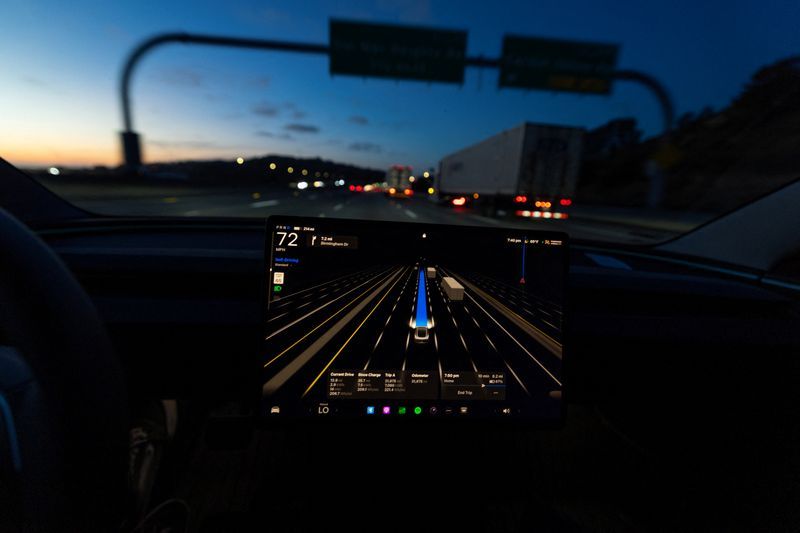
The Reuters investigation, which prompted this regulatory action, uncovered a pattern of misleading comparisons in how Tesla CEO Elon Musk and company leadership present their safety statistics to the public and regulators. Over the past twelve months, Tesla executives have repeatedly cited figures suggesting that FSD technology performs approximately ten times safer than human drivers. These claims have featured prominently in the company's marketing narratives and regulatory submissions.
However, independent researchers consulted during the Reuters examination identified critical methodological flaws undermining these conclusions. The central distortion involves Tesla's selection of comparison metrics: the company measures accident rates among vehicles operating under FSD control by counting only those collisions severe enough to deploy vehicle airbags. This threshold for inclusion is significantly more stringent than the baseline against which Tesla compares its performance—the national crash statistics for all American vehicles, which encompass minor fender-benders, parking lot collisions, and other low-severity incidents that would never trigger airbag systems.
This apples-to-oranges comparison mechanics artificially inflates the apparent safety advantage of Tesla's system. A researcher would need to compare Tesla's airbag-deployment crash rate against the airbag-deployment crash rate for the general vehicle fleet to reach any meaningful conclusion about relative safety performance. By comparing their highest safety threshold to the industry's lowest reporting standard, Tesla has constructed a statistical argument that appears scientifically sound to non-specialist audiences whilst misrepresenting fundamental truths.
Additionally, Tesla's methodology incorporates another significant bias through vehicle age demographics. The average Tesla vehicle in operation is substantially newer than the average automobile circulating on American roads, and newer vehicles inherently contain more advanced safety technologies implemented across the entire automotive industry over recent decades. Features such as electronic stability control, automatic emergency braking, and collision avoidance systems have become standard in recent model years, fundamentally reducing baseline accident frequencies regardless of autonomous capabilities. By contrasting its relatively new vehicles against a fleet average that includes vehicles from the early 2000s and 1990s, Tesla compounds the statistical distortion.
Tesla has employed these same problematic comparisons in formal submissions to European Union regulators as part of its ongoing effort to obtain official EU approval for deploying FSD technology within member states. The exportation of inflated safety claims to international regulatory bodies suggests this represents a deliberate strategy rather than analytical oversight, raising questions about the company's commitment to transparent safety assessment across different jurisdictions.
For Malaysian and Southeast Asian observers, this regulatory moment carries significant implications. As autonomous vehicle technology gradually enters development and testing phases across the region, the Tesla case demonstrates how easily manufactures can manipulate safety narratives through selective statistical presentation. The incident also highlights the urgent necessity for regulators in developing markets to establish independent verification protocols before granting approval for advanced driver-assistance and autonomous systems. Countries like Malaysia, which are developing regulatory frameworks for emerging automotive technologies, should carefully study how leading global regulators are responding to ensure that public safety remains paramount over commercial interests.
The senators' intervention suggests that American regulatory institutions may finally be mobilising to address accountability gaps in autonomous vehicle oversight. Whether NHTSA implements the substantive reforms requested—or whether this remains a largely symbolic gesture—will likely shape how other national regulators approach safety verification for next-generation driving technologies.