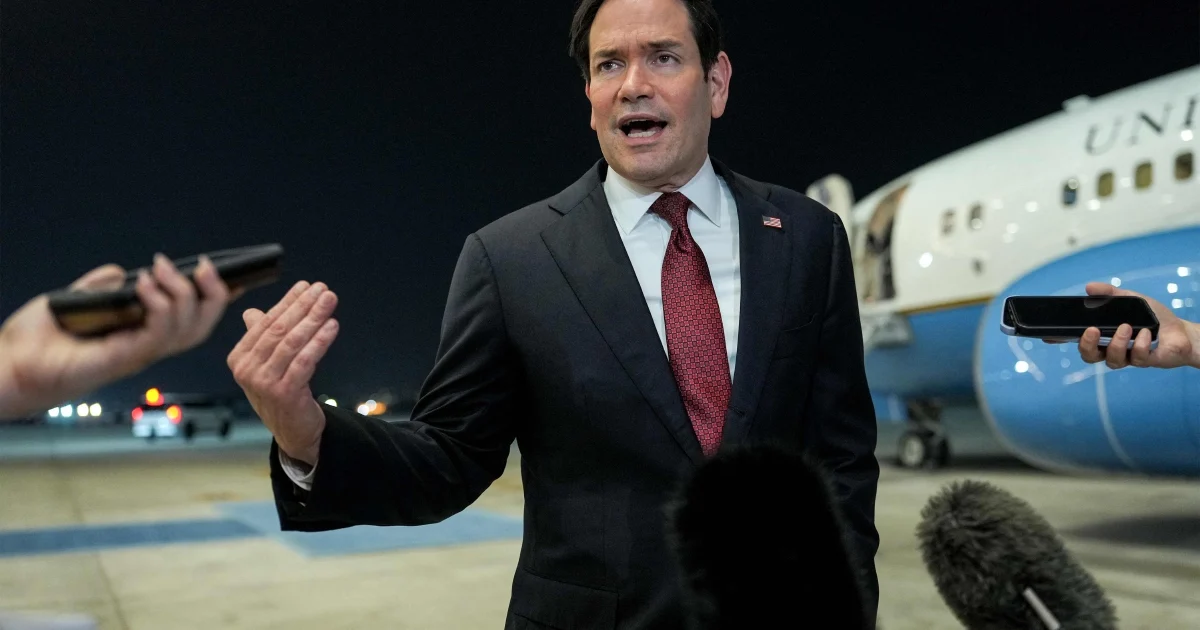
US Secretary of State Marco Rubio has drawn a firm line on one of the most contentious issues threatening to derail nascent negotiations aimed at resolving the Middle East conflict: Iran's assertion of authority over shipping lanes in the Strait of Hormuz. Rubio's unequivocal rejection of any toll or fee structure proposed by Tehran underscores how quickly diplomatic momentum can dissipate when fundamental interests collide, particularly over waterways that feed global energy supplies and commerce.
The Strait of Hormuz represents far more than a geographical choke point in international relations. Through its narrow passage flows roughly one-third of the world's traded oil, making it central to energy security across Asia, Europe, and beyond. For Malaysia and other Southeast Asian nations heavily dependent on oil imports, disruptions or uncertainties around Hormuz operations directly influence fuel prices, inflation, and economic stability. Tehran's suggestion that it should levy tolls on transiting vessels thus carries profound implications extending well beyond bilateral US-Iran relations, touching the prosperity of economies thousands of kilometres away.
Rubio's statement reflects Washington's broader strategy of maintaining the principle of free navigation through international waterways. The United States has historically positioned itself as guarantor of this freedom, deploying naval assets throughout global shipping lanes to prevent any single nation from imposing unilateral restrictions. Iran's counter-argument, that it possesses legitimate sovereignty over waters adjacent to its coastline and deserves compensation for facilitating passage, represents a fundamentally different vision of how geopolitical power should translate into economic benefit.
Yet the Hormuz question is merely one fracture in what appears to be an increasingly fragile negotiating landscape. Nuclear inspections have emerged as another major sticking point. Western nations and their allies demand robust, intrusive monitoring mechanisms to verify Iran's compliance with any potential agreement limiting its nuclear programme. Iran, having previously experienced stringent International Atomic Energy Agency inspections and viewing them as infringements on national sovereignty, resists the comprehensive oversight measures being proposed. This gap reflects deeper mistrust: each side questions whether the other will honour commitments once an accord is signed.
Missile development adds yet another layer of complexity. The United States and its regional allies view Iran's ballistic missile capabilities as a destabilising threat requiring constraint within any settlement. Iran, conversely, views its missile programme as essential to deterrence and national defence, particularly given the country's adversarial relationships with Israel and American military presence throughout the Gulf. Resolving this divergence requires finding middle ground on what constitutes acceptable military capacity—territory where compromise has historically proven elusive.
The accumulation of these disputes signals that neither party has abandoned maximalist positions in favour of pragmatic trade-offs. Preliminary discussions often expose such incompatibilities before serious bargaining begins, yet the tone surrounding these exchanges—Rubio's flat rejection rather than measured diplomatic language—suggests both sides may be hardening rather than softening their stances. For regional players including Malaysia, this pattern raises uncomfortable questions about the likelihood of meaningful progress.
Southeast Asian nations occupy an uneasy position in this dynamic. While maintaining official neutrality and trading relationships with both Iran and the United States, regional countries face genuine economic exposure to renewed Middle East instability. Higher oil prices ripple through Malaysian manufacturing competitiveness, increase transport costs, and pressure government budgets. Prolonged uncertainty around Hormuz security could push energy costs even higher, affecting everything from petrochemical industries to consumer purchasing power across Southeast Asia.
The broader context matters here. Earlier optimism about de-escalation and conflict resolution in the Middle East appears to be yielding to entrenched positions and zero-sum thinking. When negotiations begin with each side rejecting core demands from the other—as Rubio's statement demonstrates—the path toward settlement narrows considerably. Success requires both parties discovering mutual benefits from agreement; presently, the emphasis appears to rest on asserting non-negotiable red lines.
Diplomatic history offers cautionary tales about how quickly preliminary discussions can collapse when fundamental principles collide without offsetting incentives for compromise. The complexity here—involving nuclear technology, regional security balances, maritime law, and resource flows—exceeds most standard bilateral negotiations. Finding solutions requires creative frameworks that allow both Washington and Tehran to claim victory while addressing legitimate concerns on both sides.
For now, Rubio's unambiguous rejection of Hormuz tolls serves notice that the United States will not easily concede on issues affecting global commerce and international law. Whether Iran will similarly signal flexibility on inspections and missiles remains unclear. The next weeks will prove telling: either negotiators will identify areas for incremental progress or these early disputes will harden into permanent obstacles, extending Middle East instability and its economic consequences throughout Asia and beyond.