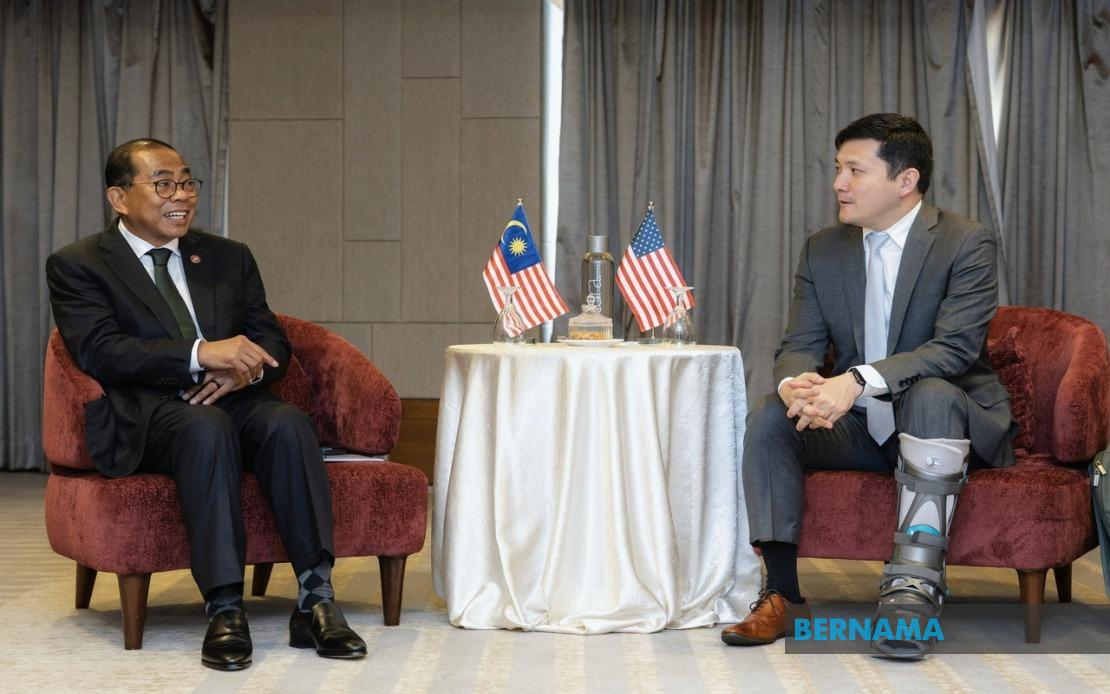
Malaysia's Defence Minister Datuk Seri Mohamed Khaled Nordin has confirmed that the United States remains dedicated to expanding its military and strategic partnership with Malaysia, underscoring Washington's sustained focus on Southeast Asian security engagement. The commitment was conveyed during a courtesy call by US Ambassador to ASEAN Kevin Kim in Kuala Lumpur on August 3, a meeting held alongside the 37th Annual Military Law and Operations Conference taking place in the capital through August 6.
The timing of Kim's visit reflects the significance that American policymakers attach to defence collaboration across the region. Rather than diving into complex policy negotiations, the ambassador and Defence Minister used the occasion to reinforce the existing foundation of cooperation and chart a course for expanded military engagement. This measured approach underscores a broader diplomatic strategy where both nations prefer to deepen established institutional channels rather than introduce contentious new frameworks.
Mohamed Khaled emphasised that the US has signalled unwavering attention to enhancing bilateral defence relations. This statement carries particular weight given the shifting geopolitical landscape in Southeast Asia, where traditional partnerships are being tested by new great power rivalries and regional tensions. Malaysia, as a major maritime nation and ASEAN member, occupies a strategically important position in these emerging dynamics, making US commitment to the relationship both symbolically significant and practically consequential.
Beyond the bilateral conversation with Washington, Mohamed Khaled also received ASEAN Secretary-General Dr Kao Kim Hourn, creating an opportunity to discuss defence sector contributions to the bloc's collective security architecture. The two officials exchanged perspectives on the mounting challenges confronting ASEAN, including maritime disputes, terrorism concerns, and the need to maintain regional stability amid broader geopolitical tensions. Their discussion underscored a critical understanding that the defence sector must actively support ASEAN's foundational principles of centrality, peace, and shared prosperity—principles increasingly difficult to maintain as external powers jockey for influence.
The Defence Minister and ASEAN's top official acknowledged that military institutions have become essential instruments for advancing the bloc's broader objectives. This recognition reflects evolving thinking within ASEAN capitals, where defence cooperation is viewed not merely as a security matter but as integral to preserving the region's ability to manage its own affairs. The agreement to strengthen defence sector involvement in supporting ASEAN goals signals a determination to ensure that institutional frameworks remain robust enough to withstand external pressures.
Singapore also featured prominently in Mohamed Khaled's diplomatic calendar through a meeting with Joseph Leong, the newly appointed Permanent Secretary for Singapore's Ministry of Defence. Leong's explicit commitment to expanding Malaysia-Singapore military cooperation carries particular significance, given the two nations' shared maritime boundaries, integrated defence ecosystems, and roles within the Five Power Defence Arrangements. The breadth of potential cooperation—spanning bilateral channels, ASEAN-level coordination, and established multilateral defence mechanisms—reflects the complexity of modern Southeast Asian security architecture.
The Five Power Defence Arrangements, encompassing Malaysia, Singapore, Australia, New Zealand, and the United Kingdom, remain a cornerstone of regional defence stability. Malaysian participation in this framework, combined with expanding ties with the US and deepening ASEAN-level cooperation, illustrates how contemporary defence strategy requires simultaneous engagement across multiple tiers of partnership. This layered approach allows Malaysia to maintain strategic flexibility while strengthening its security posture.
The 37th MILOPS Annual Conference itself demonstrates the depth of Malaysia's role in regional military affairs. The gathering of officials and military representatives from more than 30 nations to Kuala Lumpur reflects the capital's importance as a diplomatic hub and Malaysia's standing as a serious contributor to regional security discussions. The conference's focus on legal frameworks and military operations speaks to a technocratic approach to defence cooperation, where rules-based mechanisms and professional military-to-military relationships serve as anchors for stability.
For Malaysian policymakers, these multiple layers of engagement represent both opportunity and obligation. Strengthening defence ties with the US provides access to advanced military capabilities and intelligence sharing that enhance national security. Simultaneously, active participation in ASEAN defence initiatives and the Five Power Defence Arrangements ensures that Malaysia remains a shaper of regional norms rather than merely a recipient of external security arrangements. The balance between these relationships requires careful calibration to avoid appearing overly dependent on any single power or bloc.
Regional observers have noted that Southeast Asian nations increasingly seek to deepen security partnerships without abandoning their traditional policy of non-alignment. Malaysia exemplifies this approach by cultivating robust ties with Western powers while maintaining engagement with China and other major actors. Such strategic pragmatism reflects the region's recognition that in an era of great power competition, smaller nations must build diverse relationships to maintain autonomy and prevent domination by any single actor.
The emphasis on institutional cooperation through forums like MILOPS and mechanisms such as the Five Power Defence Arrangements provides vehicles for advancing shared security interests while maintaining sovereign control over strategic choices. By anchoring defence cooperation in professional military relationships and legal frameworks, participating nations create predictability and reduce the likelihood of misunderstanding or escalation.
Looking forward, Malaysia's expanding defence partnerships will likely continue along established trajectories, with incremental deepening of existing mechanisms rather than dramatic shifts in strategic orientation. The consistent reaffirmation of US commitment, ASEAN solidarity on defence matters, and Singapore's willingness to expand bilateral cooperation suggest that the institutional architecture underpinning regional security remains resilient despite broader geopolitical uncertainties. For Malaysia specifically, this provides a reassuring context in which to manage its own security challenges while contributing to the collective stability that benefits all Southeast Asian nations.

