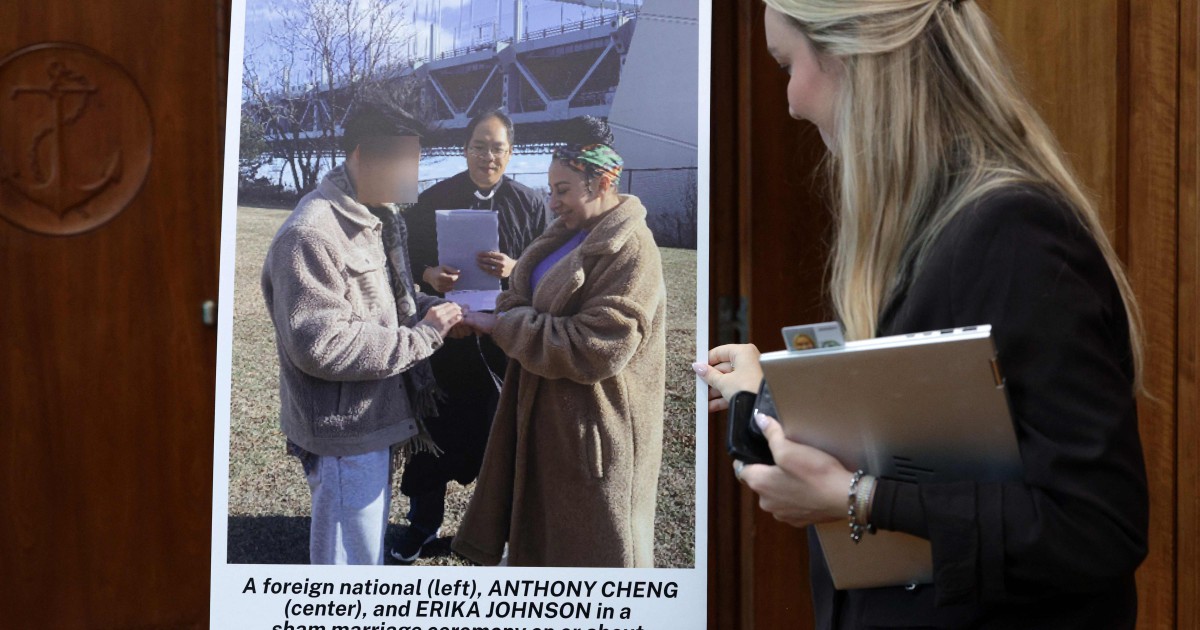
The United States Department of Justice announced charges against 11 individuals on Wednesday in connection with an intricate immigration fraud operation that had persisted for roughly ten years. According to court filings, the scheme involved arranging approximately 1,000 sham marriages, predominantly benefiting Chinese nationals who sought to circumvent standard legal immigration pathways and obtain permanent residence in America.
This enforcement action arrives at a moment of heightened scrutiny regarding immigration practices in the United States. The timing coincides with renewed policy discussions surrounding birth-related immigration benefits and other pathways to legal status, reflecting broader debates about immigration enforcement priorities under the current administration. The case underscores persistent vulnerabilities within America's immigration and marriage verification systems that criminal networks have exploited systematically.
The scale of the operation highlights how organized fraudsters have developed sophisticated mechanisms to manipulate fundamental immigration procedures. Rather than isolated instances of individuals entering into false marriages, this scheme represented a commercial enterprise with structured operations, suggesting significant infrastructure dedicated to connecting willing participants and processing fraudulent documentation. The persistence of the scheme across a decade indicates that detection mechanisms failed repeatedly to halt the activity.
Sham marriage arrangements typically involve compensation between parties with no genuine domestic relationship. Citizens or permanent residents agree to marry foreign nationals in exchange for financial payment, enabling the foreigners to apply for spousal immigration benefits. These fraudulent marriages can ultimately lead to illegal acquisition of green cards and naturalization rights. The scheme's focus on Chinese nationals reflects broader patterns of immigration fraud targeting populations facing lengthy legal immigration queues and significant barriers to conventional routes.
For Southeast Asian readers, this case carries particular relevance. Regional nations including Malaysia, Vietnam, and Thailand witness similar immigration-related fraud schemes, as citizens throughout Asia seek alternative pathways to developed economies where legal processes remain time-consuming and expensive. While Malaysia hosts significant expatriate communities, particularly from China and other Asian nations, awareness of international enforcement actions against migration fraud remains crucial for both immigration authorities and private citizens who might unwittingly become entangled in such schemes.
The operation's ten-year duration raises questions about why federal immigration authorities required such extended periods to develop sufficient evidence for prosecution. Immigration fraud detection typically relies on anomalies in visa applications, interview inconsistencies, or financial discrepancies, yet this scheme apparently continued despite regular processing of fraudulent cases through immigration courts and consular offices. The eventual charges suggest either recent procedural improvements in verification systems or heightened investigative resources dedicated to immigration crime.
Organizers of such schemes operate across multiple jurisdictions, typically identifying vulnerable citizens willing to participate for financial compensation and locating foreign nationals with resources to pay substantial fees. This particular operation presumably maintained connections with immigration consultants, document fabricators, and corrupt officials or employees who could smooth processing. The complexity of coordinating 1,000 separate fraudulent marriages implies networks extending beyond those charged, potentially including lesser participants not yet prosecuted.
The individuals charged face serious federal offenses carrying substantial prison sentences and financial penalties. Immigration fraud charges typically include marriage fraud, visa fraud, and potentially money laundering or conspiracy offenses depending on the scheme's structure and defendants' roles. Prosecutors will need to establish that participants knowingly entered false marriages specifically to evade immigration requirements, a standard that varies depending on individual defendants' awareness and intentional participation.
These prosecutions serve both deterrent and practical purposes within immigration enforcement. Public cases against operation organizers create risk for future participants, whether as citizens willing to marry fraudulently or as foreign nationals seeking such arrangements. For immigration authorities, successful prosecutions can generate intelligence about fraud methods, enabling refinement of detection procedures and identification of additional conspirators still operating.
The case reflects broader challenges facing immigration authorities globally. Even sophisticated verification procedures struggle against determined fraudsters employing creativity and exploiting system participants' vulnerability to financial inducements. Malaysian immigration authorities, operating with limited resources compared to American counterparts, must develop efficient detection methods while processing legitimate applications from the many Southeast Asian residents seeking international movement.
Looking forward, this prosecution may prompt enhanced scrutiny of marriage-based immigration applications across multiple jurisdictions. Immigration authorities could require additional verification steps, expanded interview protocols, or deepened background investigations for spousal cases. Such measures, while potentially improving fraud detection, may also create delays for legitimate couples navigating the immigration process, illustrating the tensions between security and efficiency in immigration administration.
The scheme's eventual dismantling demonstrates that sustained immigration fraud, despite its apparent success over many years, ultimately faces federal investigation and prosecution. For Malaysian and Southeast Asian citizens contemplating irregular immigration pathways or encountering offers for fraudulent arrangements, this case underscores both the serious legal consequences and the long-term enforcement commitment of destination countries like the United States.

