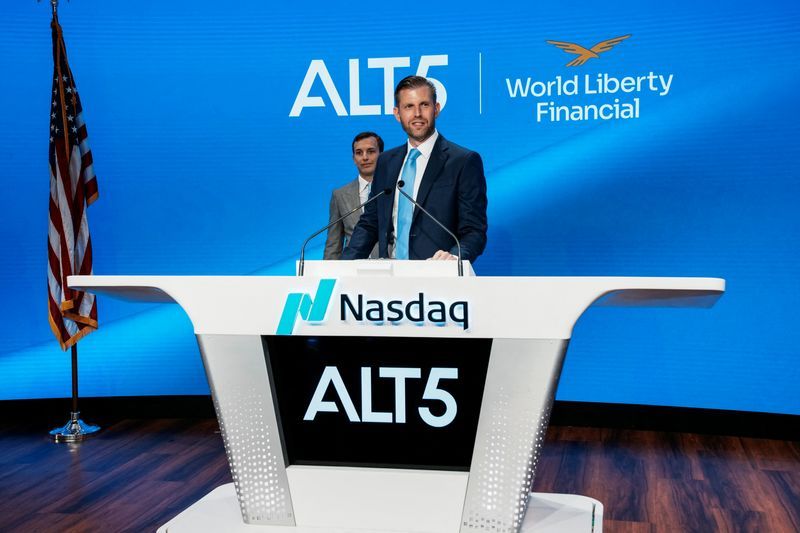
The US Office of the Comptroller of the Currency has moved to conditionally approve a bank charter application for World Liberty Trust Company, a cryptocurrency venture closely tied to President Donald Trump and his family. The preliminary approval, granted on Friday through a letter published on the regulator's website, represents a significant milestone for the company's ambitions to expand its stablecoin operations under federal banking oversight. The application, initially submitted in January, had long been awaited by Trump's crypto-focused allies and the broader digital asset industry watching for signals of regulatory openness in Washington.
The charter, once fully approved at a future date, would grant World Liberty Financial substantially enhanced capabilities beyond its current operational structure. Rather than functioning as a traditional deposit-taking bank, the trust company framework would enable the firm to directly manage and custody customer assets, settle payments with greater speed and efficiency, and operate under a unified federal license spanning the entire United States. These powers represent a fundamental shift from the company's present arrangement, in which a separate business partner, BitGo, currently handles both the issuance of USD1 stablecoins and the custodial safeguarding of US dollar reserves backing those digital tokens.
The regulatory approval reflects broader momentum within the Trump administration toward accommodating the cryptocurrency industry's longstanding requests for formal banking infrastructure. Under Comptroller Jonathan Gould, whom Trump appointed to the role last year, the OCC has begun granting preliminary approvals to multiple crypto firms seeking similar trust charters. Ripple and Circle, both prominent players in the digital asset space, have similarly received conditional greenlight for such arrangements. This shift signals a marked departure from the caution that characterised previous regulatory approaches, offering crypto companies a pathway to institutional legitimacy and the capacity to service major corporate and institutional clients seeking exposure to digital assets.
World Liberty Financial welcomed the conditional approval through a statement from Zach Witkoff, the company's president and chairman, emphasising the validation that federal banking standards represent. Witkoff framed the development as bringing USD1 issuance, custody, and reserve management under unified OCC supervision, subjecting the stablecoin operation to oversight mechanisms established over generations of traditional banking regulation. The company positioned itself as inviting ongoing regulatory scrutiny, suggesting confidence in its operational compliance with federal standards. However, the charter remains subject to specific conditions, including mandatory notification to regulators of any substantial changes to business plans, maintenance of minimum capital holdings of at least $20 million, and the appointment of qualified personnel to oversee internal audit functions.
The regulatory approval process has not proceeded without controversy. The OCC's approval letter explicitly acknowledged concerns raised during the public comment period regarding non-US investors in World Liberty Financial. The regulator determined that such investors would not qualify as principal shareholders holding control over the bank's operations. To address these concerns, several foreign investors, including those aligned with interests outside the United States, executed what are termed passivity agreements—formal commitments pledging non-interference in the bank's strategic direction or operational decisions. Among those signing such commitments was Eric Trump, the president's son, acting in his capacity as president of a Trump family-affiliated investment vehicle.
These foreign investment concerns carried genuine geopolitical weight during congressional deliberations. In February, two Democratic members of the Senate Banking Committee formally requested that Treasury Secretary examine potential national security implications surrounding a reported $500 million equity stake acquisition in World Liberty Financial. That transaction carried connections to the United Arab Emirates' national security adviser, raising questions about whether foreign government influence might extend into a financial institution bearing the Trump family name and enjoying federal regulatory approval. Such scrutiny reflects broader anxieties about entanglement between family business interests and presidential authority, particularly when foreign capital and strategic assets intersect.
The corporate structure of World Liberty Financial reveals deep interconnections between Trump's political circle and the Witkoff family, whose members hold substantial influence within the venture. Zach Witkoff, serving as the company's chief executive officer, is the son of Steve Witkoff, Trump's special diplomatic envoy—a position that itself exemplifies the blending of business relationships with official diplomatic functions. The Witkoffs ranked among the co-founders of World Liberty Financial alongside Trump and his three sons when the company formally established itself in late 2024. Beyond Zach's executive role, Robert Witkoff, his uncle and a former insurance executive, will serve as a director of World Liberty Trust. Scott Alper, proposed as another director, leads the Witkoff family's real estate operations, further concentrating decision-making authority within a narrow network of longstanding Trump associates.
Democratic opposition to the charter approval has emphasised the structural conflict of interest inherent in a sitting president's family business receiving federal banking privileges. During congressional proceedings in February, Democrats pressed Comptroller Gould to disclose the company's unredacted application materials, contending that the publicly available version omitted crucial details regarding capital structure and operational strategies. The OCC's approval letter attempted to address such concerns by asserting that Gould and his staff had acted consistently with statutory duties and ethical obligations, and that career staff rather than politically appointed officials would oversee the bank's ongoing supervision. Nevertheless, the structural reality remains that the OCC, unlike many other federal financial regulators, operates without a bipartisan governance board, allowing a single political appointee substantial discretionary authority.
World Liberty Financial represents merely the flagship cryptocurrency venture within a broader Trump family portfolio of digital asset businesses generating substantial financial returns. The company's stated mission centres on democratising financial access by enabling individuals to circumvent traditional banking systems, which the Trump organisation has consistently characterised as unnecessarily restrictive and inequitable. USD1, the company's stablecoin product launched in March 2025, embodies this vision—a US dollar-backed digital token designed to facilitate entry into blockchain-based financial products while supposedly maintaining stability and security. The asset has achieved remarkable market penetration in the eighteen months since its public announcement, currently ranking as the fourth-largest stablecoin by total market capitalisation at approximately $4 billion.
The financial implications for the Trump family have been substantial. Reuters calculations indicate that the Trump family derived approximately $50 million in earnings from USD1 stablecoin operations through the end of June 2026. These gains represent only a portion of the broader World Liberty Financial ecosystem's value generation; the entire venture has channelled more than $1.6 billion to the US president and his immediate family members as of April 2026. For Southeast Asian investors and financial institutions monitoring developments in global cryptocurrency regulation, these figures underscore how rapidly and profitably the crypto sector can generate concentrated wealth, particularly when regulatory environments shift toward accommodation rather than constraint.
For Malaysian and regional stakeholders, the World Liberty approval carries implications extending beyond mere corporate governance or family business dynamics. The conditional charter signals that major financial jurisdictions are moving toward integrating cryptocurrency operations within formal banking supervision rather than maintaining them in offshore or lightly regulated zones. This regulatory integration may ultimately strengthen stablecoin ecosystems by anchoring them in established institutional frameworks, potentially increasing their adoption among risk-averse institutional investors throughout Southeast Asia. Conversely, the geopolitical dimensions of foreign investment in such ventures—evidenced by the UAE connections and the subsequent national security inquiries—suggest that regional policymakers should carefully consider how foreign-controlled cryptocurrency infrastructure might affect financial sovereignty and stability within their own jurisdictions.
The approval's significance for Malaysia specifically relates to ongoing debates surrounding cryptocurrency regulation and central bank digital currency development. As Bank Negara Malaysia continues deliberating its approach toward stablecoin frameworks and blockchain-based financial infrastructure, the US regulatory trajectory provides instructive lessons regarding both the opportunities and governance complexities inherent in formalising cryptocurrency operations. The World Liberty precedent demonstrates that even politically sensitive ventures can secure federal banking credentials when regulatory structures prioritise accommodation over scrutiny. However, the simultaneous controversy surrounding foreign investment and conflict-of-interest concerns suggests that Southeast Asian regulators contemplating similar frameworks should establish robust governance safeguards, transparent decision-making processes, and explicit foreign investment restrictions from the outset, rather than addressing such concerns reactively after approvals have been granted.

