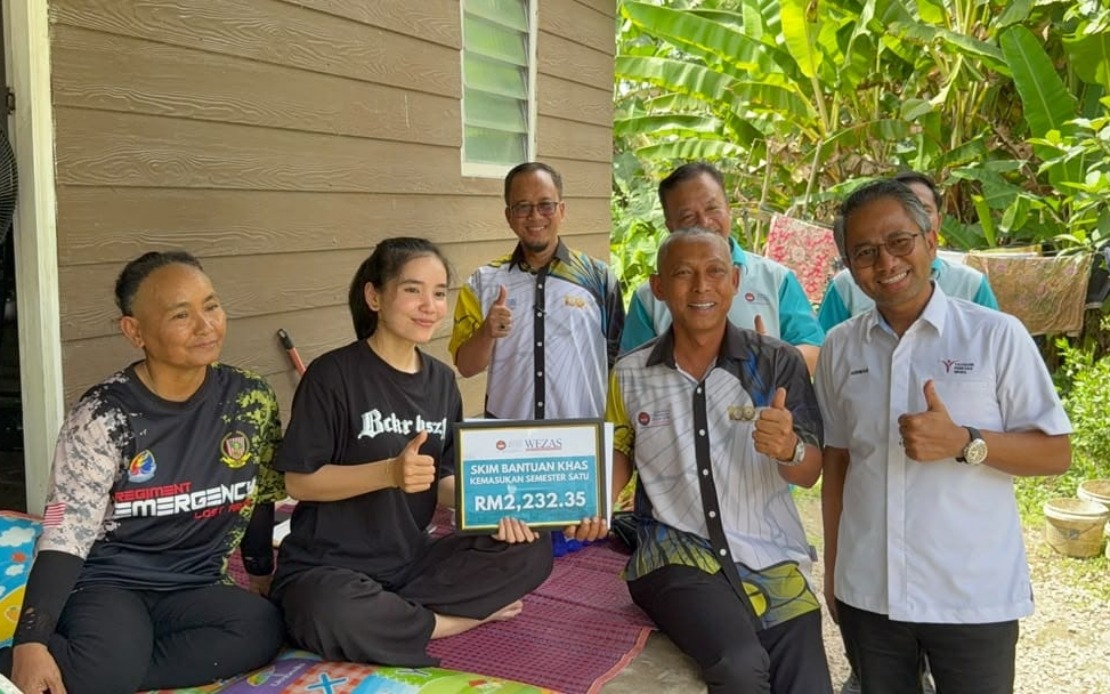
Lovely Sabana Augustine's determination to pursue higher education despite severe financial obstacles has culminated in a breakthrough moment after she secured crucial financial assistance from Universiti Pendidikan Sultan Idris (UPSI) and the Ministry of Higher Education (MOHE). The promising STPM graduate, who narrowly missed out on her tertiary ambitions owing to barriers in affording essential registration fees and study materials, will now commence her degree programme at UPSI's Faculty of Human Sciences during the 2026/2027 academic session, setting a powerful example of how institutional support can transform educational trajectories for Malaysia's most vulnerable talented youth.
Lovely Sabana's personal struggle resonated deeply across social media platforms when her plea for financial assistance circulated online, highlighting the plight of academically gifted students whose family circumstances threaten to derail their university dreams. Her case exemplifies a broader challenge within Malaysia's higher education landscape, where merit alone frequently proves insufficient when households lack the disposable income to navigate the practical costs of tertiary education. The viral response to her situation underscored growing public concern about ensuring that financial capacity rather than intellectual capability determines who gains access to university education in the country.
Two fellow students, Siti Nurdianis Nordin and Muhamad Ilias Danish, similarly benefited from this targeted intervention. Siti Nurdianis will study at the Faculty of Management and Economics, while Muhamad Ilias will pursue courses at the Faculty of Languages and Communication. All three recipients each received RM1,500 in combined assistance, a sum deliberately structured to address both immediate registration requirements and essential preparatory expenses before their scheduled campus registration on September 13. This coordinated approach recognises that financial hardship often manifests in multiple dimensions simultaneously, requiring solutions that tackle several practical barriers at once.
The funding structure itself reflects a deliberate partnership between institutional and philanthropic actors within Malaysia's education ecosystem. UPSI's Centre for Waqf, Endowment, Zakat, Khairat, and Sadaqah (WEZAS) contributed RM500 per student, leveraging Islamic charitable mechanisms to channel support toward deserving beneficiaries. The remaining RM1,000 per recipient originated from Yayasan Perkasa Siswa (YPS), a foundation explicitly mandated toward advancing student welfare across Malaysia's public universities. This collaborative framework demonstrates how different institutional and charitable channels can coordinate effectively to maximise impact for students in acute financial distress.
Hirman Awang, the Department of Higher Education (JPT) Student Affairs Division director, articulated the broader policy philosophy animating this intervention. He emphasised that MOHE remains fundamentally committed to dismantling financial barriers that prevent promising students from accessing higher education opportunities. By positioning YPS as the "frontline force" in safeguarding university student welfare, Awang signalled that the ministry recognises financial hardship as a systemic challenge requiring proactive institutional responses rather than leaving disadvantaged students to navigate obstacles entirely alone. The RM1,000 contribution per student represents not merely symbolic gesture but a calculated intervention targeting the threshold amount that frequently determines whether prospective students can complete essential registration procedures.
The three recipients emerge from strikingly difficult household circumstances that underscore why targeted assistance programmes remain essential for equitable access to higher education. Lovely Sabana resides in Tumpat, Kelantan, with her mother Mek Kenui, whose earnings as a school cleaner amount to approximately RM800 monthly, supplemented by volunteer service with RELA. Her father, a former military serviceman, passed away in 2017, creating an enduring economic vulnerability within the household. Siti Nurdianis similarly originates from a family experiencing unstable income streams, with her mother dependent upon irregular daily wage labour. Muhamad Ilias faces perhaps the most acute circumstances, having lost his father and now bearing responsibility for assisting his mother in maintaining household financial stability.
These biographical details illustrate that financial barriers to higher education within Malaysia frequently stem not from temporary setbacks but from structural poverty and precarious employment conditions affecting entire households. Students from such backgrounds often possess exceptional academic credentials precisely because they have navigated systemic disadvantages through sheer determination and intellectual capability. Yet without targeted institutional support, their talents risk remaining underdeveloped, representing a significant loss of human capital potential for the nation. The UPSI initiative implicitly acknowledges that merit-based admission systems become meaningless if graduating from secondary education through hardship leaves students unable to transition into tertiary institutions.
UPSI's institutional positioning through this intervention signals a deliberate shift toward proactive student support mechanisms. Prof Dr Norkhalid Salimin, the university's deputy vice-chancellor overseeing Student Affairs and Alumni matters, articulated a conception of institutional responsibility extending beyond reactive crisis management. He emphasised that UPSI, through its Student Affairs and Alumni Department (JHEPA) and WEZAS, maintains systematic processes for identifying prospective students requiring early assistance. This framing suggests that financial hardship should not necessitate viral social media campaigns for support to materialise; instead, universities ought to maintain institutional mechanisms for identifying and supporting vulnerable students proactively during admission and enrolment procedures.
The collaborative framework involving UPSI, YPS, and JPT represents a model with potential implications across Malaysia's entire public higher education system. By establishing structured coordination between university-level charitable mechanisms, dedicated student welfare foundations, and the ministry's Student Affairs Division, the approach creates redundancy and comprehensiveness in support identification and delivery. Rather than relying upon individual institutional capacity or philanthropic whim, students can access assistance through multiple convergent channels. This systemic design proves particularly valuable in the Malaysian context, where numerous deserving students may lack access to social media platforms or awareness of available assistance programmes.
Looking forward, the success of this intervention with three students raises questions about scalability across Malaysia's broader student population. MOHE statistics consistently reveal that financial constraints force thousands of qualified school-leavers annually to defer or abandon higher education plans. While targeted assistance for exceptional cases like Lovely Sabana generates positive publicity and demonstrates institutional commitment, scaling such support to encompass entire cohorts of financially disadvantaged students would require substantially expanded funding allocation. The current initiative therefore functions partly as a demonstration of feasibility, illustrating that with proper coordination and charitable partnerships, universities can successfully support deserving students through critical enrolment thresholds.
For Malaysian policymakers and education stakeholders, the UPSI case study underscores that access to higher education remains fundamentally constrained by financial capacity rather than intellectual merit in numerous instances. As the nation pursues ambitions toward enhanced tertiary education participation rates and greater social mobility, such targeted interventions must evolve from exceptional gestures into standard institutional practice. This requires sustained funding commitments from both government and philanthropic sources, coupled with systematic identification processes that do not depend upon students achieving viral social media recognition to access available support. The success of Lovely Sabana Augustine, Siti Nurdianis Nordin, and Muhamad Ilias Danish in accessing higher education opportunities represents progress, but scaling this model across Malaysia's entire student population remains an ongoing challenge requiring sustained policy attention and resource commitment.

