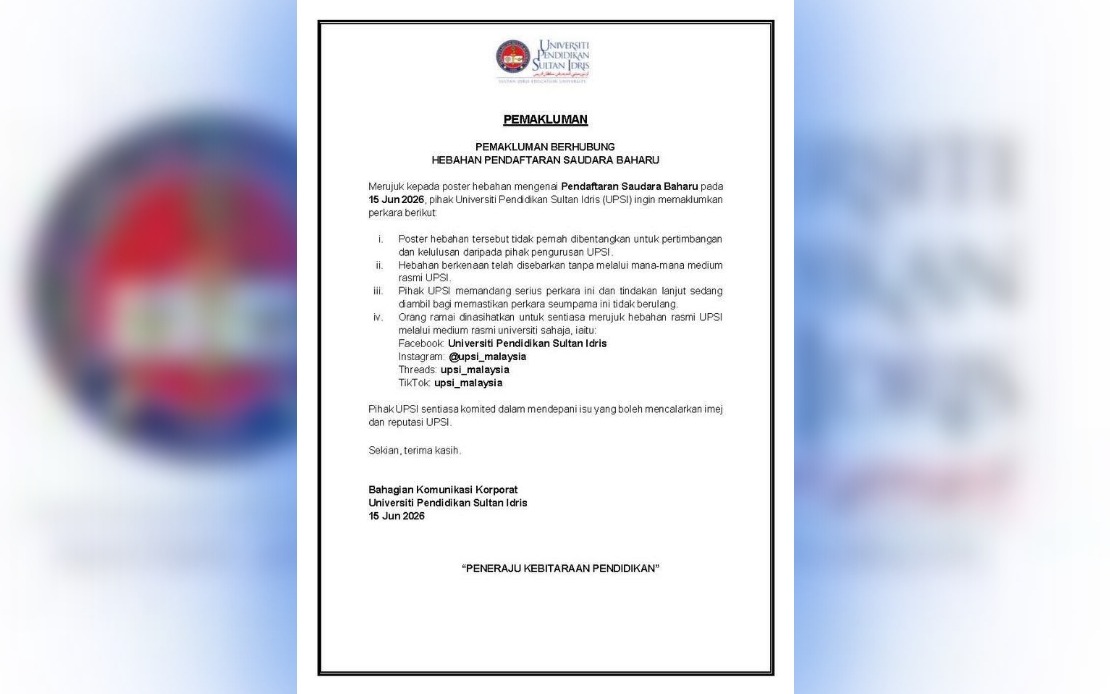
Universiti Pendidikan Sultan Idris (UPSI) has firmly rejected any association with a poster promoting registration of 'saudara baharu' or newly converted Muslims that rapidly circulated across social media platforms in mid-June. The institution moved swiftly to clarify its position through official announcements, emphasising that the material dated June 15 was neither submitted to the university's administrative bodies for review nor distributed through any legitimate UPSI communication channels.
The emergence of this poster highlights growing concerns about misinformation and unauthorised content being attributed to educational institutions in Malaysia. With social media's ability to amplify messages at unprecedented speed, the distinction between official and unofficial communications has become increasingly blurred in the public consciousness. UPSI's rapid response reflects a broader institutional awareness that failure to address such matters promptly can result in reputational damage and confusion among students, staff, and the general public about the university's actual positions and initiatives.
In its official statement released through verified social media accounts, UPSI made clear that the poster had bypassed all internal approval mechanisms that typically govern institutional communications. The university stressed that any official announcements regarding student activities, religious affairs, or administrative matters follow established protocols designed to ensure accuracy, appropriateness, and alignment with institutional values. This case underscores how unvetted materials can easily circulate with apparent institutional credibility, particularly when shared within university-affiliated social networks or forwarded by individuals claiming connection to the institution.
The university has signalled its intention to pursue further investigations into how the poster originated and spread, with the goal of identifying those responsible for its unauthorised dissemination. UPSI's commitment to addressing the matter reflects institutional responsibility for protecting its reputation and maintaining public trust. Educational institutions in Malaysia, as repositories of public confidence and centres of learning, face particular scrutiny regarding the authenticity of communications bearing their name or logo, making swift clarification essential whenever false attributions occur.
UPSI's statement also serves as a broader public advisory, urging students, staff, and community members to verify information through official university channels before crediting announcements to the institution. This guidance has become increasingly important as digital literacy remains uneven across different demographic groups, and as the sophistication of misinformation tactics continues to evolve. Many individuals may not immediately recognise the markers of official versus unofficial communications, making institutional guidance valuable for navigating the information landscape.
The incident also touches on a sensitive area within Malaysian society—the registration and support of individuals who have converted to Islam. While these matters are legitimate subjects of institutional policy and social discourse, the unauthorised nature of this poster suggests someone may have been attempting to leverage UPSI's credibility to promote a particular agenda or initiative. Such attempts to co-opt institutional authority represent a growing challenge in the digital age, where brand hijacking and false attribution can influence public perception and potentially trigger unintended consequences.
For educational institutions across Southeast Asia, this case provides a cautionary lesson about the importance of robust internal communication governance and social media monitoring protocols. As universities increasingly rely on digital platforms to disseminate official information, parallel efforts to combat unauthorised communications must be equally sophisticated. Many institutions are now implementing verification systems, clearer visual branding markers, and staff education programmes to help community members distinguish authentic from fraudulent institutional communications.
The broader context of UPSI's position involves its commitment to maintaining institutional integrity across all aspects of university operations. As an institution dedicated to teacher education and leadership development, UPSI recognises that its credibility extends beyond academic matters to encompass how it handles administrative challenges and communicates with stakeholders. The university's transparent approach to addressing this incident—openly acknowledging the problem and outlining remedial steps—demonstrates professional crisis management that may serve as a model for other institutions facing similar challenges.
Malaysian universities frequently encounter challenges related to social media attribution, particularly concerning sensitive topics. The speed at which information spreads online means that institutions often have only a narrow window to correct misinformation before it becomes widely accepted as fact. UPSI's decision to address this matter publicly reflects recognition that silence can tacitly legitimise false claims, whereas active clarification, though sometimes controversial itself, maintains institutional credibility and demonstrates responsiveness to community concerns.
Moving forward, the university has indicated that enhanced measures will be implemented to prevent recurrence of such incidents. These may include stricter oversight of materials using UPSI branding, clearer guidelines for staff and students regarding official communications, and potentially improved monitoring of social media spaces where UPSI-related content circulates. Such preventive measures represent an investment in institutional reputation management and stakeholder confidence, recognising that in today's digital environment, communications governance is as important as academic and administrative governance.